


The Chinese Nationalist Party (KMT) would submit its own draft of the special defense budget by Friday next week, when the legislature is set to deliberate different versions of the bill, KMT spokesman Niu Hsu-ting (牛煦庭) said today.
Following cross-party negotiations yesterday, the legislature agreed to schedule a review of the government’s proposed NT$1.25 trillion (US$39.94 billion) special defense budget alongside all other versions of the bill in the Foreign Affairs and National Defense and Finance committees.
The Taiwan People’s Party (TPP) has submitted its own version that would allocate NT$400 billion for certain weapons systems, to be reviewed annually.
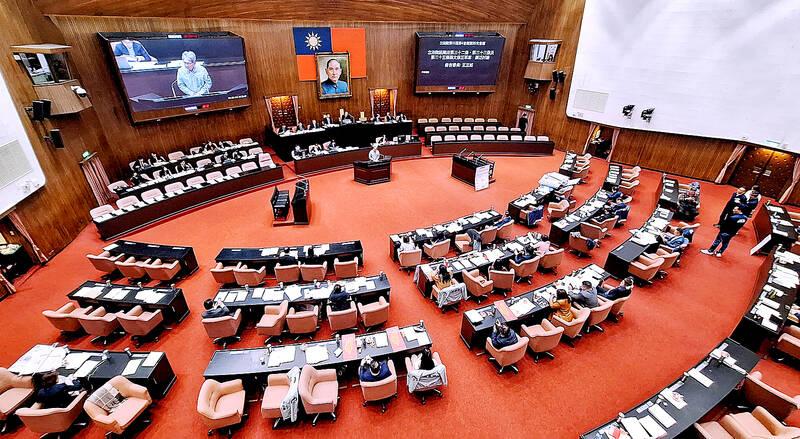
Photo: Fang Pin-chao, Taipei Times
The KMT has previously said it would also propose a draft budget, but has not yet submitted one.
Under yesterday’s agreement, all other proposals must be submitted by Thursday next week.
Speaking on a radio program this morning, Niu said that the KMT would “certainly respond” to US expectations by reviewing the budget for arms purchases.
However, it first must make thorough preparations and gain a clear understanding of the situation before taking action, he said.
“We cannot fail to respond to the US side’s expectations,” he said.
Washington has its own reasons for making certain demands, which reflects routine defense preparations made in the past, Niu said.
The government should not spend money recklessly, but it is also wrong to arbitrarily claim that purchasing US military equipment does not contribute to national defense, he said.
However, if the Democratic Progressive Party attempts to sneak other items into the bill, the KMT “will not yield an inch,” he said, vowing to conduct a rigorous review.
The exact purchase amounts, precise legal wording and ensuring that the budget is not inflated require especially careful consideration, Niu said in explaining the delay.
The KMT and TPP also need to cooperate, but as the TPP caucus has recently undergone changes, it would require time to find a “good rhythm,” he added.
Following the "two-year clause” in its party charter, six of the TPP’s eight legislators-at-large stepped down mid-term to allow other candidates on the party list to take office.
The new members were sworn in earlier this month.

REASONS FOR TRAVEL: An assistant professor said that proposed amendments to penalize drivers if they used drugs overseas would not deter people from traveling People who operate a motor vehicle under the influence of marijuana would have their driver’s license revoked, even if they used the substance while overseas, the Ministry of Transportation and Communications said yesterday, citing proposed amendments to the Road Traffic Management and Penalty Act (道路交通管理處罰條例). The amendments would also authorize the government to revoke the licenses of people determined to have used Category 1 or Category 2 narcotics, even if they were not operating a vehicle while under the influence of drugs, as well as ban them from taking the license test for three years, the ministry said. People aged 18 or

GLOBALGIVING: ‘ Caving to external pressure is not acceptable for an organization that has cultivated justice reform and human rights for 30 years,’ one NGO said A slew of non-government organizations (NGOs) have withdrawn from the GlobalGiving fundraising platform after it announced it would use “Chinese Taipei” instead of “Taiwan” from next month. The Taiwan Good Rice Association wrote on Facebook on Friday that it was informed on April 28 via a teleconference call of the change, which was made because the platform wanted to operate in China. Taiwan Good Rice is to terminate all cooperative relationships with GlobalGiving in response to the platform’s “unilateral and non-negotiable” decision to remove references to Taiwan, the NGO said. “Taiwan is in the official name of Taiwan Good Rice Association and the

HEAVY WEATHER: Typhoon Jangmi is due to crash straight into the Ryukyus as airlines look to shift flights to larger aircraft or cancel flights to Okinawa entirely Taiwan’s international air carriers announced flight adjustments over the weekend as Typhoon Jangmi is forecast to hit the Ryukyu Islands today and tomorrow. The Central Weather Administration (CWA) upgraded Jangmi from a tropical storm to a typhoon at 8am yesterday, with the eye located 580km south of Naha city. It was moving north at 19kph. Today, China Airlines’ CI-120, CI-121, CI-122 and CI-123 flights between Taoyuan and Naha, Okinawa, have been canceled as well as CI-132 and CI-133 between Kaohsiung and Naha. EVA Air’s BR-112, BR-113, BR-186 and BR-185 flights between Taoyuan and Naha are also canceled. Low-cost carrier Tigerair Taiwan canceled IT-230,
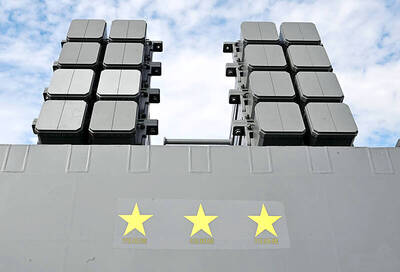
UPGRADE: The Kang Ding-class frigate is replacing its Chaparall missiles with Tien Chien II and Hua Yang VLS, which would provide it with long-range, 360° air defense Taiwan plans to produce 1,200 to 1,376 Hai Chien II missiles (海劍二, Sea Sword II) — also known as TC-2N — to serve as the standard air defense system of the navy’s surface combatant fleet, a source said yesterday. Last week, the Hai Chien II, the naval version of the Tien Kung II missile (天劍二, Sky Sword II), completed a live-fire test in waters off the National Chungshan Institute of Science and Technology’s Jiupeng facility (九鵬) in Pingtung County’s Manjhou Township (滿州). The MIM72 Chaparral and other dated air defense missiles that currently arm Taiwanese ships have inadequate range to combat Chinese


 RSS
RSS