


The National Security Bureau (NSB) has established a task force at President William Lai’s (賴清德) request to prevent foreign interference in the Nov. 28 local elections, the bureau said yesterday.
The task force would seek to prevent attempts to manipulate the nine-in-one local elections by outside forces, an NSB statement cited Lai as saying at an event yesterday marking the 71st anniversary of the bureau’s founding and the graduation of new agents.
China is expected to use disinformation, fake polls, election gambling, and the lure of tourism and economic exchange to meddle in the elections, he said.
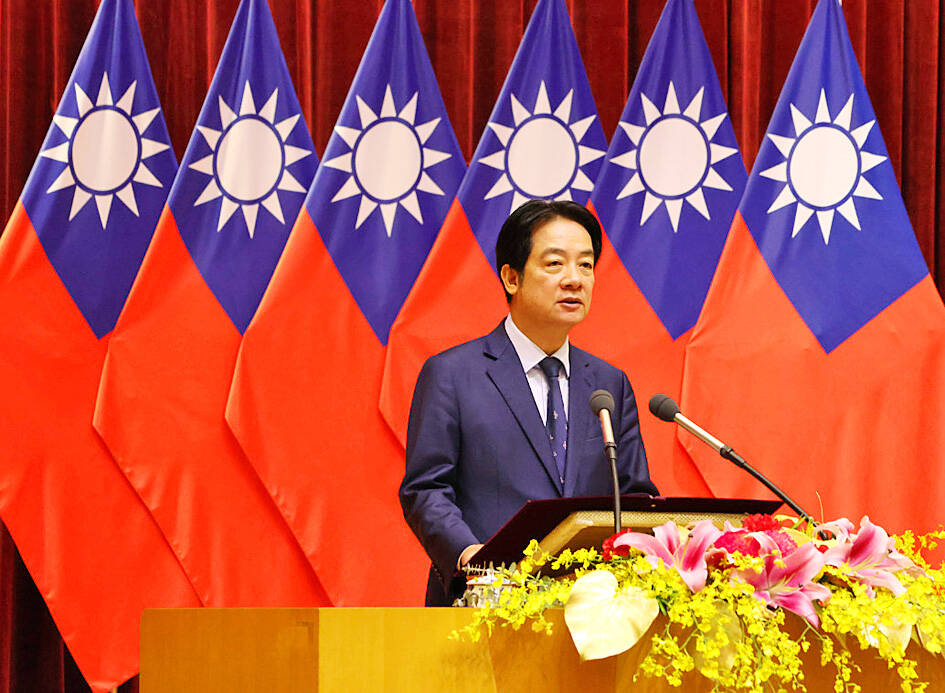
Photo: CNA
Taiwan faces new types of national security threats emanating from China amid a rapidly changing geopolitical environment, Lai said.
He highlighted Beijing’s hostile actions aimed at Taiwan, including military and economic coercion, “gray zone” activity, cyberattacks, cognitive warfare campaigns and attempts to infiltrate the government, armed forces, civic groups and key companies in the private sector.
The actions are part of a coordinated multi-domain effort to sow division in Taiwan and weaken the nation’s credibility among its friends and allies, Lai said.
Countering China’s “united front” tactics, attempts at infiltration and threats of annexation are the NSB’s top priority, he said, adding that the bureau must concentrate its efforts and cooperate with law enforcement to protect the nation’s democracy.
Taiwan, which is on the front line of authoritarian expansionism, has valuable intelligence to offer to allies, Lai said, urging the NSB to increase intelligence sharing and cooperation with its counterparts in friendly countries.
The president also praised the NSB for on Monday declassifying political archives from the Martial Law period and transferring them to the National Archives Administration, which he said was a milestone in transitional justice.
In related news, Lai told Taiwanese investors with businesses in China that his administration’s consistent policy has been to seek common ground with Beijing by improving the well-being of people on both sides of the Taiwan Strait.
Taiwan and China should strive for peaceful co-development through dialogue, understanding and reconciliation, as the two sides have a common enemy in climate change and common interest in peace and prosperity, he said at an event in Taichung.
He highlighted the goals in an address he gave during a 2014 visit to Shanghai’s Fudan University, Lai said.
The Lai administration continues former president Tsai Ing-wen’s (蔡英文) policy aims of putting the economy first and creating business opportunities for the private sector, he said.
Taiwan’s economy performed well last year despite US tariffs, and officials are projecting 7.71 percent GDP growth for this year following Taipei’s trade negotiations with Washington, Lai said.
The government is also implementing 10 new artificial intelligence (AI)-centric infrastructure investment projects, he added.
They include facilitating an ecosystem for AI start-ups, introducing the technology to small and medium-sized businesses, and promoting its use in the daily lives of Taiwanese, Lai said.
Straits Exchange Foundation chairman Su Jia-chyuan (蘇嘉全) said at the Taichung event that the government would not forget the collective contribution of Taiwanese entrepreneurs to national prosperity.
The substance of cross-strait ties does not lie in slogans, but in the links of understanding and commerce between the two peoples that are deeply embedded in society, Su said.
Mainland Affairs Council Minister Chiu Chui-cheng (邱垂正) urged Taiwanese businesspeople to exercise caution in managing geopolitical and economic risks amid intensifying rivalry between the US and China.
The council and foundation would remain the shield and protectors of entrepreneurs in their work to create wealth for a democratic Taiwan, he said.

REASONS FOR TRAVEL: An assistant professor said that proposed amendments to penalize drivers if they used drugs overseas would not deter people from traveling People who operate a motor vehicle under the influence of marijuana would have their driver’s license revoked, even if they used the substance while overseas, the Ministry of Transportation and Communications said yesterday, citing proposed amendments to the Road Traffic Management and Penalty Act (道路交通管理處罰條例). The amendments would also authorize the government to revoke the licenses of people determined to have used Category 1 or Category 2 narcotics, even if they were not operating a vehicle while under the influence of drugs, as well as ban them from taking the license test for three years, the ministry said. People aged 18 or

GLOBALGIVING: ‘ Caving to external pressure is not acceptable for an organization that has cultivated justice reform and human rights for 30 years,’ one NGO said A slew of non-government organizations (NGOs) have withdrawn from the GlobalGiving fundraising platform after it announced it would use “Chinese Taipei” instead of “Taiwan” from next month. The Taiwan Good Rice Association wrote on Facebook on Friday that it was informed on April 28 via a teleconference call of the change, which was made because the platform wanted to operate in China. Taiwan Good Rice is to terminate all cooperative relationships with GlobalGiving in response to the platform’s “unilateral and non-negotiable” decision to remove references to Taiwan, the NGO said. “Taiwan is in the official name of Taiwan Good Rice Association and the

HEAVY WEATHER: Typhoon Jangmi is due to crash straight into the Ryukyus as airlines look to shift flights to larger aircraft or cancel flights to Okinawa entirely Taiwan’s international air carriers announced flight adjustments over the weekend as Typhoon Jangmi is forecast to hit the Ryukyu Islands today and tomorrow. The Central Weather Administration (CWA) upgraded Jangmi from a tropical storm to a typhoon at 8am yesterday, with the eye located 580km south of Naha city. It was moving north at 19kph. Today, China Airlines’ CI-120, CI-121, CI-122 and CI-123 flights between Taoyuan and Naha, Okinawa, have been canceled as well as CI-132 and CI-133 between Kaohsiung and Naha. EVA Air’s BR-112, BR-113, BR-186 and BR-185 flights between Taoyuan and Naha are also canceled. Low-cost carrier Tigerair Taiwan canceled IT-230,
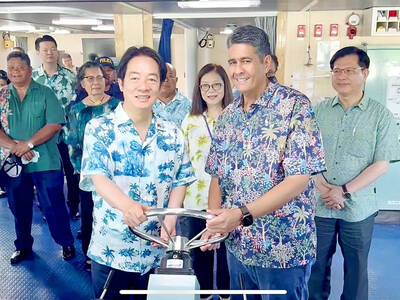
MULTIPRONGED APPROACH: China has sought to pressure Palau across a number of fronts, but the island nation has staunchly resisted overtures to ditch Taiwan Palau has been firm in backing Taiwan despite Chinese pressure that uses tourism economics, cyberattacks and criminal infiltration as tools to threaten the Pacific ally into renouncing its recognition of Taiwan as a sovereign state. The Presidential Office yesterday announced that Vice President Hsiao Bi-khim (蕭美琴) would visit Palau from Saturday to Wednesday next week at the invitation of Palauan President Surangel Whipps Jr. Whipps in April said in an interview that China had outspokenly asked Palau to “denounce Taiwan.” “And we have said: ‘We have no enemies, but nobody tells us who our friends are,’” he said. Whipps has told reporters multiple times


 RSS
RSS