


Activist groups led by the Economic Democracy Union and Taiwan Citizen Front gathered outside the Legislative Yuan yesterday in a protest condemning the opposition parties for forcing votes on controversial amendment bills.
The legislature yesterday passed amendments to the Satellite Broadcasting Act (衛星廣播電視法) as well as amendments to the Act Governing the Handling of Ill-gotten Properties by Political Parties (政黨及其附隨組織不當取得財產處理條例). Critics criticized the amendments for former as attempt to enable CTi News to retake Channel 52 and the amendments for the latter as part of an attempt to protect Chinese Nationalist Party (KMT) assets.
Taiwan Media Watch Foundation researcher Chen Yi-chuan (陳奕銓) castigated the action by opposition parties.
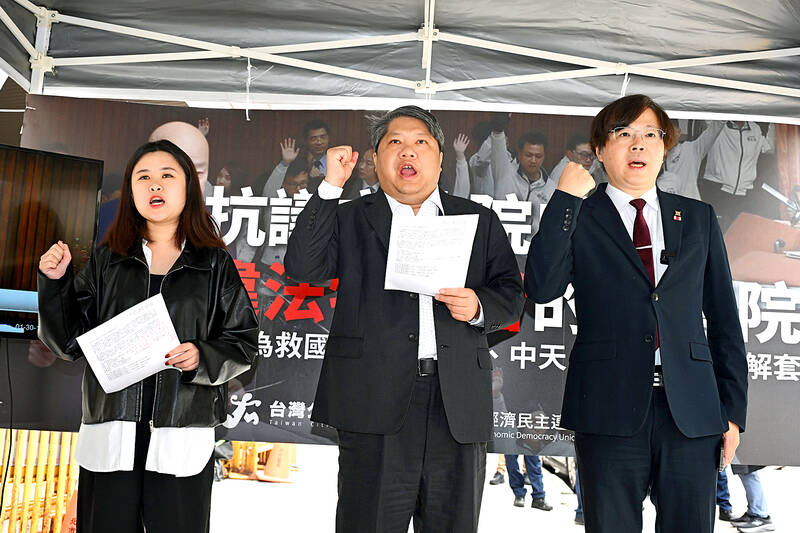
Taipei Times
“We need to have oversight mechanisms on media outlets to safeguard our democracy, and the granting of licenses must not become a tool for political parties to trade for favors and financial benefits. We are opposed to the amendments catering to one
specific outlet,” Chen said.
Democracy activist Lin Po-wei (林泊瑋) pointed to China’s constant military threats toward Taiwan and the example of media oversight elsewhere.
“Even when we set that aside for a moment, all democratic countries, including the US and European nations, have mechanisms for the supervision of the media. It is wrong for legislators to loosen oversight of media groups and pass amendments to favor one outlet, while wrecking the established system of law and order,” Lin said.
Democracy activists and media analysts pointed to CTi TV, owned by Want Want China Times Media Group, whose owner, Tsai Eng-meng (蔡衍明), has a major business presence in China and often goes to Beijing.
They warned that the passage of the opposition parties’ amendments on regulating media and party assets would open the door for pro-China “red media” to spread and influence public discourse, as well as the opportunity for the KMT to gain vast wealth from corruption and ill-gotten assets.

Alain Robert, known as the "French Spider-Man," praised Alex Honnold as exceptionally well-prepared after the US climber completed a free solo ascent of Taipei 101 yesterday. Robert said Honnold's ascent of the 508m-tall skyscraper in just more than one-and-a-half hours without using safety ropes or equipment was a remarkable achievement. "This is my life," he said in an interview conducted in French, adding that he liked the feeling of being "on the edge of danger." The 63-year-old Frenchman climbed Taipei 101 using ropes in December 2004, taking about four hours to reach the top. On a one-to-10 scale of difficulty, Robert said Taipei 101

Nipah virus infection is to be officially listed as a category 5 notifiable infectious disease in Taiwan in March, while clinical treatment guidelines are being formulated, the Centers for Disease Control (CDC) said yesterday. With Nipah infections being reported in other countries and considering its relatively high fatality rate, the centers on Jan. 16 announced that it would be listed as a notifiable infectious disease to bolster the nation’s systematic early warning system and increase public awareness, the CDC said. Bangladesh reported four fatal cases last year in separate districts, with three linked to raw date palm sap consumption, CDC Epidemic Intelligence
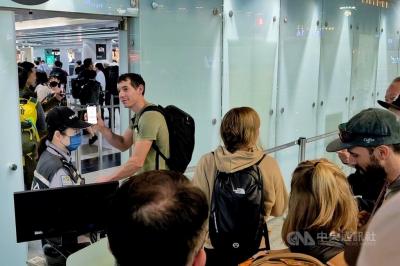
US climber Alex Honnold left Taiwan this morning a day after completing a free-solo ascent of Taipei 101, a feat that drew cheers from onlookers and gained widespread international attention. Honnold yesterday scaled the 101-story skyscraper without a rope or safety harness. The climb — the highest urban free-solo ascent ever attempted — took just more than 90 minutes and was streamed live on Netflix. It was covered by major international news outlets including CNN, the New York Times, the Guardian and the Wall Street Journal. As Honnold prepared to leave Taiwan today, he attracted a crowd when he and his wife, Sanni,

Two Taiwanese prosecutors were questioned by Chinese security personnel at their hotel during a trip to China’s Henan Province this month, the Mainland Affairs Council (MAC) said yesterday. The officers had personal information on the prosecutors, including “when they were assigned to their posts, their work locations and job titles,” MAC Deputy Minister and spokesman Liang Wen-chieh (梁文傑) said. On top of asking about their agencies and positions, the officers also questioned the prosecutors about the Cross-Strait Joint Crime-Fighting and Judicial Mutual Assistance Agreement, a pact that serves as the framework for Taiwan-China cooperation on combating crime and providing judicial assistance, Liang


 RSS
RSS