


The military today simulated repelling a Chinese sea assault, integrating shore-launched missiles and drones with fast patrol boats to stop an attempted invasion.
Taiwan routinely holds drills ahead of the Lunar New Year holiday, which begins next month, but these are the first to take place in front of the media since China held its most recent round of war games around the nation in December last year.
Any invasion of Taiwan by China would be very difficult given that the People's Liberation Army would have to first cross the Taiwan Strait and then attack the limited number of beaches on the nation’s main island that are suitable for landing their forces.
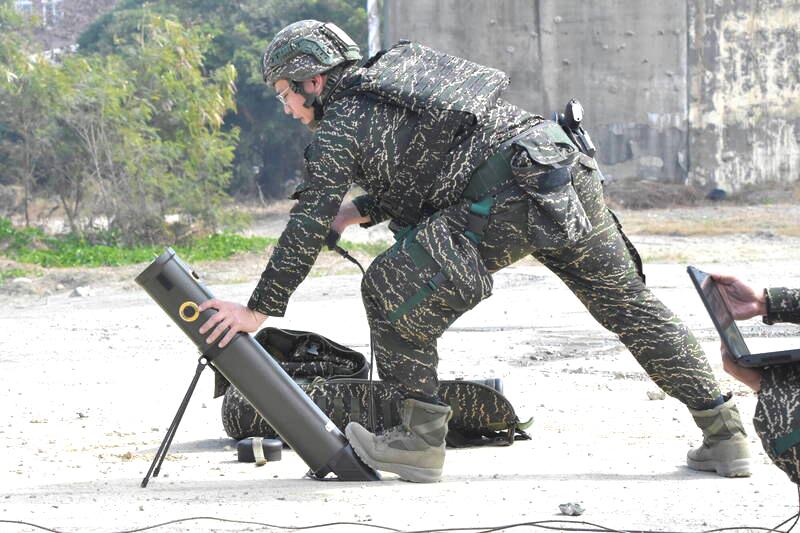
Photo: Wu Che-yu, Taipei Times
The drill, on a beach that forms part of Kaohsiung’s Zuoying (左營) naval base, imagined a scenario where Taiwan first detects an unknown boat loitering off the coast and then sends drones to investigate.
Taiwanese attack drones and fast, missile-armed patrol boats are then pressed into action. Snipers help pick off enemy forces and domestically made anti-ship Hsiung Feng missiles take aim from concealed mobile launchers on the beach.
The near-shore exercise with coordinated strike missions was able to build a "kill chain and effectively execute joint interceptions," said a Marine Corps officer, speaking while fully masked and not providing his name for security reasons.
"This demonstrated the navy's multi-layered, multi-wave defensive combat effectiveness, as well as the Marine Corps’ combat power and resilience in rapidly taking control from both the sea and the land," he said.
President William Lai’s (賴清德) administration, as part of a defense-modernization program, has pushed for more combat-realistic training that relies less on set-piece performances and more on simulating actual combat.
Earlier this week, the military showed how its US-made High Mobility Artillery Rocket System (HIMARS) would be used to hit the Penghu islands in the Taiwan Strait should Chinese forces seize them first and use them as a base to launch strikes on Taiwan proper.
The Lockheed Martin HIMARS, one of Taiwan's newest and most precise strike weapons, has been used extensively by Ukraine against Russian forces.
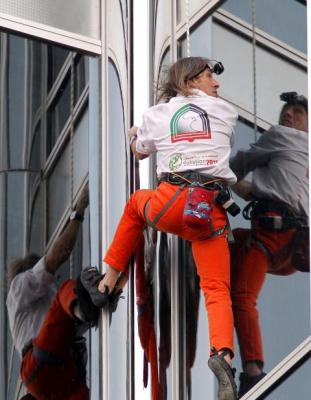
Alain Robert, known as the "French Spider-Man," praised Alex Honnold as exceptionally well-prepared after the US climber completed a free solo ascent of Taipei 101 yesterday. Robert said Honnold's ascent of the 508m-tall skyscraper in just more than one-and-a-half hours without using safety ropes or equipment was a remarkable achievement. "This is my life," he said in an interview conducted in French, adding that he liked the feeling of being "on the edge of danger." The 63-year-old Frenchman climbed Taipei 101 using ropes in December 2004, taking about four hours to reach the top. On a one-to-10 scale of difficulty, Robert said Taipei 101

Nipah virus infection is to be officially listed as a category 5 notifiable infectious disease in Taiwan in March, while clinical treatment guidelines are being formulated, the Centers for Disease Control (CDC) said yesterday. With Nipah infections being reported in other countries and considering its relatively high fatality rate, the centers on Jan. 16 announced that it would be listed as a notifiable infectious disease to bolster the nation’s systematic early warning system and increase public awareness, the CDC said. Bangladesh reported four fatal cases last year in separate districts, with three linked to raw date palm sap consumption, CDC Epidemic Intelligence
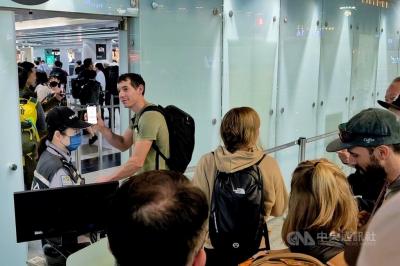
US climber Alex Honnold left Taiwan this morning a day after completing a free-solo ascent of Taipei 101, a feat that drew cheers from onlookers and gained widespread international attention. Honnold yesterday scaled the 101-story skyscraper without a rope or safety harness. The climb — the highest urban free-solo ascent ever attempted — took just more than 90 minutes and was streamed live on Netflix. It was covered by major international news outlets including CNN, the New York Times, the Guardian and the Wall Street Journal. As Honnold prepared to leave Taiwan today, he attracted a crowd when he and his wife, Sanni,

Two Taiwanese prosecutors were questioned by Chinese security personnel at their hotel during a trip to China’s Henan Province this month, the Mainland Affairs Council (MAC) said yesterday. The officers had personal information on the prosecutors, including “when they were assigned to their posts, their work locations and job titles,” MAC Deputy Minister and spokesman Liang Wen-chieh (梁文傑) said. On top of asking about their agencies and positions, the officers also questioned the prosecutors about the Cross-Strait Joint Crime-Fighting and Judicial Mutual Assistance Agreement, a pact that serves as the framework for Taiwan-China cooperation on combating crime and providing judicial assistance, Liang


 RSS
RSS