


Taiwan rose three places in the World Tourism Barometer to 36th globally in 2024, with international tourism revenue of US$10.028 billion, the Tourism Administration said on Monday.
The UN Tourism Organization publication said that its focus has switched from whether a country has returned to pre-COVID-19 levels of tourism to the amount spent by a tourist during an overseas trip.
The nation last year welcomed 8.57 million international tourists, about 9 percent more than in 2024, with most tourists coming from Japan, South Korea, and Hong Kong and Macau, all of which accounted for at least 1 million tourists each.
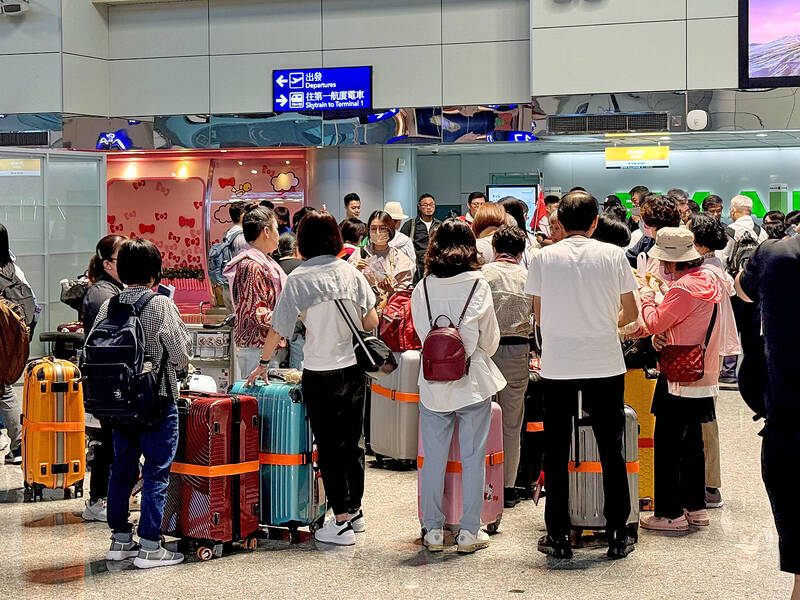
Photo: Tsai Yun-jung, Taipei Times
During the first three quarters of last year, 6,057,907 tourists arrived in Taiwan, a 9.25 percent increase from the same period in 2024, the Tourism Administration said.
International tourism revenue during the first three quarters of last year, which did not include spending on airfares, was about US$7.886 billion, year-on-year growth of 11.56 percent, it said.
“The data showed that growth in Taiwan’s international tourism revenue outpaced the number of international tourists, indicating that inbound tourists’ spending patterns are also changing,” it said.
“In the past, international tourists often came to Taiwan for short, shopping-focused trips. However, in the past few years, more inbound visitors are extending their stays, traveling across multiple cities and spending on a variety of leisure activities,” it said.
Overall spending patterns of tourists from different countries also changed.
On average, tourists from the US spent 10 days in Taiwan, with a daily expenditure of about NT$7,600 (US$241.50), while the total cost of a trip is about NT$75,000, which covers accommodation, transportation, cultural events and tours, the agency said.
European tourists spent an average of NT$6,300 per day, with an average stay of 12 days, spending a total of about NT$80,000, it said.
Tourists from Southeast Asian countries — particularly from the Philippines, Vietnam, Thailand and Malaysia — spent about NT$5,000 to NT$5,500 per day, with an average stay of seven to nine days for a total cost of about NT$35,000 to NT$45,000, it added.
The data showed that Taiwan is evolving from a transit stop into a tourist destination, the agency said.
“More inbound tourists are willing to spend more time and money on tours, local cuisine and cultural activities, showing that Taiwan has steadily developed a more definite appeal among international travelers,” it said.
Meanwhile, Taiwanese outbound travel surged to a record-high last year, figures released on Wednesday last week by the Tourism Administration showed.
The number of outbound trips by Taiwanese reached 18,944,436 last year, up 12.43 percent from 2024, it said.
Japan remained the most popular destination, followed by China, with Hong Kong and Macau ranking third.
Japan was Taiwan’s largest source for international travel, followed by Hong Kong and Macau, while South Korea ranked third.
The gap between outbound and inbound travel reached 10,369,889 trips, the agency said.
Based on average spending figures from 2024 — US$1,276 per inbound visitor and NT$55,541 per outbound Taiwanese traveler — the tourism trade deficit is an estimated NT$700.98 billion.
The Tourism Administration attributed the widening imbalance to factors such as favorable exchange rates, the continued recovery of international flight capacity from the pandemic, geopolitical developments and visa relaxations by competing destinations.
Taiwan has recorded more outbound than inbound travel every year since 1990.
Despite the tourism deficit, outbound travel by Taiwanese continues to benefit domestic carriers, as well as the travel, insurance and retail sectors.
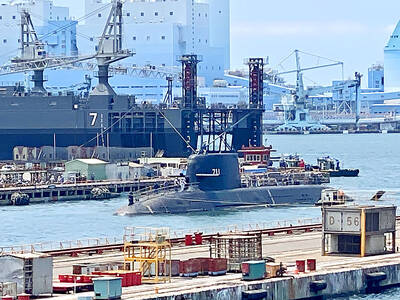
AGING: While Japan has 22 submarines, Taiwan only operates four, two of which were commissioned by the US in 1945 and 1946, and transferred to Taiwan in 1973 Taiwan would need at least 12 submarines to reach modern fleet capabilities, CSBC Corp, Taiwan chairman Chen Cheng-hung (陳政宏) said in an interview broadcast on Friday, citing a US assessment. CSBC is testing the nation’s first indigenous defense submarine, the Hai Kun (海鯤, Narwhal), which is scheduled to be delivered to the navy next month or in July. The Hai Kun has completed torpedo-firing tests and is scheduled to undergo overnight sea trials, Chen said on an SET TV military affairs program. Taiwan would require at least 12 submarines to establish a modern submarine force after assessing the nation’s operational environment and defense

A white king snake that frightened passengers and caused a stir on a Taipei MRT train on Friday evening has been claimed by its owner, who would be fined, Taipei Rapid Transit Corp (TRTC) said yesterday. A person on Threads posted that he thought he was lucky to find an empty row of seats on Friday after boarding a train on the Bannan (Blue) Line, only to spot a white snake with black stripes after sitting down. Startled, he jumped up, he wrote, describing the encounter as “terrifying.” “Taipei’s rat control plan: Release snakes on the metro,” one person wrote in reply, referring
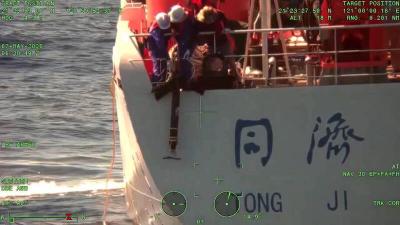
The coast guard today said that it had disrupted "illegal" operations by a Chinese research ship in waters close to the nation and driven it away, part of what Taipei sees a provocative pattern of China's stepped up maritime activities. The coast guard said that it on Thursday last week detected the Chinese ship Tongji (同濟號), which was commissioned only last year, 29 nautical miles (54km) southeast of the southern tip of Taiwan, although just outside restricted waters. The ship was observed lowering ropes into the water, suspected to be the deployment of scientific instruments for "illegal" survey operations, and the coast
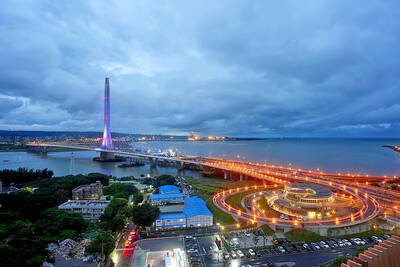
An inauguration ceremony was held yesterday for the Danjiang Bridge, the world’s longest single-mast asymmetric cable-stayed bridge, ahead of its official opening to traffic on Tuesday, marking a major milestone after nearly three decades of planning and construction. At the ceremony in New Taipei City attended by President William Lai (賴清德), Premier Cho Jung-tai (卓榮泰), Minister of Transportation and Communications Chen Shih-kai (陳世凱) and New Taipei City Mayor Hou Yu-ih (侯友宜), the bridge was hailed as both an engineering landmark and a long-awaited regional transport link connecting Tamsui (淡水) and Bali (八里)


 RSS
RSS