


Taiwan People’s Party (TPP) caucus whip and party Chairman Huang Kuo-chang (黃國昌) yesterday announced the TPP’s version of a special national defense bill, which would allocate NT$400 billion (US$12.7 billion) for various weapons systems.
The announcement comes amid an impasse over a special defense budget introduced by the Executive Yuan in November last year totaling NT$1.25 trillion, which the opposition TPP and Chinese Nationalist Party (KMT) have repeatedly refused to review at the legislature.
The TPP version of the bill would limit purchases to 60 M109A self-propelled howitzers, 82 HIMARS multiple rocket launcher systems, 70 Javelin anti-tank missile systems, 24 TOW-2B anti-tank missile systems and anti-armor uncrewed aerial vehicle missile systems.
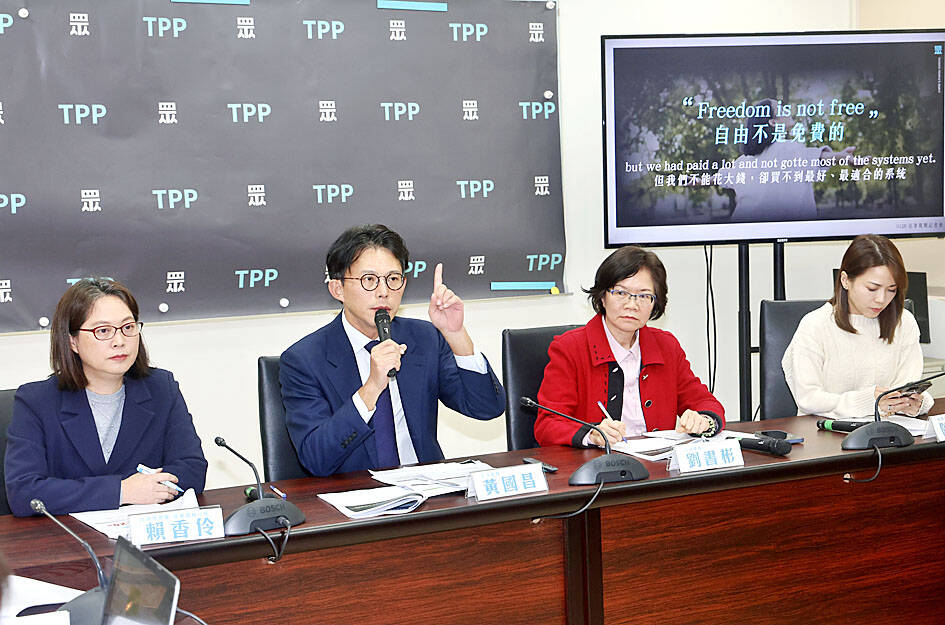
Photo: CNA
Within the NT$400 billion ceiling, the TPP proposal includes an additional NT$88.1 billion to address government assessments of urgent needs to rapidly enhance combat capabilities, which could be used upon obtaining consent from foreign governments.
TPP caucus director Vicky Chen (陳智菡) said the proposal focuses on clearly itemizing procurement categories, quantities and amounts, rationalizing the scale of the budget, shifting to annual appropriations and requiring regular special reports on procurement progress to enhance oversight and transparency.
“Taiwanese have never regarded freedom as free, but how could national security be strengthened if defense budgets are allocated and paid for while equipment fails to arrive on schedule?” Huang said.
During former president Tsai Ing-wen’s (蔡英文) administration, two special military bills were proposed, including a NT$247.2 billion special budget for F-16V jets, of which NT$143.4 billion was spent but “zero” aircraft were delivered, he said.
“Budget figures alone do not guarantee improvements in combat capability. Arms procurement should be handled in a strategic and militarily professional way to ensure stable policy direction and force development,” Huang said.
Security conditions in the Taiwan Strait have deteriorated in the past few years, with China continuing to exert institutionalized and routine military pressure on Taiwan through joint exercises, live-fire drills and “gray zone” operations, he said.
“In the face of complex threats, building a defense system with effective deterrence, dispersed survivability and sustainable combat capabilities has become an urgent task for Taiwan’s defense policy,” Huang said.
The TPP proposal seeks to ensure that every dollar of defense spending aligns with strategic objectives, effectiveness assessments and democratic deliberation, he said.
Democratic Progressive Party (DPP) caucus chief executive Chung Chia-pin (鍾佳濱) yesterday said that defense procurement is a highly classified administrative process that must be led through negotiations among executive agencies.
As such, it is essentially impossible for any political party or the legislature to independently propose a special military procurement budget, he said, adding that the DPP caucus believes deliberations should be based on the Executive Yuan’s version and subjected to legislative scrutiny.
Separately, the Institute for National Defense and Security Research’s Division of Defense Strategy and Resources director Su Tzu-yun (蘇紫雲) said lawmakers have the right to express differing views, but those views must be grounded in fact.
The NT$1.25 trillion special defense budget proposed by the Ministry of National Defense and the Executive Yuan was calculated through discussions with the US Defense Security Cooperation Agency and falls under the Monterey Strategic Dialogue framework, he said.
The opposition party’s proposal was relatively rough, and not coordinated with the US executive branch, he said, adding that it should be regarded only as reference material or expressions of opinion.
Additional reporting by Lin Che-yuan and Chen Yu-fu

REASONS FOR TRAVEL: An assistant professor said that proposed amendments to penalize drivers if they used drugs overseas would not deter people from traveling People who operate a motor vehicle under the influence of marijuana would have their driver’s license revoked, even if they used the substance while overseas, the Ministry of Transportation and Communications said yesterday, citing proposed amendments to the Road Traffic Management and Penalty Act (道路交通管理處罰條例). The amendments would also authorize the government to revoke the licenses of people determined to have used Category 1 or Category 2 narcotics, even if they were not operating a vehicle while under the influence of drugs, as well as ban them from taking the license test for three years, the ministry said. People aged 18 or

GLOBALGIVING: ‘ Caving to external pressure is not acceptable for an organization that has cultivated justice reform and human rights for 30 years,’ one NGO said A slew of non-government organizations (NGOs) have withdrawn from the GlobalGiving fundraising platform after it announced it would use “Chinese Taipei” instead of “Taiwan” from next month. The Taiwan Good Rice Association wrote on Facebook on Friday that it was informed on April 28 via a teleconference call of the change, which was made because the platform wanted to operate in China. Taiwan Good Rice is to terminate all cooperative relationships with GlobalGiving in response to the platform’s “unilateral and non-negotiable” decision to remove references to Taiwan, the NGO said. “Taiwan is in the official name of Taiwan Good Rice Association and the

HEAVY WEATHER: Typhoon Jangmi is due to crash straight into the Ryukyus as airlines look to shift flights to larger aircraft or cancel flights to Okinawa entirely Taiwan’s international air carriers announced flight adjustments over the weekend as Typhoon Jangmi is forecast to hit the Ryukyu Islands today and tomorrow. The Central Weather Administration (CWA) upgraded Jangmi from a tropical storm to a typhoon at 8am yesterday, with the eye located 580km south of Naha city. It was moving north at 19kph. Today, China Airlines’ CI-120, CI-121, CI-122 and CI-123 flights between Taoyuan and Naha, Okinawa, have been canceled as well as CI-132 and CI-133 between Kaohsiung and Naha. EVA Air’s BR-112, BR-113, BR-186 and BR-185 flights between Taoyuan and Naha are also canceled. Low-cost carrier Tigerair Taiwan canceled IT-230,
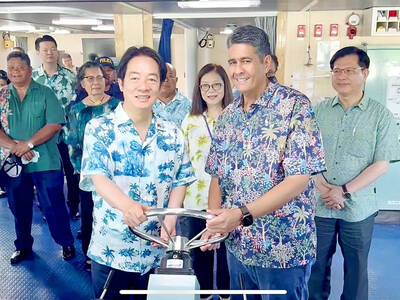
MULTIPRONGED APPROACH: China has sought to pressure Palau across a number of fronts, but the island nation has staunchly resisted overtures to ditch Taiwan Palau has been firm in backing Taiwan despite Chinese pressure that uses tourism economics, cyberattacks and criminal infiltration as tools to threaten the Pacific ally into renouncing its recognition of Taiwan as a sovereign state. The Presidential Office yesterday announced that Vice President Hsiao Bi-khim (蕭美琴) would visit Palau from Saturday to Wednesday next week at the invitation of Palauan President Surangel Whipps Jr. Whipps in April said in an interview that China had outspokenly asked Palau to “denounce Taiwan.” “And we have said: ‘We have no enemies, but nobody tells us who our friends are,’” he said. Whipps has told reporters multiple times


 RSS
RSS