


A Taipei third-grader brandished a pair of scissors in class, a parent said, adding that the incident has raised concerns about campus safety and the handling of students with behavioral issues.
The parent, speaking anonymously, said that when the student became upset in the classroom and began waving scissors, teachers and staff intervened, preventing serious injuries.
According to the parent, the student had repeatedly exhibited aggressive behavior, including stabbing others with pens, attacking classmates, attempting to strike a teacher’s eyes and smashing a teacher’s cellphone, adding that in one instance, a teacher reportedly grabbed the student’s arm to stop an outburst, only for the child’s parent to accuse the teacher of injuring the student and threatening legal action.
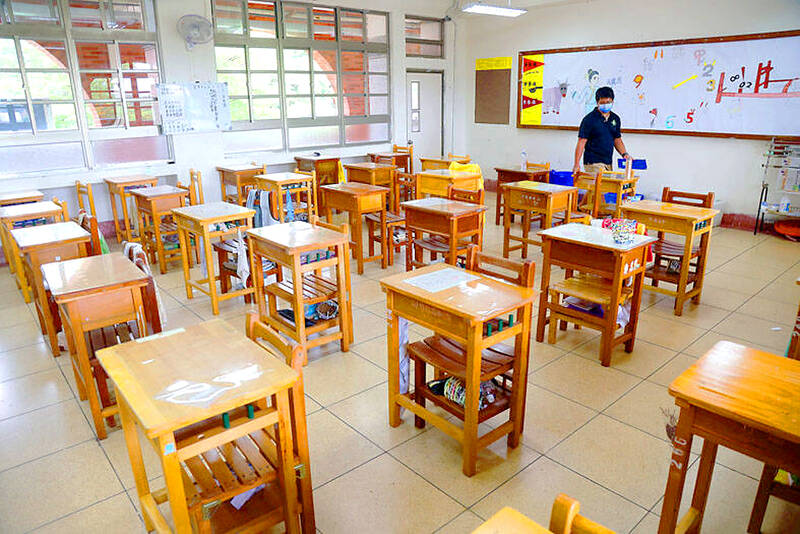
Photo: CNA
The student’s mother, who occasionally accompanies the child at school, has accused other students of misbehavior, saying they triggered her child’s outbursts and alleging bullying, the parent said.
Parents of other students rejected that claim, saying other students are afraid of the outburst-prone classmate.
The school’s director of student affairs said it has offered counseling and proactive support for the student.
The Taipei City Department of Education said the school has established standard operating procedures for emergency incidents and strengthened classroom safety management.
Measures include controlling access to sharp school property, switching to safety scissors when necessary and placing them under centralized teacher supervision as well as implementing emergency classroom support mechanisms, it said.
When reached for comment on the case, Wang Po-chi (王伯頎), a professor in Ming Chuan University’s criminal justice department, said that teachers are legally permitted to take necessary physical measures to block or restrain a student to protect others.
Referring to guidelines on teachers’ counseling and discipline measures, he said that teachers can employ defensive measures to stop attacks, damage or loss of control without facing punishment.
Given that elementary-Aschool students have limited offensive and defensive capabilities, schools should take the lead in risk management, he said.
Possible measures include adjusting seating arrangements, providing close supervision and placing high-risk students where homeroom teachers can easily monitor them, he said.
When necessary, guardians could be asked to accompany the student during classes to reduce the risk of sudden incidents, he said.
On-site responses should prioritize de-escalation and avoid accusatory or provocative language, he said, adding that teachers should maintain a neutral tone, keep appropriate distance and ensure the child feels safe.
In case of a conflict, teachers should prioritize evacuating other students, remove dangerous items such as scissors, prevent escalation in anger, avoid crowds gathering and activate cross-unit support, he said.
Campus violence should not be treated merely as “behavioral deviation,” he said, adding that schools should first determine whether a student might have special needs through professional assessment and institutional intervention.
Family dynamics should also be examined, he said, adding that social safety nets and external resources should be referred to high-risk or vulnerable households.
A veteran juvenile and family court judge, speaking on condition of anonymity, said that children under the age of 12 who stab others with pencils or wave scissors are considered to have “violated the law” rather than “committed a crime,” as criminal liability applies only to those aged 14 or older.
Relying solely on judicial coercion can only suppress behavior in the short term and fails to address underlying emotional, cognitive and family issues, often leading to relapse once pressure is eased, the judge said.
The key issue is not whether punishment can be imposed, but whether schools and authorities promptly report, assess and refer cases to prevent issues from growing and leading to irreversible consequences, the judge said.

Taiwanese can file complaints with the Tourism Administration to report travel agencies if their activities caused termination of a person’s citizenship, Mainland Affairs Council Minister Chiu Chui-cheng (邱垂正) said yesterday, after a podcaster highlighted a case in which a person’s citizenship was canceled for receiving a single-use Chinese passport to enter Russia. The council is aware of incidents in which people who signed up through Chinese travel agencies for tours of Russia were told they could obtain Russian visas and fast-track border clearance, Chiu told reporters on the sidelines of an event in Taipei. However, the travel agencies actually applied

New measures aimed at making Taiwan more attractive to foreign professionals came into effect this month, the National Development Council said yesterday. Among the changes, international students at Taiwanese universities would be able to work in Taiwan without a work permit in the two years after they graduate, explainer materials provided by the council said. In addition, foreign nationals who graduated from one of the world’s top 200 universities within the past five years can also apply for a two-year open work permit. Previously, those graduates would have needed to apply for a work permit using point-based criteria or have a Taiwanese company
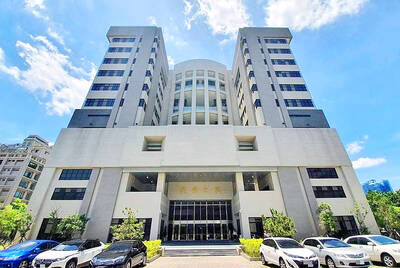
The Shilin District Prosecutors’ Office yesterday indicted two Taiwanese and issued a wanted notice for Pete Liu (劉作虎), founder of Shenzhen-based smartphone manufacturer OnePlus Technology Co (萬普拉斯科技), for allegedly contravening the Act Governing Relations Between the People of the Taiwan Area and the Mainland Area (臺灣地區與大陸地區人民關係條例) by poaching 70 engineers in Taiwan. Liu allegedly traveled to Taiwan at the end of 2014 and met with a Taiwanese man surnamed Lin (林) to discuss establishing a mobile software research and development (R&D) team in Taiwan, prosecutors said. Without approval from the government, Lin, following Liu’s instructions, recruited more than 70 software

Taiwanese singer Jay Chou (周杰倫) plans to take to the courts of the Australian Open for the first time as a competitor in the high-stakes 1 Point Slam. The Australian Open yesterday afternoon announced the news on its official Instagram account, welcoming Chou — who celebrates his 47th birthday on Sunday — to the star-studded lineup of the tournament’s signature warm-up event. “From being the King of Mandarin Pop filling stadiums with his music to being Kato from The Green Hornet and now shifting focus to being a dedicated tennis player — welcome @jaychou to the 1 Point Slam and #AusOpen,” the


 RSS
RSS