


The Mainland Affairs Council today defended the Anti-infiltration Act (反滲透法) as useful despite a low prosecution rate, as lawmakers reviewed proposed amendments that would expand the scope of the law and set minimum penalties.
The amendments reviewed at the Legislative Yuan’s Internal Administration Committee today would allow “prospective candidates,” in addition to officially registered candidates, to be prosecuted for infiltration if instructed by an external actor, and set a minimum prison sentence of a year to address lenient sentencing.
The current penalty for receiving instructions, commissions or funding from infiltration sources to campaign, donate political funds or lobby is up to five years imprisonment.

Photo: Liao Chen-huei, Taipei Times
Democratic Progressive Party (DPP) Legislator Su Chiao-hui (蘇巧慧) questioned how useful the law is, having been in place for six years with limited enforcement.
Over the six years of its implementation, prosecutors have indicted 127 people under the law and five have been convicted, with average prison sentences ranging from three to six months, the Liberty Times (sister paper of the Taipei Times) reported.
Since 2023, 80 percent of cases investigated under the act have not been prosecuted, Su said.
Council Deputy Minister Liang Wen-chieh (梁文傑) said he does not believe the law is “useless,” as defendants are often found not guilty and acquitted due to insufficient evidence, not necessarily because they are innocent.
Moreover, the conditions required to apply the act are very specific, he said.
For example, a person must already have registered as a candidate for the law to apply, he added.
The Chinese Communist Party (CCP) can act faster than Taiwan, and it often finds loopholes to exploit the system, Liang said.
The penalties under the act are also too light, as many forms of infiltration now involve inciting others to spread rumors, assault others or throw paint, he said, welcoming the proposed amendments in principle.
Enemy spies would infiltrate using any avenue available, with the situation only worsening due to the Internet facilitating cross-strait exchanges, Liang said.
The act is intended to block interference and plug loopholes, but many cases require explicit proof that a specific act is linked to instructions from an external actor, he said.
Although it proves difficult for judges and prosecutors to present such evidence, the work must still be done, he added.
The CCP interferes in every election in Taiwan, from the presidential to the local level, DPP Legislator Wang Mei-hui (王美惠) said, adding that it is more of a guarantee than a possibility that interference would continue and likely worsen.
Even before official registration, “prospective candidates” have already begun campaigning, and the law should be amended to regulate this, she added.
The Ministry of the Interior in its report said that there should be a clear definition of “prospective.”
Article 17 of the Constitution protects the right to stand for election as a fundamental right, a Ministry of Justice report said.
Under electoral law, whether a person intends to run remains in a ”fluid status” before registration, so there is no objective standard to judge “prospective candidates” or a person’s intention to run, it said.
Therefore, the proposed amendments are inconsistent with the relevant provisions of electoral law and may be incongruent with the principle of clarity in criminal punishment, it said.
Additional reporting by CNA

Taiwanese can file complaints with the Tourism Administration to report travel agencies if their activities caused termination of a person’s citizenship, Mainland Affairs Council Minister Chiu Chui-cheng (邱垂正) said yesterday, after a podcaster highlighted a case in which a person’s citizenship was canceled for receiving a single-use Chinese passport to enter Russia. The council is aware of incidents in which people who signed up through Chinese travel agencies for tours of Russia were told they could obtain Russian visas and fast-track border clearance, Chiu told reporters on the sidelines of an event in Taipei. However, the travel agencies actually applied

Japanese footwear brand Onitsuka Tiger today issued a public apology and said it has suspended an employee amid allegations that the staff member discriminated against a Vietnamese customer at its Taipei 101 store. Posting on the social media platform Threads yesterday, a user said that an employee at the store said that “those shoes are very expensive” when her friend, who is a migrant worker from Vietnam, asked for assistance. The employee then ignored her until she asked again, to which she replied: "We don't have a size 37." The post had amassed nearly 26,000 likes and 916 comments as of this
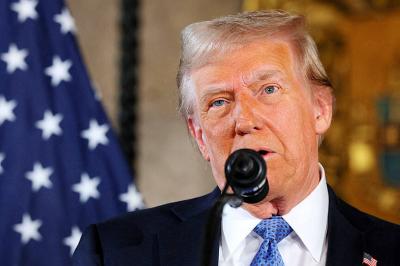
US President Donald Trump said "it’s up to" Chinese President Xi Jinping (習近平) what China does on Taiwan, but that he would be "very unhappy" with a change in the "status quo," the New York Times said in an interview published yesterday. Xi "considers it to be a part of China, and that’s up to him what he’s going to be doing," Trump told the newspaper on Wednesday. "But I’ve expressed to him that I would be very unhappy if he did that, and I don’t think he’ll do that," he added. "I hope he doesn’t do that." Trump made the comments in

Tourism in Kenting fell to a historic low for the second consecutive year last year, impacting hotels and other local businesses that rely on a steady stream of domestic tourists, the latest data showed. A total of 2.139 million tourists visited Kenting last year, down slightly from 2.14 million in 2024, the data showed. The number of tourists who visited the national park on the Hengchun Peninsula peaked in 2015 at 8.37 million people. That number has been below 2.2 million for two years, although there was a spike in October last year due to multiple long weekends. The occupancy rate for hotels


 RSS
RSS