


Significantly more seismic activity was recorded in Tainan and Chiayi County this year following a major earthquake in Chiayi’s Dapu Township (大埔) in January, the Central Weather Administration (CWA) said yesterday.
The agency at a news conference reviewed this year’s significant weather and seismic events, and presented a general weather forecast for spring.
From 2020 to last year, a yearly average of nine earthquakes in the “noticeable range” were recorded in the two counties, Seismological Center Director Wu Chien-fu (吳健富) said.
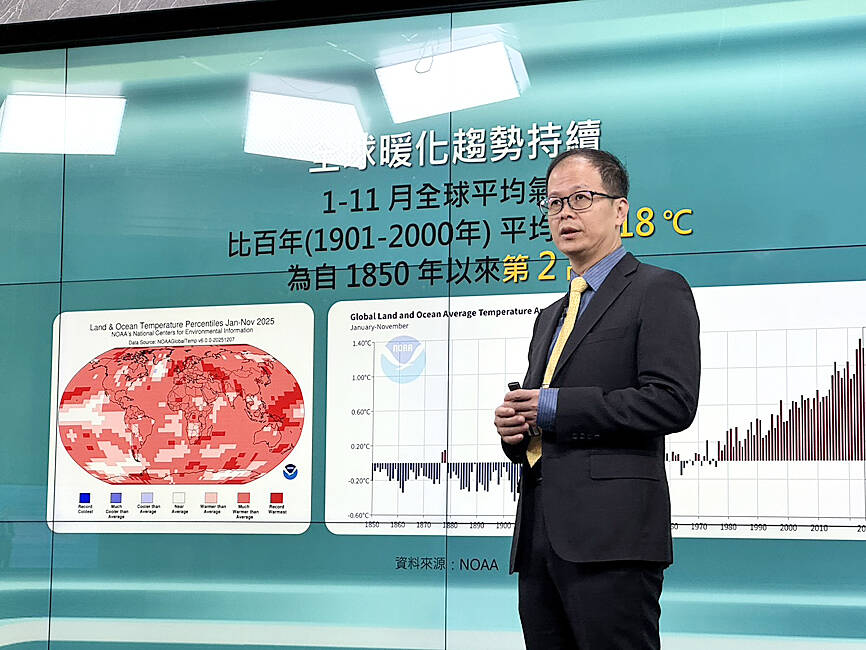
Photo: CNA
This year, the center detected 62 such quakes centered in the two counties, 6.9 times more than the average, Wu said.
They were mainly triggered by a magnitude 6.4 quake that struck Dapu on Jan. 21 at a depth of 9.7km, he said.
A total of 143 aftershocks were recorded in January, before the activity subsided in February, Wu said, adding that small quakes are still occurring.
On average, about 32,000 earthquakes occur in Taiwan annually, Wu said.
This year, there was one earthquake with a magnitude of 7, five earthquakes with a magnitude of 6 or higher, 41 with a magnitude of 5 or higher, and 306 with a magnitude of 4 or higher, Wu said.
There were 156 noticeable earthquakes, close to the 10-year average of 150, he said.
The largest this year was the magnitude 7 quake that struck off Yilan County on Saturday, followed by January’s magnitude 6.4 earthquake in Dapu and another magnitude 6.4 quake off Hualien County on June 11.
Meanwhile, Taiwan’s average temperature this year rose to 24.53°C, about 1.22°C higher than the average from 1901 to 2000.
Weather Forecast Center Director Huang Chun-hsi (黃椿喜) said that the average global temperature from January to last month reached 14°C, a 1.18°C increase.
It was the second-highest average global temperature since 1850, second to last year’s, Huang said.
As of Sunday, the average temperature in Taiwan was 24.53°C, about 1.22°C higher than the average from 1901 to 2000, he said.
It was the 12th-highest average temperature recorded in Taiwan since 1897, he said.
Except for lower average temperatures in January, February and July, monthly temperatures were within the normal range or higher than normal, he said, adding that the forecast center in September and October recorded extremely high temperatures.
Thanks to four typhoons and strong southwesterly airflow, Taiwan has had more rainfall than normal this year, particularly in spring and summer, he said.
Rainfall in July was the highest since 1951, but the number of rainy days was the ninth-lowest over the same period, he added.
Four of the 27 typhoons that formed in the northwestern Pacific Ocean this year made landfall in Taiwan, including Typhoon Danas, which severely impacted the nation’s southwest in July; Typhoon Podul in August; Typhoon Ragasa, which brought intense rainfall to Hualien and Taitung counties in September and caused a barrier lake on the Mataian River (馬太鞍溪) to collapse; and Typhoon Fung-wong last month, which caused severe flooding in Yilan, Huang said.
Currently, the La Nina effect remains the dominant influence in the tropical Pacific regions, he said.
“Based on simulations of meteorological data, the CWA forecast that temperatures from next month to March would fall within normal range or higher than climate average, while rainfall during the same period would be normal or lower than climate average. However, people should still be prepared for the arrival of cold waves and rain fronts,” he added.
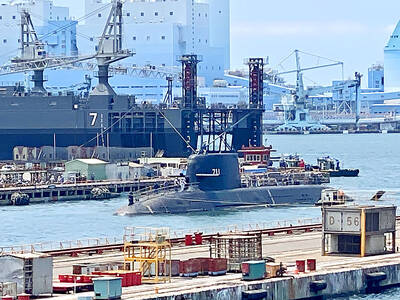
AGING: While Japan has 22 submarines, Taiwan only operates four, two of which were commissioned by the US in 1945 and 1946, and transferred to Taiwan in 1973 Taiwan would need at least 12 submarines to reach modern fleet capabilities, CSBC Corp, Taiwan chairman Chen Cheng-hung (陳政宏) said in an interview broadcast on Friday, citing a US assessment. CSBC is testing the nation’s first indigenous defense submarine, the Hai Kun (海鯤, Narwhal), which is scheduled to be delivered to the navy next month or in July. The Hai Kun has completed torpedo-firing tests and is scheduled to undergo overnight sea trials, Chen said on an SET TV military affairs program. Taiwan would require at least 12 submarines to establish a modern submarine force after assessing the nation’s operational environment and defense

A white king snake that frightened passengers and caused a stir on a Taipei MRT train on Friday evening has been claimed by its owner, who would be fined, Taipei Rapid Transit Corp (TRTC) said yesterday. A person on Threads posted that he thought he was lucky to find an empty row of seats on Friday after boarding a train on the Bannan (Blue) Line, only to spot a white snake with black stripes after sitting down. Startled, he jumped up, he wrote, describing the encounter as “terrifying.” “Taipei’s rat control plan: Release snakes on the metro,” one person wrote in reply, referring
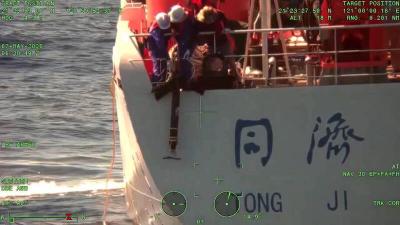
The coast guard today said that it had disrupted "illegal" operations by a Chinese research ship in waters close to the nation and driven it away, part of what Taipei sees a provocative pattern of China's stepped up maritime activities. The coast guard said that it on Thursday last week detected the Chinese ship Tongji (同濟號), which was commissioned only last year, 29 nautical miles (54km) southeast of the southern tip of Taiwan, although just outside restricted waters. The ship was observed lowering ropes into the water, suspected to be the deployment of scientific instruments for "illegal" survey operations, and the coast
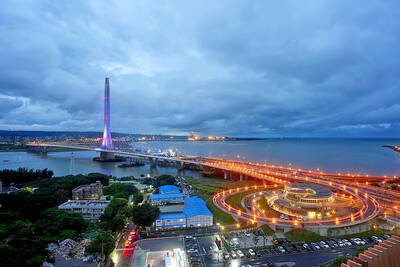
An inauguration ceremony was held yesterday for the Danjiang Bridge, the world’s longest single-mast asymmetric cable-stayed bridge, ahead of its official opening to traffic on Tuesday, marking a major milestone after nearly three decades of planning and construction. At the ceremony in New Taipei City attended by President William Lai (賴清德), Premier Cho Jung-tai (卓榮泰), Minister of Transportation and Communications Chen Shih-kai (陳世凱) and New Taipei City Mayor Hou Yu-ih (侯友宜), the bridge was hailed as both an engineering landmark and a long-awaited regional transport link connecting Tamsui (淡水) and Bali (八里)


 RSS
RSS