


The opposition parties yesterday said they would attempt to impeach President William Lai (賴清德) over what they described as his “undemocratic” practices, despite practical obstacles that would preclude the scenario.
The move came after Lai on Monday refused to promulgate a legislative amendment that would have allowed local governments to receive a larger share of government revenue, arguing that the legislation would hurt the nation’s fiscal sustainability.
Premier Cho Jung-tai (卓榮泰) had declined to countersign the legislation earlier that day, which Lai cited as the reason for not publicly announcing the law, normally considered to be routine.
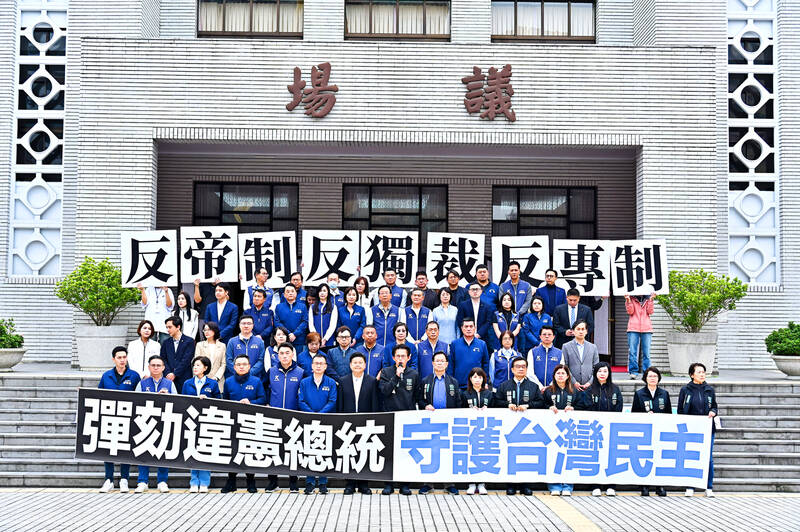
Photo: Tu Chien-jung, Taipei Times
“Lai has made himself emperor. He has shown that he has no regard for public opinion,” Chinese Nationalist Party (KMT) caucus whip Fu Kun-chi (傅?萁) told a news conference at the legislature.
Taiwan People’s Party (TPP) Chairman Huang Kuo-chang (黃國昌) said that according to the Constitution, Lai should have promulgated the bill within 10 days after the legislature voted down on Dec. 5 an Executive Yuan motion to reconsider the amendment.
“Never has there been a president who has gone so far as to refuse to promulgate a law passed by the legislature,” Huang said.
He said the opposition caucuses would tender a motion to impeach Lai for review at a plenary session, but he did not specify when.
The Additional Articles of the Constitution of the Republic of China (中華民國憲法增修條文) state that a motion to impeach the president or vice president can be initiated after gaining the backing of half of lawmakers.
It then must gain the approval of two-thirds of lawmakers before being forwarded to the Constitutional Court to be adjudicated.
However, the court, which normally has 15 justices, but currently has only eight, is below the legal threshold for adjudication and the government’s attempts to fill the vacancies have failed.
That means the proposed impeachment could not be put into effect even if it cleared the legislative floor, which is a near impossibility in itself.
The KMT and TPP together control 60 of the 113 seats in the legislature. The Democratic Progressive Party (DPP) has 51 seats, with the remaining two held by KMT-leaning independent lawmakers, making a two-thirds majority in any vote highly unlikely.
Asked to comment on the opposition parties’ proposed impeachment drive, Presidential Office spokeswoman Karen Kuo (郭雅慧) said the Presidential Office respected any move as long as it is within constitutional limits.
DPP spokesman Lee Kun-cheng (李坤城) said that it is absurd for the opposition parties to claim they are fighting against dictatorship and an authoritarian regime when they dare not criticize Chinese President Xi Jinping (習近平) and Russian President Vladimir Putin.
“It is the KMT and TPP combining to take power from other government branches and to paralyze the Constitutional Court. Now they pass a motion to impeach President Lai. It is aimed at deceiving the public with a fake move,” Lee said. “KMT Chairwoman Cheng Li-wun (鄭麗文) even stated that Putin is not a dictator.”
As they dare not to condemn Putin and Xi, they have no credibility talking about fighting against authoritarianism in the motion to impeach Lai,” he said.
Additional reporting by Jason Pan
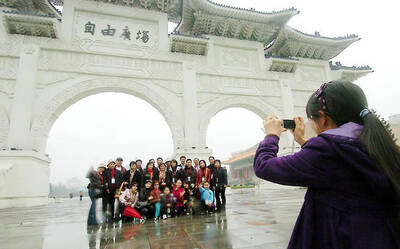
NUMBERS IMBALANCE: More than 4 million Taiwanese have visited China this year, while only about half a million Chinese have visited here Beijing has yet to respond to Taiwan’s requests for negotiation over matters related to the recovery of cross-strait tourism, the Tourism Administration said yesterday. Taiwan’s tourism authority issued the statement after Chinese-language daily the China Times reported yesterday that the government’s policy of banning group tours to China does not stop Taiwanese from visiting the country. As of October, more than 4.2 million had traveled to China this year, exceeding last year. Beijing estimated the number of Taiwanese tourists in China could reach 4.5 million this year. By contrast, only 500,000 Chinese tourists are expected in Taiwan, the report said. The report
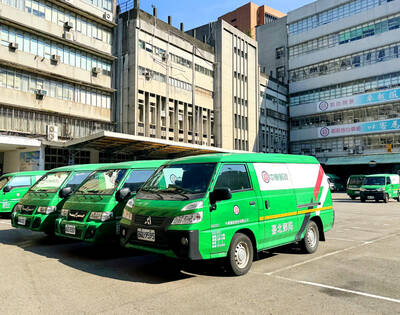
SHIPS, TRAINS AND AUTOMOBILES: The ministry has announced changes to varied transportation industries taking effect soon, with a number of effects for passengers Beginning next month, the post office is canceling signature upon delivery and written inquiry services for international registered small packets in accordance with the new policy of the Universal Postal Union, the Ministry of Transportation and Communications said yesterday. The new policy does not apply to packets that are to be delivered to China, the ministry said. Senders of international registered small packets would receive a NT$10 rebate on postage if the packets are sent from Jan. 1 to March 31, it added. The ministry said that three other policies are also scheduled to take effect next month. International cruise ship operators
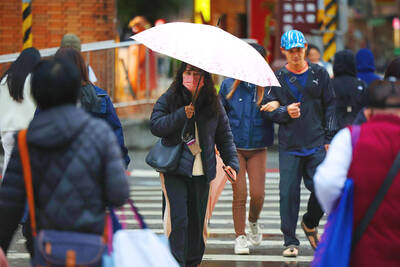
Temperatures are forecast to drop steadily as a continental cold air mass moves across Taiwan, with some areas also likely to see heavy rainfall, the Central Weather Administration (CWA) said. From today through early tomorrow, a cold air mass would keep temperatures low across central and northern Taiwan, and the eastern half of Taiwan proper, with isolated brief showers forecast along Keelung’s north coast, Taipei and New Taipei City’s mountainous areas and eastern Taiwan, it said. Lows of 11°C to 15°C are forecast in central and northern Taiwan, Yilan County, and the outlying Kinmen and Lienchiang (Matsu) counties, and 14°C to 17°C
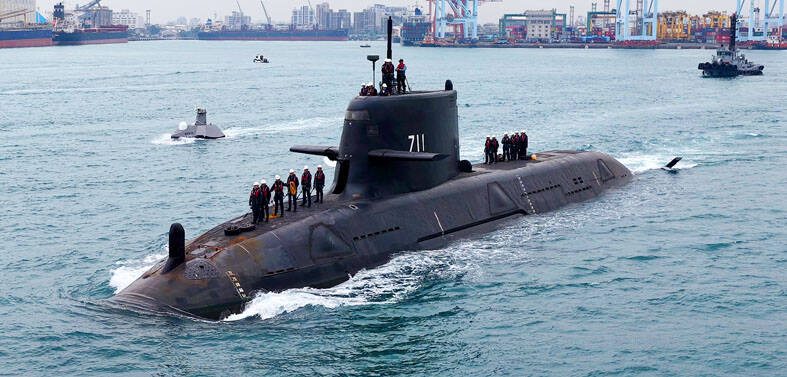
STEERING FAILURE: The first boat of its class is experiencing teething issues as it readies for acceptance by the navy, according to a recent story about rudder failure The Hai Kun (海鯤), the nation’s first locally built submarine, allegedly suffered a total failure of stern hydraulic systems during the second round of sea acceptance trials on June 26, and sailors were forced to manually operate the X-rudder to turn the submarine and return to port, news Web site Mirror Daily reported yesterday. The report said that tugboats following the Hai Kun assisted the submarine in avoiding collisions with other ships due to the X-rudder malfunctioning. At the time of the report, the submarine had completed its trials and was scheduled to begin diving and surfacing tests in shallow areas. The X-rudder,


 RSS
RSS