


Premier Cho Jung-tai (卓榮泰) today said he would not countersign the Legislative Yuan’s fiscal planning bill, as it would harm national development, infringes on executive authority and was passed in an undemocratic manner.
The Legislative Yuan’s version of the Act Governing the Allocation of Government Revenues and Expenditures (財政收支劃分法) that passed on Nov. 14 was required to be promulgated by today.
Cho this afternoon convened a news conference entitled “Defending the Constitutional Order” to announce that he would not countersign the bill.
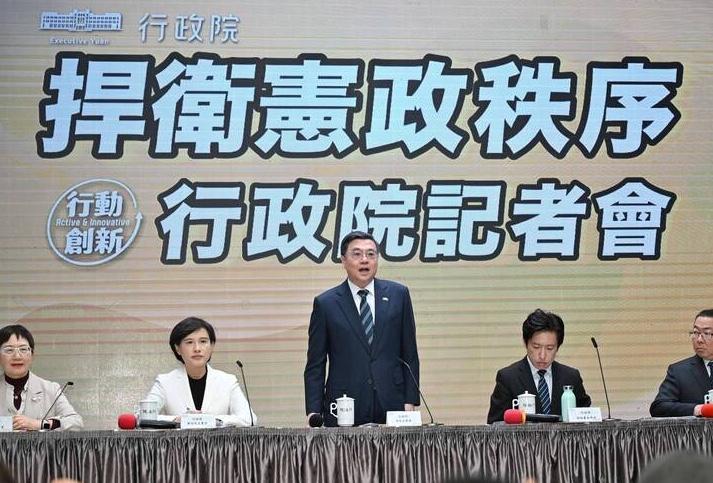
Photo: Chen Yi-kuan, Taipei Times
This marks the first time in the nation’s history that a premier has refused to countersign a bill.
Former premier Hau Pei-tsun (郝柏村) previously refused to countersign personnel appointments, but not a bill.
The ruling and opposition parties have been wrangling over the fiscal planning act for more than a year.
The Legislative Yuan amended the act at the end of last year to shift a greater proportion of national revenues to local governments and passed another amendment last month aiming to ensure that local government subsidies are not adjusted by the central government.
The Executive Yuan considered the amendments highly flawed and challenging to implement, but the legislature rejected its requests to reconsider the bills.
The premier has the right to refuse to countersign according to Article 37 of the Constitution, which states that the president shall promulgate laws and issue mandates according to the law, with the countersignature of the premier or the premier and relevant ministers.
If the Legislative Yuan disagrees with his decision, Cho said it can exercise its constitutional right to hold a vote of no confidence against him.
Cho told reporters that the bill infringes on the separation of powers, breaches democratic principles and would harm national development.
Under the Constitution, the Executive Yuan has the right to propose the budget, while the legislature approves it, he said.
However, the amendments would force the government to borrow an additional NT$264.6 billion (US$8.45 billion) next fiscal year to fund project-based subsidies for local governments, significantly increasing government spending and crowding out other policy expenditures, he said.
Total borrowing would reach NT$560 billion, accounting for 17.1 percent of the total budget in excess of the statutory debt ceiling of 15 percent, he said.
This is tantamount to the legislature both compiling and approving the budget, thus infringing on the separation of power, he said, adding that it would also force the executive to compile an illegal budget.
In addition, the bill was sent to a second reading without holding a line-by-line review by legislative committees, and was sent to a vote without the party caucuses reaching a consensus, he said.
“This completely violates democratic principles and infringes upon national sovereignty,” he said.
Furthermore, the executive has a responsibility to ensure “national development and fiscal stability,” Cho said.
The bill would cut funding for national defense, infrastructure, foreign affairs, social welfare, labor and health insurance, and other important federal work, he said.
It would also place a greater burden on local governments to implement things such as disaster relief, as well as exacerbate the urban-rural wealth cap, he added.
“Can the Legislative Yuan take responsibility for this?” he asked.
Earlier this morning, President William Lai (賴清德) hosted a tea gathering with the heads of the Executive Yuan and Examination Yuan to discuss next year’s budget, amendments to the fiscal planning act and civil servant pension reform.
All ministries and agencies should implement legislation on a constitutionally sound basis to ensure the integrity of the constitutional system, Lai said after the meeting.
He pointed out that amendments to the Act Governing the Legislative Yuan's Power (立法院職權行使法) passed last year were ruled unconstitutional.
However, the Legislative Yuan afterward passed amendments to the Constitutional Court Procedure Act (憲法訴訟法), effectively paralyzing the functioning of the court, Lai said.
Since then, the Legislative Yuan has pushed through several bills with which the Executive Yuan and Examination Yuan disagree, including the fiscal planning bill and the cancelation of pension cuts, he said.
The Constitutional Court, which currently has only eight sitting judges, has been unable to operate since January, when a legal revision took effect requiring a quorum 10 grand justices to participate in deliberations and nine to rule on the constitutionality of cases.
Additional reporting by Chen Yun

US climber Alex Honnold is to attempt to scale Taipei 101 without a rope and harness in a live Netflix special on Jan. 24, the streaming platform announced on Wednesday. Accounting for the time difference, the two-hour broadcast of Honnold’s climb, called Skyscraper Live, is to air on Jan. 23 in the US, Netflix said in a statement. Honnold, 40, was the first person ever to free solo climb the 900m El Capitan rock formation in Yosemite National Park — a feat that was recorded and later made into the 2018 documentary film Free Solo. Netflix previewed Skyscraper Live in October, after videos

Starting on Jan. 1, YouBike riders must have insurance to use the service, and a six-month trial of NT$5 coupons under certain conditions would be implemented to balance bike shortages, a joint statement from transportation departments across Taipei, New Taipei City and Taoyuan announced yesterday. The rental bike system operator said that coupons would be offered to riders to rent bikes from full stations, for riders who take out an electric-assisted bike from a full station, and for riders who return a bike to an empty station. All riders with YouBike accounts are automatically eligible for the program, and each membership account

A classified Pentagon-produced, multiyear assessment — the Overmatch brief — highlighted unreported Chinese capabilities to destroy US military assets and identified US supply chain choke points, painting a disturbing picture of waning US military might, a New York Times editorial published on Monday said. US Secretary of Defense Pete Hegseth’s comments in November last year that “we lose every time” in Pentagon-conducted war games pitting the US against China further highlighted the uncertainty about the US’ capability to intervene in the event of a Chinese invasion of Taiwan. “It shows the Pentagon’s overreliance on expensive, vulnerable weapons as adversaries field cheap, technologically
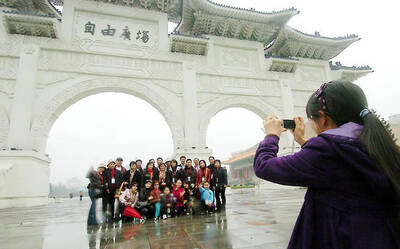
NUMBERs IMBALANCE: More than 4 million Taiwanese have visited China this year, while only about half a million Chinese have visited here Beijing has yet to respond to Taiwan’s requests for negotiation over matters related to the recovery of cross-strait tourism, the Tourism Administration said yesterday. Taiwan’s tourism authority issued the statement after Chinese-language daily the China Times reported yesterday that the government’s policy of banning group tours to China does not stop Taiwanese from visiting the country. As of October, more than 4.2 million had traveled to China this year, exceeding last year. Beijing estimated the number of Taiwanese tourists in China could reach 4.5 million this year. By contrast, only 500,000 Chinese tourists are expected in Taiwan, the report said. The report


 RSS
RSS