


President William Lai (賴清德) yesterday called on Legislative Speaker Han Kuo-yu (韓國瑜) to reconsider his invitation for a tea gathering tomorrow with heads of the Executive Yuan and the Examination Yuan to promote harmony between the government and opposition, and overall social solidarity.
“We hope Speaker Han would reconsider his stance, given the difficulties he faces, as the meeting would discuss critical national issues,” Lai said.
The invitation came in light of increasing friction between the legislative and executive branches after opposition lawmakers last week voted to turn down the Executive Yuan’s petition for a review of the amendment to the Act Governing the Allocation of Government Revenues and Expenditures (財政收支劃分法) and on Friday passed an amendment to legislation reversing the Democratic Progressive Party’s (DPP) 2018 pension reform.
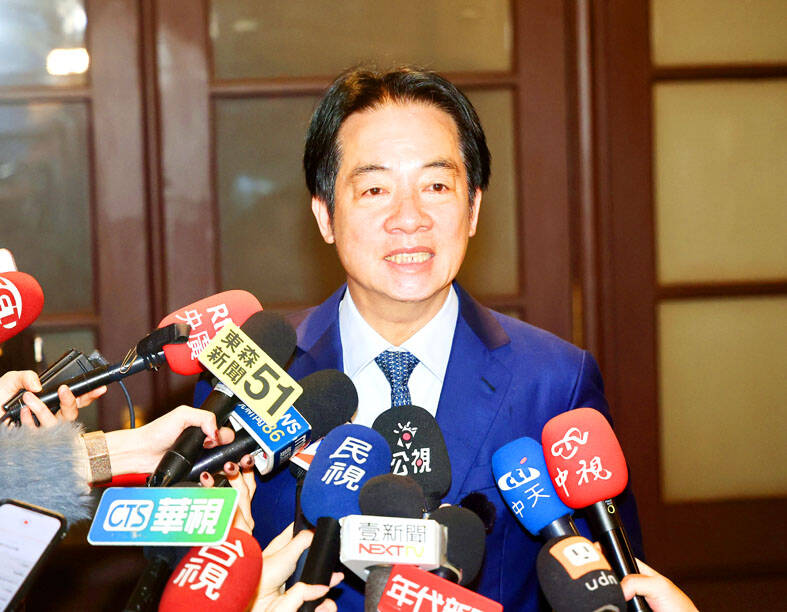
Photo: CNA
Han, a member of the Chinese Nationalist Party (KMT), declined the invitation, saying that the legislature is a collegial body.
The KMT yesterday expressed support for Han’s decision, stating that the Lai administration has been antagonistic, often disrespecting and refusing to initiate dialogue with the legislature.
The KMT said it questioned the governing party’s basic understanding of and respect for democracy when, as the minority in the Legislative Yuan, it refuses to work with the majority and often resorts to sensational rhetoric to incite public opposition.
KMT Chairwoman Cheng Li-wun (鄭麗文) yesterday said that Lai missed the window to communicate with the opposition parties after his party collaborated on a failed recall campaign against opposition lawmakers this summer, adding that the difficulty the government faces in pushing its policies stems from a long-term refusal to engage in sincere talks with the opposition.
The Taiwan People’s Party yesterday said it respected Han’s refusal “to kowtow to the executive branch” and called on the DPP government to be law-abiding, uphold justice in law enforcement and step up dialogue with opposition parties.
The president should meet directly with opposition party chairs if the government wishes to reach substantive resolutions to national issues, it said.
DPP Policy Committee Executive Officer Rosalia Wu (吳思瑤) said in response to Han’s claims that he should refrain from being involved in inter-branch mediation that it had not stopped him from participating in similar talks in the past, and that the speaker should rise above party lines.
Inter-branch mediation is a constitutionally enabled power, and such attempts were not attempts to patronize Han, Wu said, adding that Han should instead be concerned “whether certain political parties are hijacking him.”
Additional reporting by Huang Tzu-yang, Lee Wen-hsin, and Chen Cheng-yu

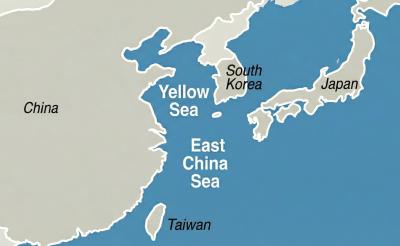
China has reserved offshore airspace in the Yellow Sea and East China Sea from March 27 to May 6, issuing alerts usually used to warn of military exercises, although no such exercises have been announced, the Wall Street Journal (WSJ) reported yesterday. Reserving such a large area for 40 days without explanation is an “unusual step,” as military exercises normally only last a few days, the paper said. These alerts, known as Notice to Air Missions (Notams), “are intended to inform pilots and aviation authorities of temporary airspace hazards or restrictions,” the article said. The airspace reserved in the alert is

More than 6,000 Taiwanese students have participated in exchange programs in China over the past two years, despite the Mainland Affairs Council’s (MAC) “orange light” travel advisory, government records showed. The MAC’s publicly available registry showed that Taiwanese college and university students who went on exchange programs across the Strait numbered 3,592 and 2,966 people respectively. The National Immigration Agency data revealed that 2,296 and 2,551 Chinese students visited Taiwan for study in the same two years. A review of the Web sites of publicly-run universities and colleges showed that Taiwanese higher education institutions continued to recruit students for Chinese educational programs without

A bipartisan group of US senators has introduced a bill to enhance cooperation with Taiwan on drone development and to reduce reliance on supply chains linked to China. The proposed Blue Skies for Taiwan Act of 2026 was introduced by Republican US senators Ted Cruz and John Curtis, and Democratic US senators Jeff Merkley and Andy Kim. The legislation seeks to ease constraints on Taiwan-US cooperation in uncrewed aerial systems (UAS), including dependence on China-sourced components, limited access to capital and regulatory barriers under US export controls, a news release issued by Cruz on Wednesday said. The bill would establish a "Blue UAS
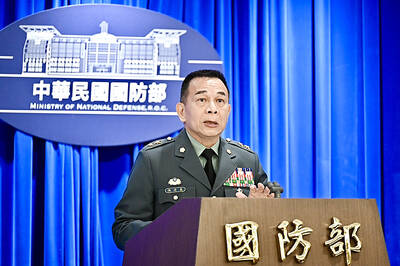
The Republic of China Army Command yesterday relieved Kinmen Defense Battalion commander after authorities indicted the officer on charges connected to using methamphetamine. The Kinmen District Prosecutors’ Office on Wednesday detained Colonel He (何) after the Coast Guard linked him to drug shipments and proceeded to charge him yesterday for using and possessing crystal meth. The man was released on a NT$50,000 bail and banned from leaving Kinmen, the office said. Army Chief of Staff Lieutenant General Chen Chien-yi (陳建義) told a news conference yesterday that He has been removed and another officer is taking over the unit as the acting commander. The military


 RSS
RSS