


The US House of Representatives on Wednesday passed a compromise National Defense Authorization Act (NDAA), which includes authorization of up to US$1 billion for Taiwan-related security cooperation and a joint drone program.
The latest version of the NDAA for Fiscal 2026, released on Sunday, passed the House in a 312-112 vote.
In a news release, US Representative Mike Rogers, chairman of the House Armed Services Committee, said the bill advances US President Donald Trump’s “peace through strength” agenda, and keeps US forces ready and lethal amid an increasingly complex security environment.
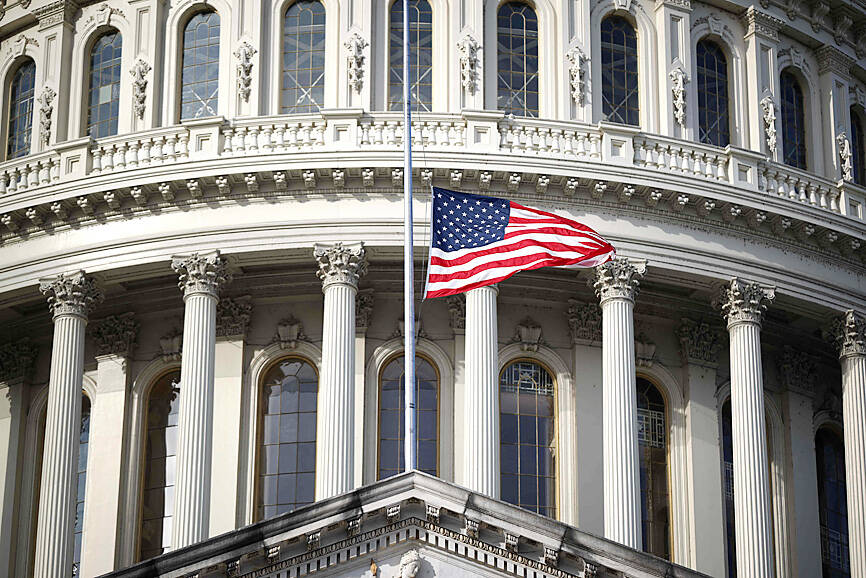
Photo: AFP
According to the committee, the 2026 NDAA focuses on countering China’s threats, ensuring mission success in the Indo-Pacific region, and supporting regional allies and partners.
The bill authorizes up to US$1 billion for the Taiwan Security Cooperation Initiative and directs the Pentagon to collaborate with Taiwan on a joint drone program, including codevelopment and coproduction, in line with the Taiwan Relations Act.
It further authorizes US forces to maintain training programs with Taiwan and other partners to counter “malign influence operations” by Beijing.
The bill also calls for a plan to expand joint Taiwan-US coast guard training and to deploy US personnel in Taiwan to bolster maritime security, law enforcement and deterrence.
The NDAA includes the Taiwan Non-Discrimination Act, which supports Taiwan’s bid to join the IMF.
The US Senate and House had earlier passed their own versions of the NDAA. The two chambers would now have to produce a single reconciled version of the bill, which would then require passage by both chambers of the US Congress before it could be signed into law by the president.
In other news, American Institute in Taiwan (AIT) Director Raymond Greene said that the international community might find it hard to understand the domestic criticisms of Taiwan’s efforts to increase its defense budget.
Washington supports President William Lai’s (賴清德) proposal for a supplementary defense budget of NT$1.25 trillion (US$40 billion) to be spent over the next eight years in the face of a growing Chinese threat, Greene said in podcast interview published on Wednesday.
Greene said he understands the proposed budget has to go through a democratic process, including approval by lawmakers.
“But I remain very confident that at the end of the day, all of the parties in Taiwan will come together on behalf of increased defense spending,” Greene said.
Following Lai’s announcement of the proposal last month, the Cabinet put forth a bill to allocate NT$1.25 trillion for the purchase of weapons and joint development programs with the US from next year to 2033.
However, the draft bill has been blocked in the opposition-controlled legislature, with lawmakers of the main opposition Chinese Nationalist Party (KMT) and smaller Taiwan People’s Party arguing that it lacks details, and that the funds could only be secured through debt financing and would likely force cuts to other spending.
On Wednesday, Greene said that all the Taiwanese lawmakers he and visiting US Congress members had met with in Taipei supported the idea of boosting Taiwan’s self-defense capabilities, and he was “quite optimistic” the bill would be passed.
The US side is also looking forward to “answering questions from our Taiwan friends in the legislature once they get into the detailed review of the budget,” he added.
However, the international community might not understand domestic pushback against the proposal, Greene said.
“I would say I think it’s important for Taiwanese citizens to understand, though, that some of the criticism of increasing Taiwan’s defense spending will unlikely receive support or understanding from the international community,” he said.
The international community is more concerned about Taiwan’s under-investment in defense, which has “actually increased the risk of a conflict,” he said.

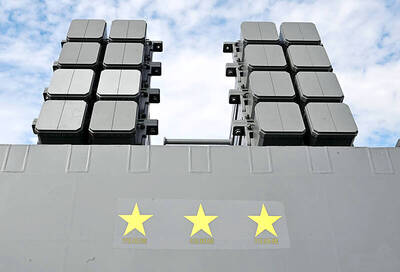
UPGRADE: The Kang Ding-class frigate is replacing its Chaparall missiles with Tien Chien II and Hua Yang VLS, which would provide it with long-range, 360° air defense Taiwan plans to produce 1,200 to 1,376 Hai Chien II missiles (海劍二, Sea Sword II) — also known as TC-2N — to serve as the standard air defense system of the navy’s surface combatant fleet, a source said yesterday. Last week, the Hai Chien II, the naval version of the Tien Kung II missile (天劍二, Sky Sword II), completed a live-fire test in waters off the National Chungshan Institute of Science and Technology’s Jiupeng facility (九鵬) in Pingtung County’s Manjhou Township (滿州). The MIM72 Chaparral and other dated air defense missiles that currently arm Taiwanese ships have inadequate range to combat Chinese

REASONS FOR TRAVEL: An assistant professor said that proposed amendments to penalize drivers if they used drugs overseas would not deter people from traveling People who operate a motor vehicle under the influence of marijuana would have their driver’s license revoked, even if they used the substance while overseas, the Ministry of Transportation and Communications said yesterday, citing proposed amendments to the Road Traffic Management and Penalty Act (道路交通管理處罰條例). The amendments would also authorize the government to revoke the licenses of people determined to have used Category 1 or Category 2 narcotics, even if they were not operating a vehicle while under the influence of drugs, as well as ban them from taking the license test for three years, the ministry said. People aged 18 or
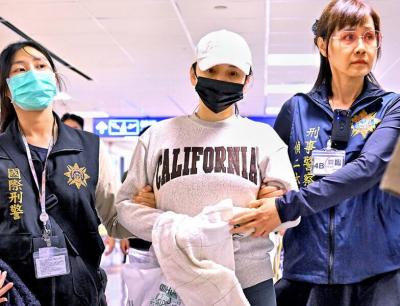
Johanne Liou (劉喬安), a Taiwanese woman who shot to unwanted fame during the Sunflower movement protests in 2014, returned to Taiwan last night after being deported from the US. She is to stand trial in Taiwan for charges involving embezzlement, fraud and drug crimes. The Criminal Investigation Bureau (CIB) said it took her into custody at Taiwan Taoyuan International Airport and would first question her before transferring her to the New Taipei District Prosecutors’ Office. She was arrested upon disembarking a flight from San Francisco that landed shortly before 7pm. Liou absconded to the US in 2019 after jumping bail
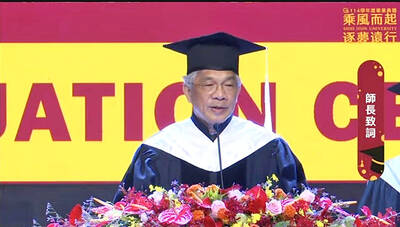
Shih Hsin University President Chen Ching-he (陳清河) yesterday issued a public apology for comments made in his commencement speech last week, stating that he has asked the school to suspend his duties and halt his wages for two months as a show of contrition. At the commencement ceremony on May 30, Chen said, “If you don’t manage your time well, or your own emotions, or your health, then I am telling every one of you — put a quick end to ‘you,’ because the world has no need for ‘you.’” The comments have sparked significant controversy online, and Chen through an open


 RSS
RSS