


The year 2027 is regarded as the year China would likely gain the capability to invade Taiwan, not the year it would launch an invasion, Taiwanese defense experts said yesterday.
The experts made the remarks after President William Lai (賴清德) told a news conference on Wednesday that his administration would introduce a NT$1.25 trillion (US$39.8 billion) special defense budget bill to boost Taiwan’s overall defense posture over the next eight years.
Lai said that Beijing aims for military unification of Taiwan by 2027. The Presidential Office later clarified that what Lai meant was that China’s goal is to “prepare for military unification of Taiwan by 2027.”
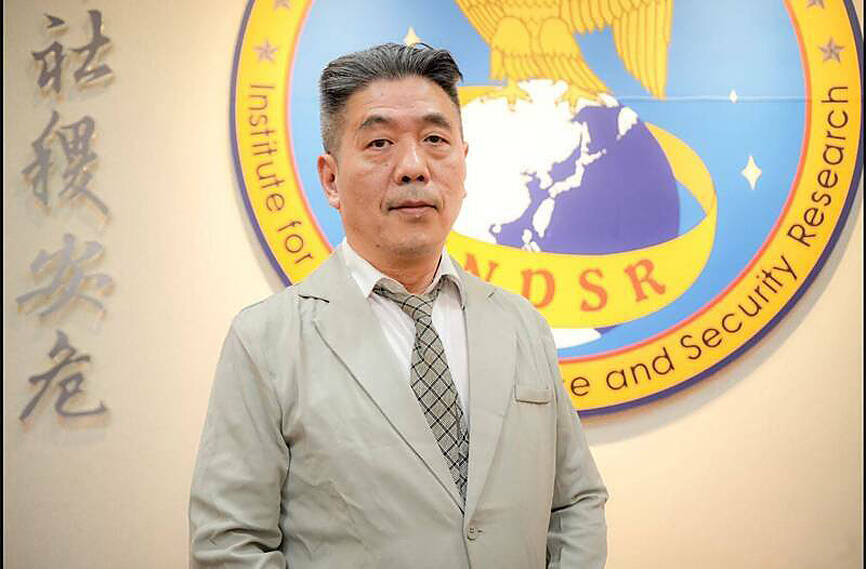
Photo: Taipei Times
Su Tzu-yun (蘇紫雲), director of the Division of Defense Strategy and Resources at the military-funded Institute for National Defense and Security Research, on Thursday said that former top US Indo-Pacific commander Philip Davidson in 2021 predicted that China would attain the military capability to mount an invasion by 2027.
Although the timeframe — later coined the Davidson window — is frequently discussed in the context of Chinese military development, it does not mean that experts believe Beijing would launch an invasion that year, or that it would win if such an attack were attempted, Su said.
For China, obtaining the military capabilities to invade Taiwan enables the Chinese People’s Liberation Army (PLA) to try waging war, but does not guarantee victory, he said.
Davidson’s discussions of the timeframe are speculations based on Chinese President Xi Jinping’s (習近平) publicly stated force modernization goals revolving around scheduled milestone events on the Chinese administrative-political calendar, Su said.
The years 2027, 2035 and 2049 are the years that Xi is anticipated to seek a fourth term as China’s supreme leader, the centennial benchmark of the PLA’s force modernization plan and the People’s Republic of China’s 100th founding anniversary respectively, Su said.
For that reason, Beijing is expected to set 2027 as the year the PLA must acquire the capabilities to conduct an offensive campaign against Taiwan, he said.
Taiwan’s regular military spending accounts for 3.23 percent of GDP, which is low, he said.
Lai’s pledge on Wednesday to invest in national defense is a remedial measure aimed at addressing urgent needs, not a permanent answer to the underlying problem, he said.
While the president’s defense pledge could potentially boost total military spending to 5 percent of GDP by 2030, the appropriate solution should be to achieve the expenditure via the regular defense budget, Su said.
The impact of the COVID-19 pandemic, US-China trade disputes, China’s economic decline and Xi’s military purge have introduced uncertainties about Beijing’s ability to meet the PLA’s force modernization timetable, said Shen Ming-shih (沈明室), another researcher at the institute.
It is unknown whether Xi would remain in power past 2027 and the likelihood of the Chinese leader resorting to invading Taiwan for internal political ends has significantly declined, Shen said.
Additionally, Xi’s repeated public calls on the PLA to be prepared to invade Taiwan suggest that the Chinese military has not achieved its modernization goals, he said.
The Davidson window remains prominent in expert discourse because the concrete dates it furnishes are useful for informing strategic planning, including Taiwan’s timetable for acquiring F-16 jets and M1 tanks, he said.
The public should refrain from incorrectly interpreting Lai’s comments surrounding his pledge to boost defense spending as a prediction that China would attack in 2027, Shen said.
The strategic environment, China’s internal political struggles leading up to the 21st National Congress of the Chinese Communist Party and the PLA’s level of preparedness would likely play major roles in determining whether China would invade, he said.
However, Taiwan’s military capabilities and preparedness — which dictate its deterrence capabilities — remain the most important factors, Shen said.
As there is no possible method to accurately predict if and when war would break out, the best and only measure for the nation is to be prepared to repel a Chinese invasion in 2027, he said.
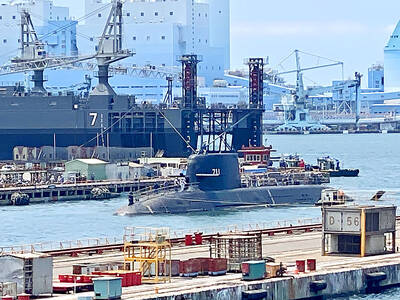
AGING: While Japan has 22 submarines, Taiwan only operates four, two of which were commissioned by the US in 1945 and 1946, and transferred to Taiwan in 1973 Taiwan would need at least 12 submarines to reach modern fleet capabilities, CSBC Corp, Taiwan chairman Chen Cheng-hung (陳政宏) said in an interview broadcast on Friday, citing a US assessment. CSBC is testing the nation’s first indigenous defense submarine, the Hai Kun (海鯤, Narwhal), which is scheduled to be delivered to the navy next month or in July. The Hai Kun has completed torpedo-firing tests and is scheduled to undergo overnight sea trials, Chen said on an SET TV military affairs program. Taiwan would require at least 12 submarines to establish a modern submarine force after assessing the nation’s operational environment and defense

A white king snake that frightened passengers and caused a stir on a Taipei MRT train on Friday evening has been claimed by its owner, who would be fined, Taipei Rapid Transit Corp (TRTC) said yesterday. A person on Threads posted that he thought he was lucky to find an empty row of seats on Friday after boarding a train on the Bannan (Blue) Line, only to spot a white snake with black stripes after sitting down. Startled, he jumped up, he wrote, describing the encounter as “terrifying.” “Taipei’s rat control plan: Release snakes on the metro,” one person wrote in reply, referring
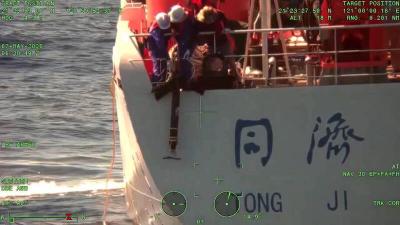
The coast guard today said that it had disrupted "illegal" operations by a Chinese research ship in waters close to the nation and driven it away, part of what Taipei sees a provocative pattern of China's stepped up maritime activities. The coast guard said that it on Thursday last week detected the Chinese ship Tongji (同濟號), which was commissioned only last year, 29 nautical miles (54km) southeast of the southern tip of Taiwan, although just outside restricted waters. The ship was observed lowering ropes into the water, suspected to be the deployment of scientific instruments for "illegal" survey operations, and the coast

Taiwan’s two cases of hantavirus so far this year are on par with previous years’ case numbers, and the government is coordinating rat extermination work, so there should not be any outbreaks, Centers for Disease Control (CDC) Director-General Philip Lo (羅一鈞) said today in an interview with the Liberty Times (the Taipei Times’ sister newspaper). An increase in rat sightings in Taipei and New Taipei City has raised concerns about the spread of hantavirus, as rats can carry the disease. In January, a man in his 70s who lived in Taipei’s Daan District (大安) tested positive posthumously for hantavirus, Taiwan’s


 RSS
RSS