


An elderly Chinese war veteran’s shin still bears the mark of a bullet wound he sustained when fighting the Japanese as a teenager, a year before the end of World War II.
Eighty years on, Li Jinshui’s scar remains as testimony to the bravery of Chinese troops in a conflict that killed millions of their people.
However, the story behind China’s overthrow of the brutal Japanese occupation is deeply contested.
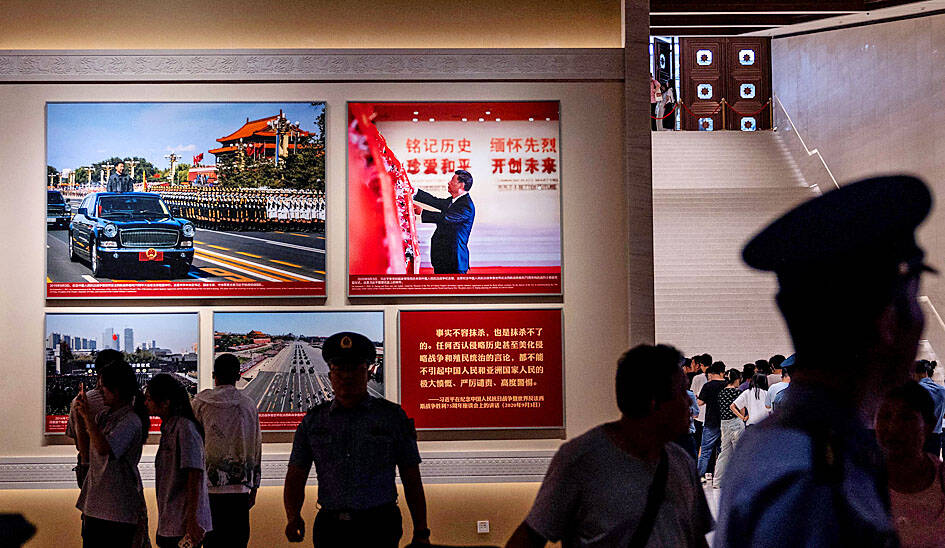
Photo: Reuters
Historians broadly agree that credit for victory lies primarily with the Chinese Nationalist Party (KMT)-led Republic of China (ROC) Army. Its leader, Chiang Kai-shek (蔣介石), fled to Taiwan in 1949 after losing a civil war to Mao Zedong’s (毛澤東) communists, laying the groundwork for decades of cross-strait tensions that continue to this day.
Beijing says that the Chinese Communist Party (CCP) played a central role in the war, bolstered by the stories of Li and his comrades’ courage and sacrifice. It is a narrative expected to prevail at a major military parade today.
“With the country in trouble, Chinese people with conscience had to stand up,” said Li, who turned 98 on Wednesday last week and was a soldier in the CCP-run Eighth Route Army.
After Japan’s full-scale invasion in 1937, the CCP resisted mainly by guerrilla fighting in the rural, hilly stretches of northern China outside of ROC control.
Li was shot in the leg while fighting Japanese in his native Wuxiang County in China’s rugged northern Shanxi Province.
Released from the hospital early, he returned to the battlefield despite not having fully recovered.
Dressed in a green military uniform topped by a cap with a red star, Li bent to pull up his left trouser leg, revealing the scar.
“It was extremely hard for us,” he said. “We were just young lads.”
At a government-organized media tour in July, veterans including Li touted the CCP’s role in liberating China from the yoke of Japanese imperialism.
“The KMT did not play a major role in the War Against Japanese Aggression,” Wen Yunfu, 96, said. “It was mainly the communist party.”
Wen’s hometown of Shenzhou in northern Hebei Province was attacked by the Japanese army just a few months after their 1937 invasion.
Chiang’s army was forced to retreat south in the face of the Japanese onslaught.
That left the people under the leadership of the CCP, Wen said.
“Life was extremely difficult for the people,” he said. “Our home was burned down. My uncle was also killed by the Japanese.”
Wen later joined Mao’s CCP at age 16 in the final months of the war, and was put to work making grenades.
A truce was called in the civil war between the KMT, which ruled most of the country at the time, and the insurgent CCP in the years leading up to the defeat of Japan in 1945.
That suspension came to an end in the wake of Japan’s defeat, and the CCP was ultimately victorious in the ensuing domestic conflict.
Under Chinese President Xi Jinping (習近平), Beijing has paid special attention to pushing the “correct” interpretation of the complex history of the victory over Japan, said Rana Mitter, author of multiple books on China’s role in World War II.
“They’re trying to find ways in which the communist role can be brought more to the forefront,” he said.
Although he does not contest that the party’s role was significant, “the primary role in terms of political and military resistance against the Japanese was played by the then-government of China, which was the Nationalist Kuomintang [KMT] government,” he said.
There have been efforts in the past few decades to recognize the contributions made by forces other than the CCP, including the KMT and the US.
One chapter that has received widespread attention is the “Flying Tigers” US air brigade that fought with the KMT in the early 1940s, conducting dangerous assaults on enemy bombers.
A museum in Hunan Province’s Zhijiang sheds light on their assistance, just a stone’s throw away from a key airport from which they launched their missions.
In that central province’s capital of Changsha, locals and patriotic tourism groups pay their respects at a monument to fallen KMT soldiers.
Still, there are glimmers of the complicated history at play.
The scars of three Chinese characters since removed from the monument were visible.
The erased name is likely Wang Tung-yuan (王東原), local CCP historian Ji Jianliang said.
Wang, a general under Chiang and later Taiwan’s ambassador to South Korea, had once provided an inscribed dedication for the monument.
Ji said his name had been removed for “complex political reasons.”
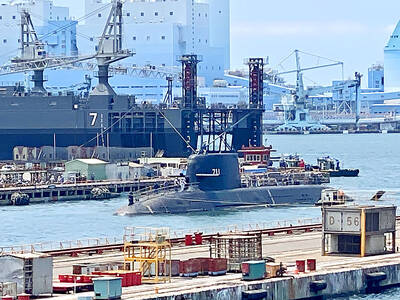
AGING: While Japan has 22 submarines, Taiwan only operates four, two of which were commissioned by the US in 1945 and 1946, and transferred to Taiwan in 1973 Taiwan would need at least 12 submarines to reach modern fleet capabilities, CSBC Corp, Taiwan chairman Chen Cheng-hung (陳政宏) said in an interview broadcast on Friday, citing a US assessment. CSBC is testing the nation’s first indigenous defense submarine, the Hai Kun (海鯤, Narwhal), which is scheduled to be delivered to the navy next month or in July. The Hai Kun has completed torpedo-firing tests and is scheduled to undergo overnight sea trials, Chen said on an SET TV military affairs program. Taiwan would require at least 12 submarines to establish a modern submarine force after assessing the nation’s operational environment and defense

A white king snake that frightened passengers and caused a stir on a Taipei MRT train on Friday evening has been claimed by its owner, who would be fined, Taipei Rapid Transit Corp (TRTC) said yesterday. A person on Threads posted that he thought he was lucky to find an empty row of seats on Friday after boarding a train on the Bannan (Blue) Line, only to spot a white snake with black stripes after sitting down. Startled, he jumped up, he wrote, describing the encounter as “terrifying.” “Taipei’s rat control plan: Release snakes on the metro,” one person wrote in reply, referring
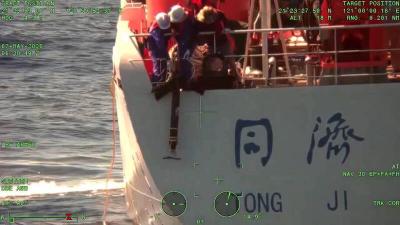
The coast guard today said that it had disrupted "illegal" operations by a Chinese research ship in waters close to the nation and driven it away, part of what Taipei sees a provocative pattern of China's stepped up maritime activities. The coast guard said that it on Thursday last week detected the Chinese ship Tongji (同濟號), which was commissioned only last year, 29 nautical miles (54km) southeast of the southern tip of Taiwan, although just outside restricted waters. The ship was observed lowering ropes into the water, suspected to be the deployment of scientific instruments for "illegal" survey operations, and the coast
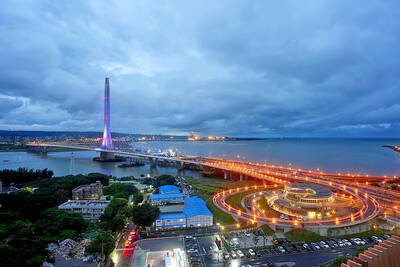
An inauguration ceremony was held yesterday for the Danjiang Bridge, the world’s longest single-mast asymmetric cable-stayed bridge, ahead of its official opening to traffic on Tuesday, marking a major milestone after nearly three decades of planning and construction. At the ceremony in New Taipei City attended by President William Lai (賴清德), Premier Cho Jung-tai (卓榮泰), Minister of Transportation and Communications Chen Shih-kai (陳世凱) and New Taipei City Mayor Hou Yu-ih (侯友宜), the bridge was hailed as both an engineering landmark and a long-awaited regional transport link connecting Tamsui (淡水) and Bali (八里)


 RSS
RSS