


Uncertainty surrounds the Chinese Nationalist Party (KMT) chairperson election, after current Chairman Eric Chu (朱立倫) and frontrunner Taichung Mayor Lu Shiow-yen (盧秀燕) announced they would not run.
Despite getting an endorsement from Chu, Lu said yesterday that she would not run for chair due to the “tsunami” effect of US President Donald Trump’s 20 percent tariffs, as she must “stand guard with our businesses and our citizens through expected hardships ahead.”
Chu, who is serving his second term as chair, has also announced that he would not run again.

Photo: Taipei Times
The election is scheduled for Oct. 18, with candidate registration to close on Friday next week.
Possible frontrunners now include former Taipei mayor Hau Lung-bin (郝龍斌), who has served as KMT vice chairman multiple times and ran in the previous chair election, as well as former minister of foreign affairs and Taichung mayor Jason Hu (胡志強), and former KMT vice chairperson and Chiayi Mayor Huang Min-hui (黃敏惠).
Due to his previous experience in senior party roles and his power within the KMT, Hau may be the best choice for the role, an anonymous KMT official said.
However, local election officials within the party said that Hu could bring fresh ideas and energy to the party, while his connections to the US and China could help the KMT deepen ties with both Washington and Beijing.
Meanwhile, Huang’s mayoral term in Chiayi is to end next year and her former service as acting and vice chair of the party gives her ample experience to take on the role, the official said.
Additional party members have expressed interest in the role, including Sun Yat-sen School president Chang Ya-chung (張亞中), who previously called for Chu to step down following the last failed presidential election.
Former KMT deputy secretary-general Chang Ya-ping (張雅屏), found guilty in 2016 of conducting a smear campaign during the 2014 local elections and sentenced to two years, 10 months in prison, has also been touted for the role.
Other notable names include former Changhua County commissioner Cho Po-yuan (卓伯源), former legislator Cheng Li-wun (鄭麗文) and KMT Central Standing Committee member Sun Chien-ping (孫健萍).
However, it remains to be seen if the party can convince Lu or Chu to put their names in the running before the registration period, which is to run from Monday to Friday next week.
Calls for Lu to step up are expected to continue, the official said.
Former KMT secretary-general Lee Chien-lung (李乾龍) said he would rally council speakers across the country to support her, while KMT caucus whip Fu Kun-chi (傅崐萁) today endorsed Lu.
Meanwhile, some within the party believe that Chu remains the party’s best choice should Lu stand by her decision, after he led the KMT to sweeping victories in local elections over the past four years and secured a legislative majority last year.
The next KMT chair is to take office on Nov. 1 ahead of next year’s local elections and lead campaigns for the January 2028 national election.

The military has spotted two Chinese warships operating in waters near Penghu County in the Taiwan Strait and sent its own naval and air forces to monitor the vessels, the Ministry of National Defense (MND) said. Beijing sends warships and warplanes into the waters and skies around Taiwan on an almost daily basis, drawing condemnation from Taipei. While the ministry offers daily updates on the locations of Chinese military aircraft, it only rarely gives details of where Chinese warships are operating, generally only when it detects aircraft carriers, as happened last week. A Chinese destroyer and a frigate entered waters to the southwest
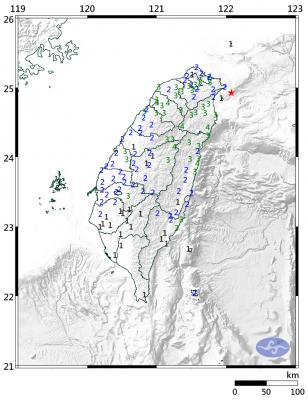
A magnitude 6.1 earthquake struck off the coast of Yilan County at 8:39pm tonight, the Central Weather Administration (CWA) said, with no immediate reports of damage or injuries. The epicenter was 38.7km east-northeast of Yilan County Hall at a focal depth of 98.3km, the CWA’s Seismological Center said. The quake’s maximum intensity, which gauges the actual physical effect of a seismic event, was a level 4 on Taiwan’s 7-tier intensity scale, the center said. That intensity level was recorded in Yilan County’s Nanao Township (南澳), Hsinchu County’s Guansi Township (關西), Nantou County’s Hehuanshan (合歡山) and Hualien County’s Yanliao (鹽寮). An intensity of 3 was

Japanese Prime Minister Sanae Takaichi’s comment last year on Tokyo’s potential reaction to a Taiwan-China conflict has forced Beijing to rewrite its invasion plans, a retired Japanese general said. Takaichi told the Diet on Nov. 7 last year that a Chinese naval blockade or military attack on Taiwan could constitute a “survival-threatening situation” for Japan, potentially allowing Tokyo to exercise its right to collective self-defense. Former Japan Ground Self-Defense Force general Kiyofumi Ogawa said in a recent speech that the remark has been interpreted as meaning Japan could intervene in the early stages of a Taiwan Strait conflict, undermining China’s previous assumptions
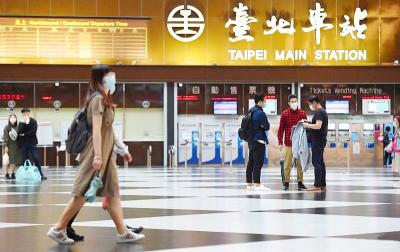
Taiwan Railways Corp (TRC) today announced that Shin Kong Mitsukoshi has been selected as the preferred bidder to operate the Taipei Railway Station shopping mall, replacing the current operator, Breeze Development Co Ltd. Among eight qualified firms that delivered presentations and were evaluated by a review committee, Shin Kong Mitsukoshi was ranked first, while Breeze was named the runner-up, the rail company said in a statement. Contract negotiations are to proceed in accordance with regulations, it said, adding that if negotiations with the top bidder fail, it could invite the second-ranked applicant to enter talks. Breeze in a statement today expressed doubts over


 RSS
RSS