


Two German warships are awaiting orders from Berlin to determine whether they would be the first German naval vessels in decades to pass through the Taiwan Strait next month, at the risk of stoking tensions with Beijing, a German commander said.
While the US and other nations, including Canada, have sent warships through the narrow strait in recent weeks, it would be the German navy’s first passage through the Strait since 2002.
China claims sovereignty over Taiwan, and says it has jurisdiction over the nearly 180km waterway that divides the two sides.
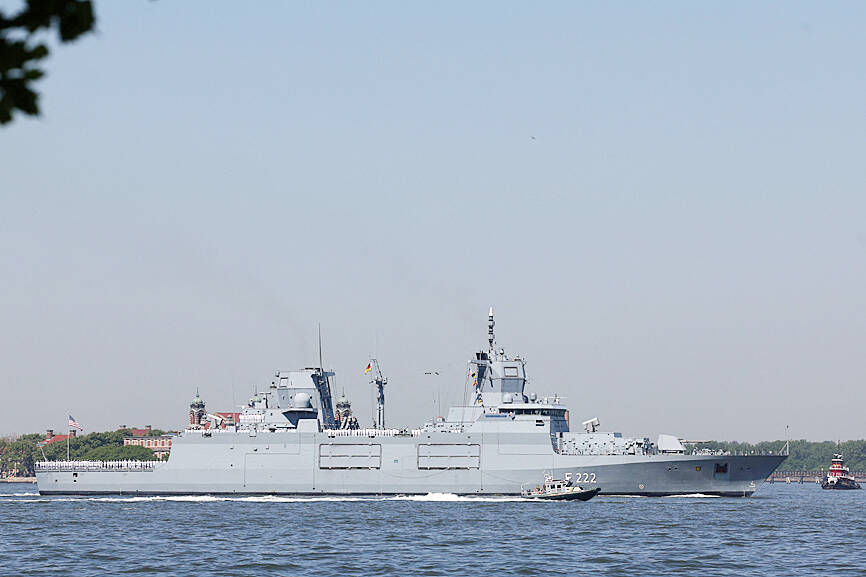
Photo: Reuters
Taiwan strongly objects to these claims, saying only its people can decide their future and that the Taiwan Strait is an international waterway.
“The decision has not been made yet,” Rear Admiral Axel Schulz told Reuters, adding that the weather would play a role.
“We are showing our flag here to demonstrate that we stand by our partners and friends, our commitment to the rules-based order, the peaceful solution of territorial conflicts and free and secure shipping lanes,” Schulz said.
The German frigate Baden-Wuerttemberg and the replenishment ship Frankfurt am Main plan to call in Tokyo today. They would also make stops in South Korea and the Philippines. They are to take part in exercises in the region with France, Indonesia, Italy, Japan, Malaysia, Singapore, the Philippines and the US.
Sailings through the waterway by foreign warships, especially US warships, are regularly condemned by Beijing, which says such missions “undermine peace and stability” in the region.
Germany, for whom China and Taiwan are major trade partners, has joined other Western nations in expanding its military presence in the region, as their alarm has grown over Beijing’s territorial ambitions.
A German warship in 2021 sailed through the South China Sea for the first time in almost 20 years.
Luftwaffe, the aerial warfare branch of the German armed forces, last month deployed fighter jets to Japan for the first joint drills there.
Schulz said he did not have specific security measures should the warships under his command cross the Taiwan Strait, calling it a “normal passage” similar to sailing through the English Channel or the North Sea.
However, he anticipates the passage would be closely monitored.
“I expect the Chinese navy and potentially the coast guard or maritime militia to escort us,” Schulz said, adding that it was common practice.

The Centers for Disease Control (CDC) yesterday reported the first case of a new COVID-19 subvariant — BA.3.2 — in a 10-year-old Singaporean girl who had a fever upon arrival in Taiwan and tested positive for the disease. The girl left Taiwan on March 20 and the case did not have a direct impact on the local community, it said. The WHO added the BA.3.2 strain to its list of Variants Under Monitoring in December last year, but this was the first imported case of the COVID-19 variant in Taiwan, CDC Deputy Director-General Lin Ming-cheng (林明誠) said. The girl arrived in Taiwan on

South Korea is planning to revise its controversial electronic arrival card, a step Taiwanese officials said prompted them to hold off on planned retaliatory measures, a South Korean media report said yesterday. A Yonhap News Agency report said that the South Korean Ministry of Foreign Affairs is planning to remove the “previous departure place” and “next destination” fields from its e-arrival card system. The plan, reached after interagency consultations, is under review and aims to simplify entry procedures and align the electronic form with the paper version, a South Korean ministry official said. The fields — which appeared only on the electronic form

The Ministry of Foreign Affairs (MOFA) is suspending retaliation measures against South Korea that were set to take effect tomorrow, after Seoul said it is updating its e-arrival system, MOFA said today. The measures were to be a new round of retaliation after Taiwan on March 1 changed South Korea's designation on government-issued alien resident certificates held by South Korean nationals to "South Korea” from the "Republic of Korea," the country’s official name. The move came after months of protests to Seoul over its listing of Taiwan as "China (Taiwan)" in dropdown menus on its new online immigration entry system. MOFA last week

A bipartisan group of US senators has introduced a bill to enhance cooperation with Taiwan on drone development and to reduce reliance on supply chains linked to China. The proposed Blue Skies for Taiwan Act of 2026 was introduced by Republican US senators Ted Cruz and John Curtis, and Democratic US senators Jeff Merkley and Andy Kim. The legislation seeks to ease constraints on Taiwan-US cooperation in uncrewed aerial systems (UAS), including dependence on China-sourced components, limited access to capital and regulatory barriers under US export controls, a news release issued by Cruz on Wednesday said. The bill would establish a "Blue UAS


 RSS
RSS