


Agricultural losses in Taiwan caused by Typhoon Gaemi totaled approximately NT$1.8 billion (US$54.83 million) as of 11am yesterday, Ministry of Agriculture statistics showed.
The three administrative areas that sustained the greatest losses were Pingtung County at NT$386 million, Chiayi County at NT$384 million and Yunlin County at NT$368 million, the data showed.
Sector-wise, crops were hit the hardest, with NT$1.2 billion losses, followed by fisheries with NT$270 million, livestock with NT$250 million and agricultural infrastructure with NT$57 million, it showed.
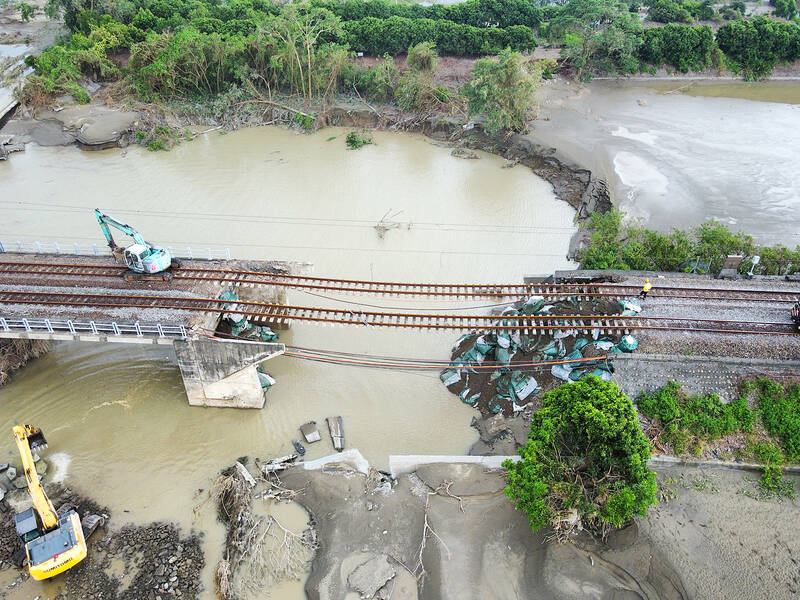
Photo courtesy of You Tzu-yuan
Farmers growing bananas, pears and guavas suffered the most, with estimated losses of NT$241.9 million, NT$84.6 million and NT$83.8 million respectively, the ministry added.
Fishery losses were mainly from damage to oysters, followed by milkfish and freshwater prawns, the ministry said.
Chickens accounted for majority of livestock losses at NT$214 million, followed by ducks, pigs and geese, it said.
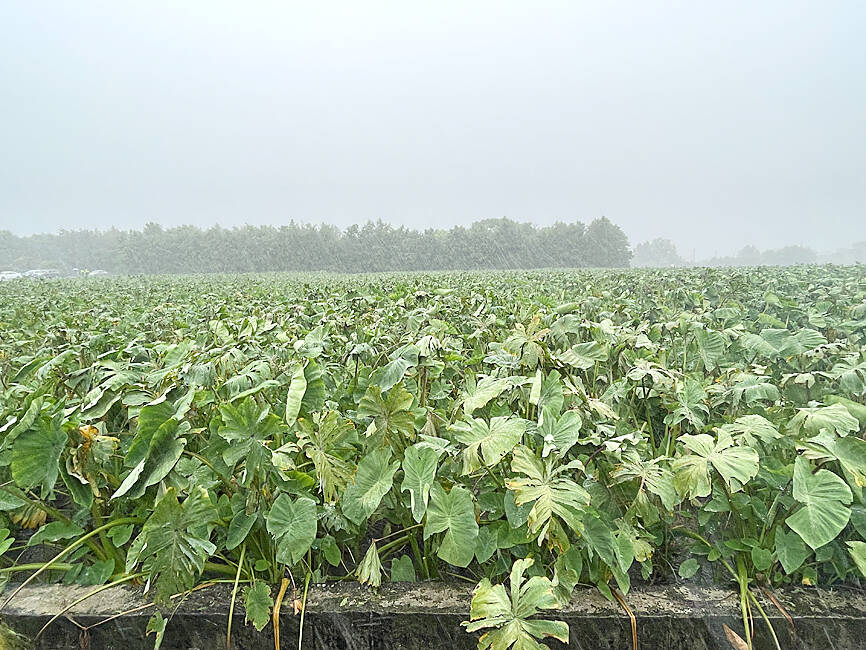
Photo: CNA
Typhoon Gaemi swept through Taiwan on Thursday and left 10 people dead, two missing and 895 injured as of Saturday, and caused widespread flooding across the country.
Meanwhile, the Coast Guard Administration (CGA) yesterday said that as of 8am yesterday, 59 people have been rescued from six of the eight cargo ships that ran aground in southern Taiwan due to Gaemi, while 29 people on two cargo ships are still waiting to be rescued, but are safe.
The cargo ships ran aground along Tainan, Kaohsiung and Pingtung County coastlines, the CGA’s Southern Branch said.

Photo from the Tainan Agricultural Bureau
Coast guards saved all eight crew members of cargo ship Basia, which ran aground 0.5 nautical miles (926m) southwest of Donggang Township (東港) in Pingtung County, during the latest rescue operation on Saturday evening, the CGA said.
Given improved weather conditions, one drone was dispatched on Saturday and two more were deployed yesterday to monitor the waters and shores around the cargo ships stranded along the coasts of Tainan and Kaohsiung for any drifting containers or oil spills, it said.
As for the Tanzania-registered cargo ship Fu Shun, which is believed to have sunk 16 nautical miles off Kaohsiung, the captain has been confirmed dead, four crew members have been rescued and four others remain missing, the CGA added.
The CGA said that the Fifth Maritime Patrol Flotilla received a report on Saturday evening about a body found near the Chung-yun Fishing Harbor in Kaohsiung’s Linyuan District (林園), but the retrieval operation has been delayed due to a large amount of driftwood surrounding the body, preventing personnel and vessels from approaching and confirming the deceased’s identity.
Separately, the Alishan Forest Railway, which resumed full operations earlier this month, is now to remain closed until the end of next month due to the impact of Typhoon Gaemi, the Alishan Forest Railway and Cultural Heritage Office said.
Eighty-nine locations along the railway line from Chiayi to Alishan stations were covered by fallen trees and landslide debris, it said.
The office said it would announce when services are to resume for Alishan railway’s three branch lines — Jhushan (祝山), Shenmu (神木) and Jhaoping (沼平) — at a later date.
People who have already purchased tickets can get a full refund at Alishan Forest Railway stations or at ibon-equipped 7-Eleven stores around the country within one year from the date of their ride, it said.
Travel agency Lion Travel Co said that scenic Formosensis and Vivid Express trains that run on the Alishan line have been suspended until the end of next month.
Passengers with tickets for next month are entitled to full refunds, the agency said, adding that prospective travelers can begin booking trips on the Formosensis train between October and December on Aug. 19.

Considering that most countries issue more than five denominations of banknotes, the central bank has decided to redesign all five denominations, the bank said as it prepares for the first major overhaul of the banknotes in more than 24 years. Central bank Governor Yang Chin-lung (楊金龍) is expected to report to the Legislative Yuan today on the bank’s operations and the redesign’s progress. The bank in a report sent to the legislature ahead of today’s meeting said it had commissioned a survey on the public’s preferences. Survey results showed that NT$100 and NT$1,000 banknotes are the most commonly used, while NT$200 and NT$2,000

The Centers for Disease Control (CDC) yesterday reported the first case of a new COVID-19 subvariant — BA.3.2 — in a 10-year-old Singaporean girl who had a fever upon arrival in Taiwan and tested positive for the disease. The girl left Taiwan on March 20 and the case did not have a direct impact on the local community, it said. The WHO added the BA.3.2 strain to its list of Variants Under Monitoring in December last year, but this was the first imported case of the COVID-19 variant in Taiwan, CDC Deputy Director-General Lin Ming-cheng (林明誠) said. The girl arrived in Taiwan on

South Korea is planning to revise its controversial electronic arrival card, a step Taiwanese officials said prompted them to hold off on planned retaliatory measures, a South Korean media report said yesterday. A Yonhap News Agency report said that the South Korean Ministry of Foreign Affairs is planning to remove the “previous departure place” and “next destination” fields from its e-arrival card system. The plan, reached after interagency consultations, is under review and aims to simplify entry procedures and align the electronic form with the paper version, a South Korean ministry official said. The fields — which appeared only on the electronic form

The Ministry of Foreign Affairs (MOFA) is suspending retaliation measures against South Korea that were set to take effect tomorrow, after Seoul said it is updating its e-arrival system, MOFA said today. The measures were to be a new round of retaliation after Taiwan on March 1 changed South Korea's designation on government-issued alien resident certificates held by South Korean nationals to "South Korea” from the "Republic of Korea," the country’s official name. The move came after months of protests to Seoul over its listing of Taiwan as "China (Taiwan)" in dropdown menus on its new online immigration entry system. MOFA last week


 RSS
RSS