


The US military is confident that it would win a war against China if a conflict broke out in the Taiwan Strait, US Joint Chiefs of Staff Chairman General Charles Q. Brown said at a forum on Saturday.
During an interview at the Aspen Security Forum in Aspen, Colorado, on Saturday, CNN reporter Jennifer Griffin asked Brown about the possible outcome of a US-China war in the Taiwan Strait.
“Can the US win a war against China if Beijing tries to take Taiwan, from your military perspective?” Griffin asked.
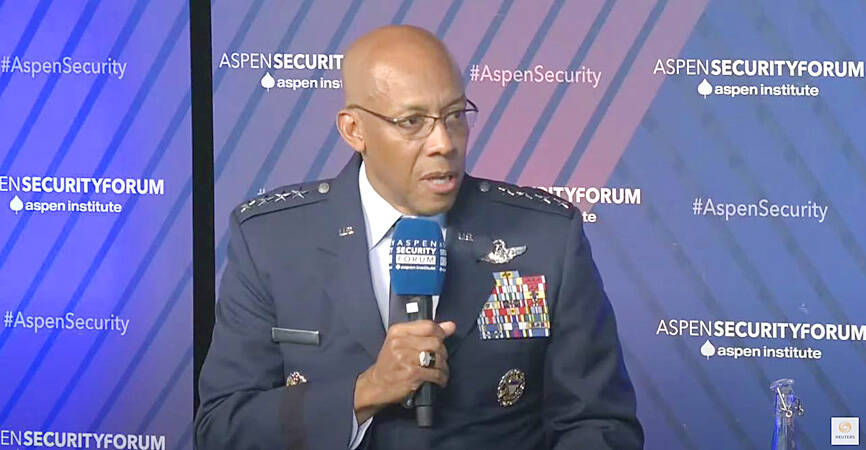
Photo: Screen grab from YouTube
“I’m fully confident in our forces. You should be too. We are the most lethal, most respected combat force in the world, and every nation I go to wants to be like us,” Brown said.
“We have to be an example. If we have a conflict with China, it has to be dealt with as a nation. If we are challenged by the PRC [People’s Republic of China], we will be there,” he said.
Commenting on how a US-China war would play out, he said it would be as brutal as World War II.
Brown said he believes that Chinese President Xi Jinping (習近平) is focused on the logistics of a potential invasion before sending troops across the Taiwan Strait.
Also speaking at the forum, US National Security Adviser Jake Sullivan said that war in the Taiwan Strait would be “calamitous for everyone,” and that it remained “of paramount importance to US policy” that peace and stability in the Strait be maintained.
Asked by a reporter whether the US should ramp up its military presence in the Indo-Pacific region, Sullivan said that the US had already been strengthening multinational partnerships with allies in the region.
Citing partnerships with Australia, the Philippines and Japan, Sullivan said that “the combination of these activities will have a material impact on the physical presence and distribution of force of the United States” in the region, “not to start a war, but to prevent a war.”
Separately, while speaking with US National Public Radio’s Louise Kelly during the forum, US Secretary of State Antony Blinken said a Taiwan crisis is a world crisis.
“If there were to be a crisis over Taiwan, it would be a crisis that affects quite literally everyone in the world, not just the immediate neighbors,” Blinken said.
The US was “impressing upon China the imperative of not having a crisis, not stirring the pot, not disturbing the status quo, preserving peace and stability,” he said. “The more you have that collective weight on China, I think, the more they’re likely to not lead us in that direction.”

Considering that most countries issue more than five denominations of banknotes, the central bank has decided to redesign all five denominations, the bank said as it prepares for the first major overhaul of the banknotes in more than 24 years. Central bank Governor Yang Chin-lung (楊金龍) is expected to report to the Legislative Yuan today on the bank’s operations and the redesign’s progress. The bank in a report sent to the legislature ahead of today’s meeting said it had commissioned a survey on the public’s preferences. Survey results showed that NT$100 and NT$1,000 banknotes are the most commonly used, while NT$200 and NT$2,000

The Centers for Disease Control (CDC) yesterday reported the first case of a new COVID-19 subvariant — BA.3.2 — in a 10-year-old Singaporean girl who had a fever upon arrival in Taiwan and tested positive for the disease. The girl left Taiwan on March 20 and the case did not have a direct impact on the local community, it said. The WHO added the BA.3.2 strain to its list of Variants Under Monitoring in December last year, but this was the first imported case of the COVID-19 variant in Taiwan, CDC Deputy Director-General Lin Ming-cheng (林明誠) said. The girl arrived in Taiwan on

South Korea is planning to revise its controversial electronic arrival card, a step Taiwanese officials said prompted them to hold off on planned retaliatory measures, a South Korean media report said yesterday. A Yonhap News Agency report said that the South Korean Ministry of Foreign Affairs is planning to remove the “previous departure place” and “next destination” fields from its e-arrival card system. The plan, reached after interagency consultations, is under review and aims to simplify entry procedures and align the electronic form with the paper version, a South Korean ministry official said. The fields — which appeared only on the electronic form

The Ministry of Foreign Affairs (MOFA) is suspending retaliation measures against South Korea that were set to take effect tomorrow, after Seoul said it is updating its e-arrival system, MOFA said today. The measures were to be a new round of retaliation after Taiwan on March 1 changed South Korea's designation on government-issued alien resident certificates held by South Korean nationals to "South Korea” from the "Republic of Korea," the country’s official name. The move came after months of protests to Seoul over its listing of Taiwan as "China (Taiwan)" in dropdown menus on its new online immigration entry system. MOFA last week


 RSS
RSS