


A Matsu (媽祖) temple in Tainan is threatening legal action against a shrine in the city that produced a poster proclaiming the marriage of the sea goddess to Guan Gong (關公), the deity of war and martial arts, and conducted a pilgrimage to unite two idols.
Luermen Tianho Temple (鹿耳門天后宮) in a statement on Tuesday said that it was not informed beforehand of the so-called marriage and pilgrimage carried out by the Wuxuan Shrine (武玄壇), a privately owned site in the city.
On June 9, the Wuxuan Shrine conducted the pilgrimage to Luermen Tianho Temple, transporting its own idols, which wore marriage paraphernalia.
The shrine’s actions had tarnished Luermen Tianho Temple’s reputation, the temple said, adding that it would demand a formal apology and reserved the right to pursue legal action.
In the pilgrimage, Guan Gong was said to have married a Matsu subordinate to the main one enshrined in Luermen Tianho Temple.
The shrine gave its Matsu the married name “Guan” in its promotional materials and placed red pom-poms on the chests of the deities inside the palanquin that carried them.
Luerhmen Tienho Temple staff initially blocked the pilgrimage, only acquiescing once decorations in the form of the Chinese character for marriage, 囍, were removed from the idols on the palaquin.
In an interview with TVBS, temple chair Lin Yu-shan (林玉山) asked whether the party from the shrine was trying to leverage the prestige of the Matsu temple, which was built in 1946.
While the marriage was considered a private matter within the shrine, it should not have been conducted without notice, Lin said, adding that “even Matsu would be shocked.”
There was also outrage online, with some comments expressing support for legal action, fearing that without it, “acts of vandalism or worse might be justified as the will of heaven.”
The Wuxuan Shrine initially insisted that the betrothal was blessed.
“Instructions from the deities are not subject to the opinions of critics online or the consent of the public,” it said on Sunday last week, urging the public to “maintain their own spiritual cultivation and avoid creating negative karma.”
However, the shrine closed its Facebook page and on Wednesday apologized for “bringing unnecessary trouble to Luermen Tianho Temple and causing a social disturbance.”
There was no “marriage” planned and the wording of the “internal campaign” was leaked due to inadequate control, leading to misunderstandings, it said in a statement.
“If there are further malicious attacks or verbal abuse against our legitimate religious beliefs, we will gather evidence and take appropriate legal action to uphold our freedom of religious belief,” it said.
Originating in China’s Fujian Province, Matsu was a shamaness believed to have special powers to protect fishers and seafarers.
Over the centuries, worship of Matsu spread. Belief in Matsu was brought to Taiwan by early Chinese settlers and is still widely held.
She came to be regarded as a benevolent protector of all, not just fishers and seafarers.
Guan Gong was a deified general from the Three Kingdoms period in China, and is remembered as one of the greatest military figures of Classical China, revered for his loyalty, righteousness and integrity.
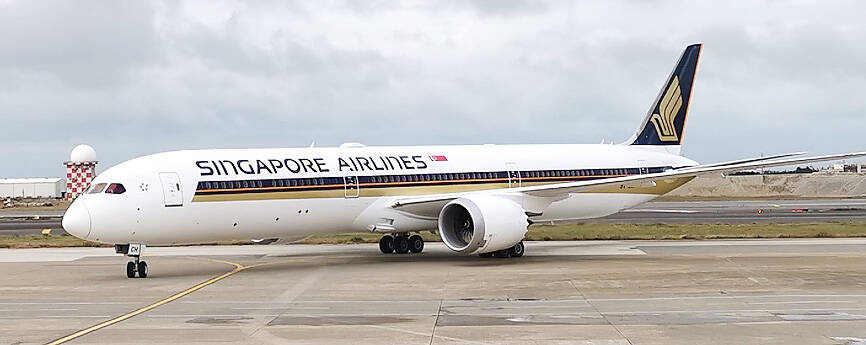
INCREASED CAPACITY: The flights on Mondays, Wednesdays, Fridays and Sundays would leave Singapore in the morning and Taipei in the afternoon Singapore Airlines is adding four supplementary flights to Taipei per week until May to meet increased tourist and business travel demand, the carrier said on Friday. The addition would raise the number of weekly flights it operates to Taipei to 18, Singapore Airlines Taiwan general manager Timothy Ouyang (歐陽漢源) said. The airline has recorded a steady rise in tourist and business travel to and from Taipei, and aims to provide more flexible travel arrangements for passengers, said Ouyang, who assumed the post in July last year. From now until Saturday next week, four additional flights would depart from Singapore on Monday, Wednesday, Friday
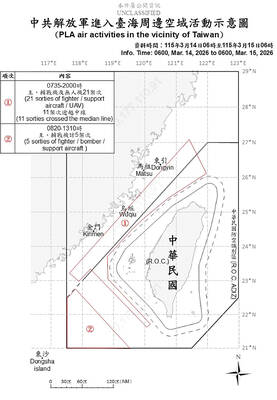
The Ministry of National Defense yesterday reported the return of large-scale Chinese air force activities after their unexplained absence for more than two weeks, which had prompted speculation regarding Beijing’s motives. China usually sends fighter jets, drones and other military aircraft around the nation on a daily basis. Interruptions to such routine are generally caused by bad weather. The Ministry of National Defense said it had detected 26 Chinese military aircraft in the Taiwan Strait over the previous 24 hours. It last reported that many aircraft on Feb. 25, when it spotted 30 aircraft, saying Beijing was carrying out another “joint combat

Taiwan successfully defended its women’s 540 kilogram title and won its first-ever men’s 640 kg title at the 2026 World Indoor Tug of War Championships in Taipei yesterday. In the women’s event, Taiwan’s eight-person squad reached the final following a round-robin preliminary round and semifinals featuring teams from Ukraine, Japan, Thailand, Vietnam, the Basque Country and South Korea. In the finals, they swept the Basque team 2-0, giving the team composed mainly of National Taiwan Normal University students and graduates its second championship in a row, and its fourth in five years. Team captain

When Paraguayan opposition lawmaker Leidy Galeano returned from an all-expenses-paid tour of six Chinese cities late last year, she was convinced Paraguay risked missing out on major economic gains by sticking with longtime ally Taipei over Beijing — a message that participants on the trip heard repeatedly from Chinese officials. “Everything I saw there, I wanted for my country,” said Galeano, a member of the newly-formed Yo Creo party whose senior figures have spoken favorably about China. This trip and others like it — which people familiar with the visits said were at the invitation of the Chinese consulate in Sao Paulo


 RSS
RSS