


Taipei Mayor Chiang Wan-an (蔣萬安) yesterday said the City’s Department of Government Ethics is looking into two land development cases approved under former Taipei mayor Ko Wen-je’s (柯文哲) administration, as city councilors have raised speculation about Ko allegedly allowing some companies to profit.
The Liberty Times (sister paper of the Taipei Times) yesterday reported that the Ko administration had allowed the floor area ratio of Core Pacific City Co (京華城), a shopping mall in Songshan District (松山), to increase from 392 percent to 840 percent.
Core Pacific Group (威京集團) was suspected of profiting from the increased floor area ration, it said.
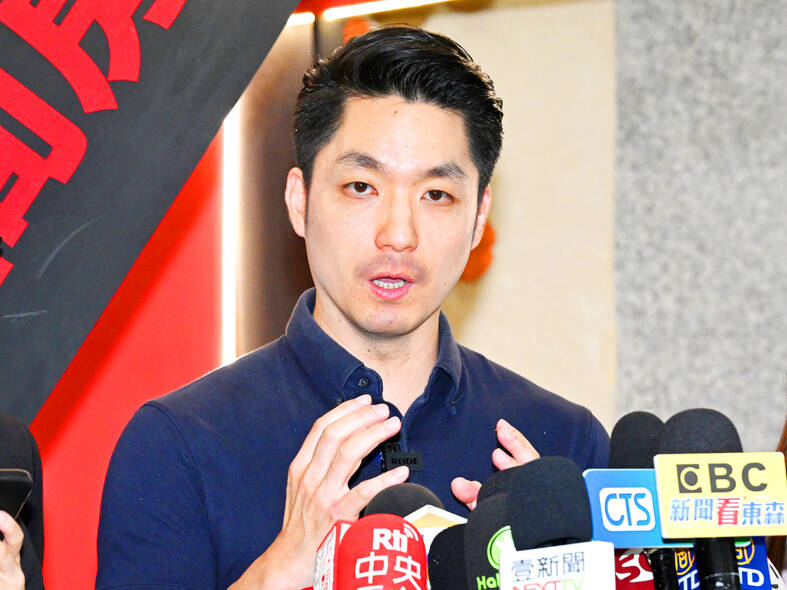
Photo: Liao Chen-huei, Taipei Times
It also reported that the Ko administration in 2021 had allowed Shin Kong Life Insurance Co (新光人壽) to win the bid for a 50-year surface rights to plot T17 and T18 in the Beitou Shilin Science Park (北投士林科技園區) without needing an investment plan.
As the Taiwan People’s Party (TPP), of which Ko is founder and chairperson, allowed former Shin Kong Life Insurance Co vice president Cynthia Wu (吳欣盈), who is the granddaughter of Shin Kong Group founder Wu Ho-su (吳火獅), to fill a legislative seat vacancy the following year, the Ko administration was suspected of aiding the company, it said.
Democratic Progressive Party and the Chinese Nationalist Party (KMT) city councilors have been gathering signatures to propose the establishment of a special investigation team to look into the cases, and they plan to propose it on Wednesday, the report said.
Chiang said the Department of Government Ethics has already begun investigating the two cases, and the city government would “do whatever is necessary” if problems are uncovered.
“We will not treat them wrongly, if they are innocent, nor let them off easily if they are not,” he said.
Meanwhile, the TPP Taipei City Council caucus yesterday issued a news release saying the party holds a rational, scientific and practical attitude in facing and solving problems, so it supports the city council forming an investigation team to transparently look into the cases.
It said the city government should publicize all related meeting minutes and have specialists and academics review them, along with another case involving Taiwan Intelligent Fiber Optic Network Consortium (TAIFO, 台灣智慧光網).

Considering that most countries issue more than five denominations of banknotes, the central bank has decided to redesign all five denominations, the bank said as it prepares for the first major overhaul of the banknotes in more than 24 years. Central bank Governor Yang Chin-lung (楊金龍) is expected to report to the Legislative Yuan today on the bank’s operations and the redesign’s progress. The bank in a report sent to the legislature ahead of today’s meeting said it had commissioned a survey on the public’s preferences. Survey results showed that NT$100 and NT$1,000 banknotes are the most commonly used, while NT$200 and NT$2,000

The Centers for Disease Control (CDC) yesterday reported the first case of a new COVID-19 subvariant — BA.3.2 — in a 10-year-old Singaporean girl who had a fever upon arrival in Taiwan and tested positive for the disease. The girl left Taiwan on March 20 and the case did not have a direct impact on the local community, it said. The WHO added the BA.3.2 strain to its list of Variants Under Monitoring in December last year, but this was the first imported case of the COVID-19 variant in Taiwan, CDC Deputy Director-General Lin Ming-cheng (林明誠) said. The girl arrived in Taiwan on

South Korea is planning to revise its controversial electronic arrival card, a step Taiwanese officials said prompted them to hold off on planned retaliatory measures, a South Korean media report said yesterday. A Yonhap News Agency report said that the South Korean Ministry of Foreign Affairs is planning to remove the “previous departure place” and “next destination” fields from its e-arrival card system. The plan, reached after interagency consultations, is under review and aims to simplify entry procedures and align the electronic form with the paper version, a South Korean ministry official said. The fields — which appeared only on the electronic form

The Ministry of Foreign Affairs (MOFA) is suspending retaliation measures against South Korea that were set to take effect tomorrow, after Seoul said it is updating its e-arrival system, MOFA said today. The measures were to be a new round of retaliation after Taiwan on March 1 changed South Korea's designation on government-issued alien resident certificates held by South Korean nationals to "South Korea” from the "Republic of Korea," the country’s official name. The move came after months of protests to Seoul over its listing of Taiwan as "China (Taiwan)" in dropdown menus on its new online immigration entry system. MOFA last week


 RSS
RSS