


National Taiwan University (NTU) on Friday inaugurated the Yu Ying-shih (余英時) International Sinology Research Center dedicated to international Sinological research.
NTU and Academia Sinica are to collaborate to make Taiwan an essential center of research for international Sinology, NTU president Chen Wen-chang (陳文章) said at a ceremony marking the inauguration.
Thin Chang Corp president Teng Chuang-hsin (鄧傳馨), one of the center’s major donors, said he was honored to be part of the effort that brought the center to life.
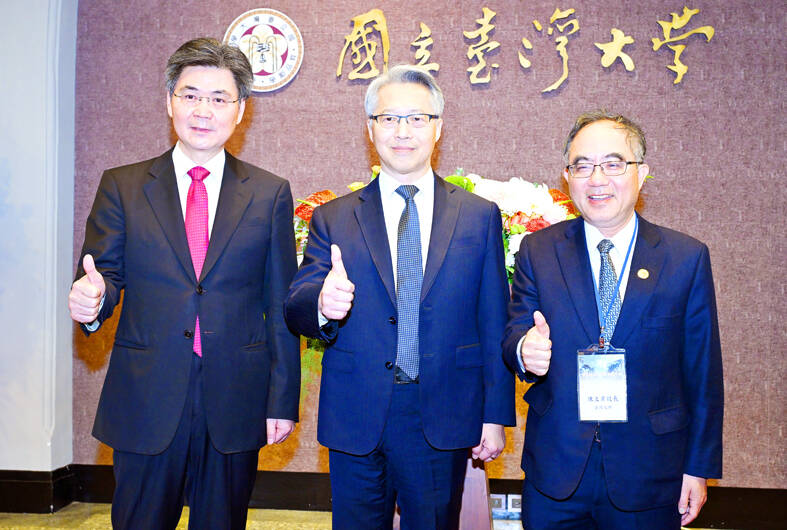
Photo: Liao Chen-huei, Taipei Times
He also urged NTU and Academia Sinica to collaborate closely with other academics in Asia to make the center renowned internationally.
He said he hoped that a decade from now, at least 40 of the top 100 renowned Sinologists would have visited the center.
Academia Sinica president James Liao (廖俊智) said that Academia Sinica and NTU are renowned centers for Sinology research and that Academia Sinica had always supported the founding of such a center.
Liao said he had the honor of meeting Yu in 2019, on the verge of the centennial anniversary of the May Fourth Movement, which made him realize that a historian’s perspective of an incident should always be focused on the underlying significance.
Liao said that the center would undoubtedly take up the mantle of Yu’s teachings and, under the leadership of the center director and NTU Department of History professor Chen Jo-shui (陳弱水), would take the lead in Sinology research worldwide.
Academia Sinica vice president Huang Chin-shing (黃進興), having learned from Yu personally, said Yu was against the idolization of individuals, and it was significant that Sinology has taken root in and seen further development in a democratic Taiwan.
Yu (1930-2021) was professor emeritus at Princeton University, an academician at Academia Sinica and was a recipient of the prestigious Kluge and Tang prizes. He was a lifelong supporter of democracy and liberty.
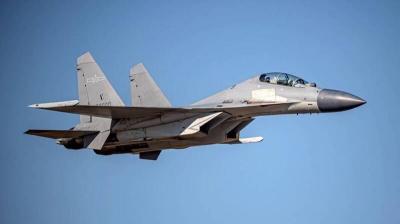
Eight Chinese naval vessels and 24 military aircraft were detected crossing the median line of the Taiwan Strait between 6am yesterday and 6am today, the Ministry of National Defense said this morning. The aircraft entered Taiwan’s northern, central, southwestern and eastern air defense identification zones, the ministry said. The armed forces responded with mission aircraft, naval vessels and shore-based missile systems to closely monitor the situation, it added. Eight naval vessels, one official ship and 36 aircraft sorties were spotted in total, the ministry said.
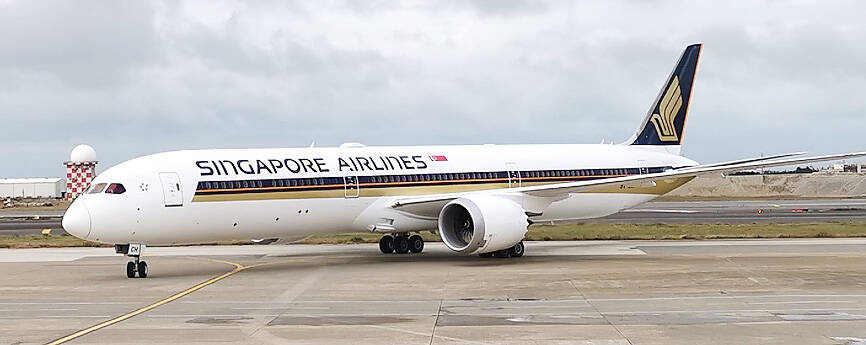
INCREASED CAPACITY: The flights on Mondays, Wednesdays, Fridays and Sundays would leave Singapore in the morning and Taipei in the afternoon Singapore Airlines is adding four supplementary flights to Taipei per week until May to meet increased tourist and business travel demand, the carrier said on Friday. The addition would raise the number of weekly flights it operates to Taipei to 18, Singapore Airlines Taiwan general manager Timothy Ouyang (歐陽漢源) said. The airline has recorded a steady rise in tourist and business travel to and from Taipei, and aims to provide more flexible travel arrangements for passengers, said Ouyang, who assumed the post in July last year. From now until Saturday next week, four additional flights would depart from Singapore on Monday, Wednesday, Friday
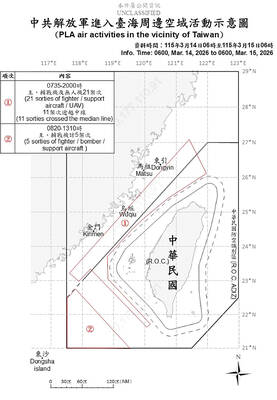
The Ministry of National Defense yesterday reported the return of large-scale Chinese air force activities after their unexplained absence for more than two weeks, which had prompted speculation regarding Beijing’s motives. China usually sends fighter jets, drones and other military aircraft around the nation on a daily basis. Interruptions to such routine are generally caused by bad weather. The Ministry of National Defense said it had detected 26 Chinese military aircraft in the Taiwan Strait over the previous 24 hours. It last reported that many aircraft on Feb. 25, when it spotted 30 aircraft, saying Beijing was carrying out another “joint combat
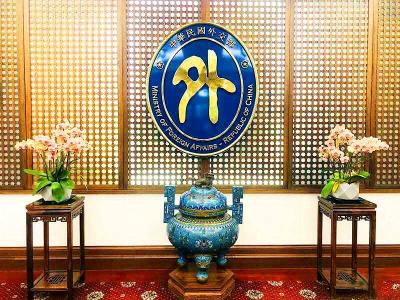
The Ministry of Foreign Affairs (MOFA) today said that if South Korea does not reply appropriately to its request to correct Taiwan’s name on its e-Arrival card system before March 31, it would take corresponding measures to alter how South Korea is labeled on the online Taiwan Arrival Card system. South Korea’s e-Arrival card system lists Taiwan as “China (Taiwan)” in the “point of departure” and “next destination” fields. The ministry said that it changed the nationality for South Koreans on Taiwan’s Alien Resident Certificates from “Korea” to “South Korea” on March 1, in a gesture of goodwill and based on the


 RSS
RSS