


The military is to hold combat readiness drills involving the air force, navy and army this month in the wake of China stepping up military activities around Taiwan, a military source said on Tuesday.
After a six-year hiatus, the army is to conduct a one-week force-on-force training exercise in central Taiwan starting on Monday to strengthen live-fire training for combined armed brigades, the source said.
The drill, which would simulate confrontation scenarios in central areas of the country, is to be be carried out by the army’s 269th Mechanized Infantry Brigade in northern Taiwan and the Republic of China (ROC) Marine Corps’ 99th Brigade in the south, with the 10th Army Corps Command presiding over the exercise, the source added.
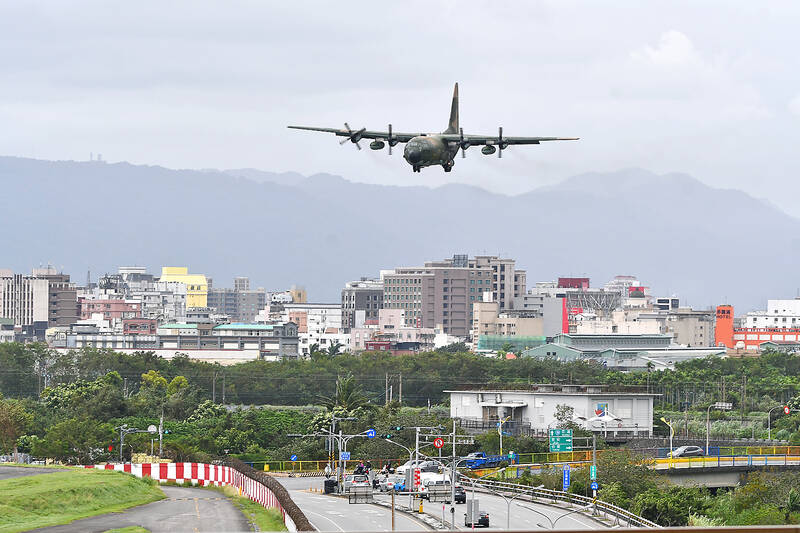
Photo: Yu Tai-lang, Taipei Times
The air force’s annual Tien Lung (“Sky Dragon”) drills are scheduled to start on Oct. 30 to test the air force’s air-to-air, air-to-sea and air-to-ground combat skills.
In addition, the navy’s annual drills started on Monday and would run until tomorrow, the source said.
The military drills are being staged amid rising cross-Taiwan Strait tensions and routine incursions by the Chinese People’s Liberation Army warplanes into Taiwan’s air defense identification zone (ADIZ).
The ADIZ is a self-defined area in which the country states it has the right to identify, locate and control approaching foreign aircraft, but is not part of territorial airspace as defined by international law.
China also frequently sailed military vessels near Taiwan, including many that crossed the median line of the Taiwan Strait and entered the country’s southwestern ADIZ.
Meanwhile, The military yesterday held a landing exercise at Cisingtan (七星潭) in Hualien County, listing the beach as a potential landing site for an amphibious operation for the first time since 1989.
Cisingtan has been named as one of nearly 20 “red beaches,” or potential landing sites for the Chinese military, but it is considered a difficult landing site due to its terrain, requiring study to identify potential landing paths and defense strategies.

Taiwanese paleontologists have discovered fossil evidence that pythons up to 4m long inhabited Taiwan during the Pleistocene epoch, reporting their findings in the international scientific journal Historical Biology. National Taiwan University (NTU) Institute of Ecology and Evolutionary Biology associate professor Tsai Cheng-hsiu (蔡政修) led the team that discovered the largest snake fossil ever found in Taiwan. The single trunk vertebra was discovered in Tainan at the Chiting Formation, dated to between 400,000 and 800,000 years ago in the Middle Pleistocene, the paper said. The area also produced Taiwan’s first avian fossil, as well as crocodile, mammoth, saber-toothed cat and rhinoceros fossils, it said. Discoveries

Taiwanese paleontologists have discovered fossil evidence that pythons up to 4m long inhabited Taiwan during the Pleistocene epoch, reporting their findings in the international scientific journal Historical Biology. National Taiwan University (NTU) Institute of Ecology and Evolutionary Biology associate professor Tsai Cheng-hsiu (蔡政修) led the team that discovered the largest snake fossil ever found in Taiwan. A single trunk vertebra was discovered in Tainan at the Chiting Formation, dated to between 800,000 to 400,000 years ago in the Middle Pleistocene, the paper said. The area also produced Taiwan’s first avian fossil, as well as crocodile, mammoth, sabre-toothed cat and rhinoceros fossils, it said. Discoveries

Whether Japan would help defend Taiwan in case of a cross-strait conflict would depend on the US and the extent to which Japan would be allowed to act under the US-Japan Security Treaty, former Japanese minister of defense Satoshi Morimoto said. As China has not given up on the idea of invading Taiwan by force, to what extent Japan could support US military action would hinge on Washington’s intention and its negotiation with Tokyo, Morimoto said in an interview with the Liberty Times (sister paper of the Taipei Times) yesterday. There has to be sufficient mutual recognition of how Japan could provide
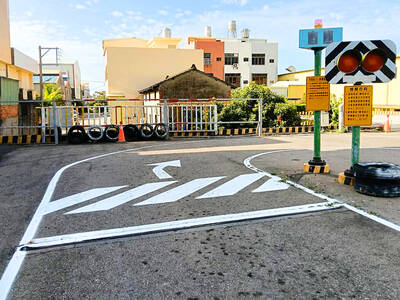
UPDATED TEST: The new rules aim to assess drivers’ awareness of risky behaviors and how they respond under certain circumstances, the Highway Bureau said Driver’s license applicants who fail to yield to pedestrians at intersections or to check blind spots, or omit pointing-and-calling procedures would fail the driving test, the Highway Bureau said yesterday. The change is set to be implemented at the end of the month, and is part of the bureau’s reform of the driving portion of the test, which has been criticized for failing to assess whether drivers can operate vehicles safely. Sedan drivers would be tested regarding yielding to pedestrians and turning their heads to check blind spots, while drivers of large vehicles would be tested on their familiarity with pointing-and-calling


 RSS
RSS