


A narrow majority of Americans would support committing US troops to defend Taiwan if China were to invade, a survey said on Wednesday.
The study by the Eurasia Group Foundation found that 42 percent of Americans would “somewhat support intervention” to support Taiwan and another 18 percent would “strongly” back intervention.
US President Joe Biden has publicly said he would back sending US forces to defend Taiwan, despite the official US position of ambiguity.
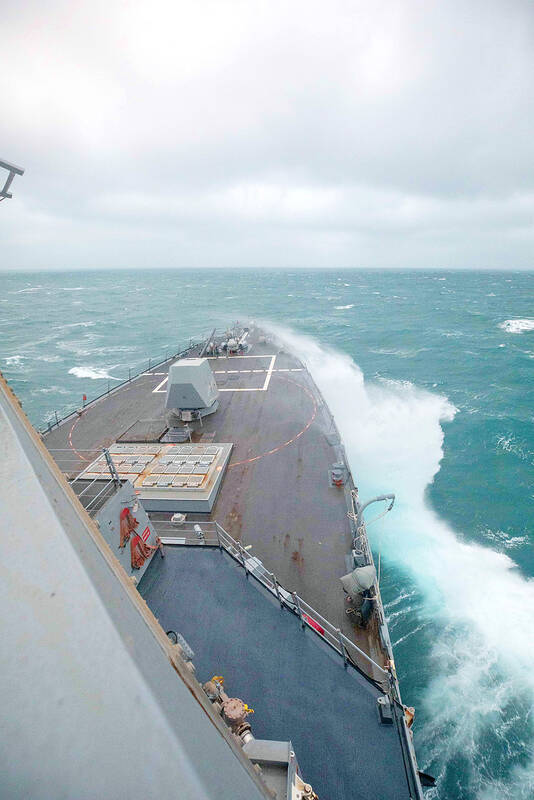
Photo: EPA
Mark Hannah, a senior fellow at the Eurasia Group Foundation, said that support for intervention in Taiwan could be linked in part to the negative image in the US of China, which has faced wide criticism on issues from trade to human rights.
“China is perceived as a bad actor and there could be a rally-around-the-flag effect if they invaded an island that is democratic and has been a long-term partner of the United States,” he said.
The survey took responses from 1,000 US adults from Aug. 28 to Sept. 6.
It found broad support for Taiwan, but Republicans were most likely to back intervention strongly.
Support was flipped on Ukraine, with backers of Biden’s Democratic Party most enthusiastic about the robust US support for Ukraine, which has been criticized by Republican former US president Donald Trump.
However, in one area that did not entirely mirror political statements, a bipartisan majority of 77 percent said they supported diplomacy with Iran to prevent it from obtaining a nuclear weapon.
The question did not specifically mention a 2015 nuclear deal with Iran which was negotiated by former US president Barack Obama and trashed by Trump.
A full 67 percent of Americans also said they backed direct negotiations with US adversaries “even if they are human rights abusers, dictators or home to terrorist organizations.”
The survey was taken before a bloody weekend assault on Israel by Islamic movement Hamas, which has support from Iran’s clerical leaders.
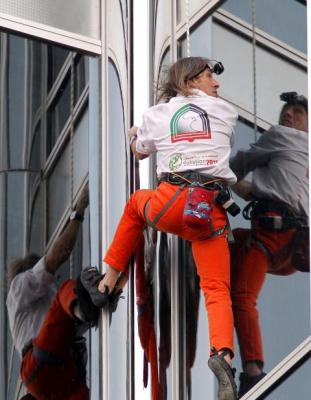
Alain Robert, known as the "French Spider-Man," praised Alex Honnold as exceptionally well-prepared after the US climber completed a free solo ascent of Taipei 101 yesterday. Robert said Honnold's ascent of the 508m-tall skyscraper in just more than one-and-a-half hours without using safety ropes or equipment was a remarkable achievement. "This is my life," he said in an interview conducted in French, adding that he liked the feeling of being "on the edge of danger." The 63-year-old Frenchman climbed Taipei 101 using ropes in December 2004, taking about four hours to reach the top. On a one-to-10 scale of difficulty, Robert said Taipei 101

Nipah virus infection is to be officially listed as a category 5 notifiable infectious disease in Taiwan in March, while clinical treatment guidelines are being formulated, the Centers for Disease Control (CDC) said yesterday. With Nipah infections being reported in other countries and considering its relatively high fatality rate, the centers on Jan. 16 announced that it would be listed as a notifiable infectious disease to bolster the nation’s systematic early warning system and increase public awareness, the CDC said. Bangladesh reported four fatal cases last year in separate districts, with three linked to raw date palm sap consumption, CDC Epidemic Intelligence
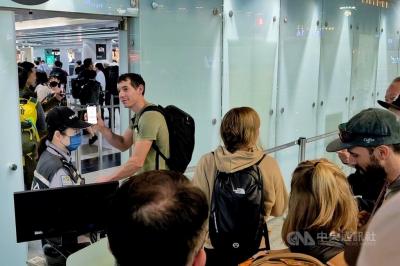
US climber Alex Honnold left Taiwan this morning a day after completing a free-solo ascent of Taipei 101, a feat that drew cheers from onlookers and gained widespread international attention. Honnold yesterday scaled the 101-story skyscraper without a rope or safety harness. The climb — the highest urban free-solo ascent ever attempted — took just more than 90 minutes and was streamed live on Netflix. It was covered by major international news outlets including CNN, the New York Times, the Guardian and the Wall Street Journal. As Honnold prepared to leave Taiwan today, he attracted a crowd when he and his wife, Sanni,
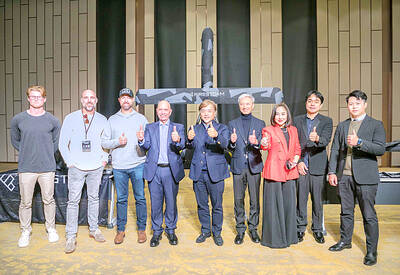
Taiwanese and US defense groups are collaborating to introduce deployable, semi-autonomous manufacturing systems for drones and components in a boost to the nation’s supply chain resilience. Taiwan’s G-Tech Optroelectronics Corp subsidiary GTOC and the US’ Aerkomm Inc on Friday announced an agreement with fellow US-based Firestorm Lab to adopt the latter’s xCell, a technology featuring 3D printers fitted in 6.1m container units. The systems enable aerial platforms and parts to be produced in high volumes from dispersed nodes capable of rapid redeployment, to minimize the risk of enemy strikes and to meet field requirements, they said. Firestorm chief technology officer Ian Muceus said


 RSS
RSS