


The Chinese Nationalist Party’s (KMT) presidential candidate, New Taipei City Mayor Hou You-yi (侯友宜), yesterday pledged to protect Taiwan’s freedom and democracy amid “geopolitical” tensions.
At the KMT’s headquarters in Taipei, where dozens of the party’s executives and local government leaders rallied to show support, Hou vowed to adhere to the Constitution and preserve Taiwan’s free and democratic way of life.
Hou said the country must take into account increasing “global geopolitical pressure” and “full-fledged competition between strong powers.”
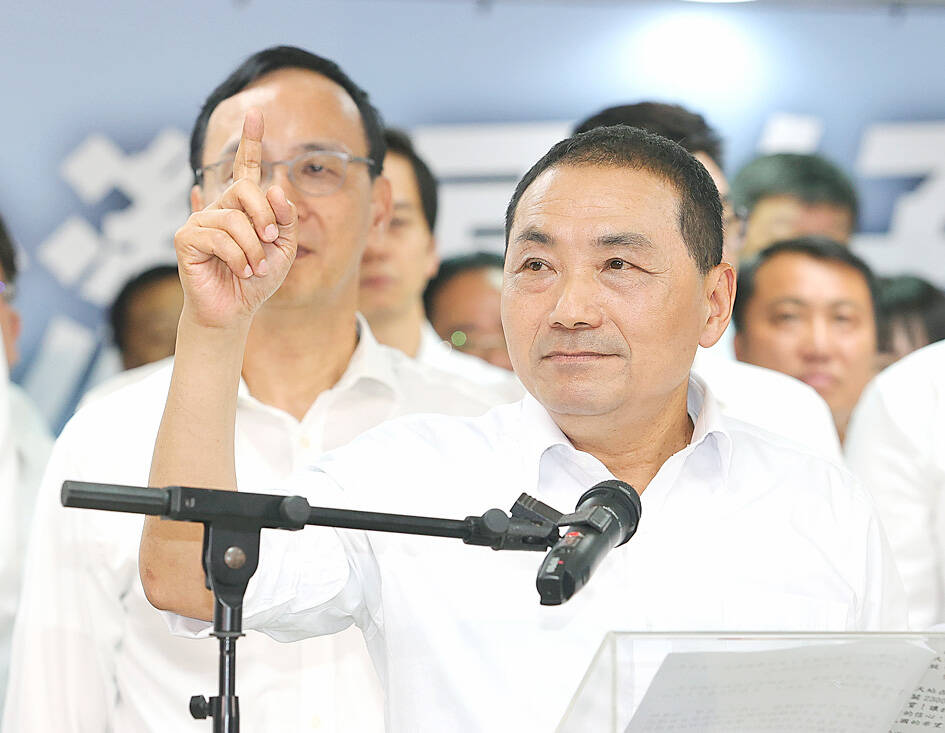
Photo: CNA
“In the face of all kinds of threats, [Taiwan] must upgrade” and make “the others” incapable of waging a war, the 65-year-old said, without mentioning China.
“Even more important is that we need to engage in dialogue and exchanges in order to navigate our way toward maintaining the stability of the region,” he added.
Trained as a police officer, Hou served as National Police Agency chief and head of Central Police University before entering politics.
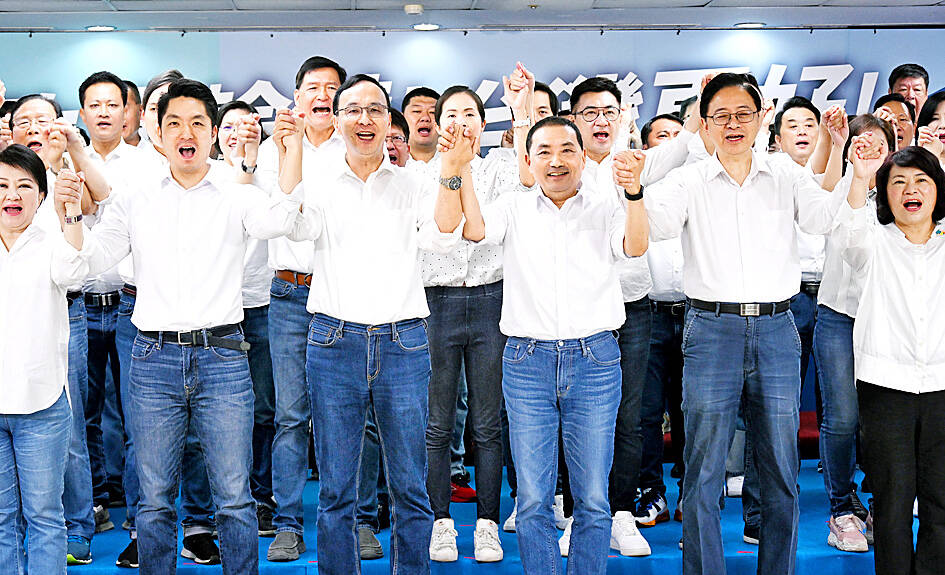
Photo: Fang Pin-chao, Taipei Times
In 2010, Hou was picked by then-New Taipei City mayor Eric Chu (朱立倫), who now chairs the KMT, to serve as one of his deputies.
Hou won the New Taipei City mayoral seat in 2018 and again last year, defeating Democratic Progressive Party (DPP) candidates with wide margins, making him a preferred KMT candidate for the country’s top job as the party seeks to return to power.
He secured the party’s presidential candidacy on Wednesday without going through a primary, despite being up against Hon Hai Precision Industry Co founder Terry Gou (郭台銘), who also sought the KMT’s nomination.
Gou, who has pledged his support for Hou after being forced out, did not attend yesterday’s event at the KMT headquarters.
Hou yesterday said that Vice President William Lai (賴清德), who is running as the DPP’s presidential candidate in next year’s election, was “dividing” Taiwanese and “tearing apart” the nation.
Lai is expected to continue President Tsai Ing-wen’s (蔡英文) cross-strait policy if he is elected president in January next year.
Hou denied Lai’s claims that next year’s presidential race would be a fight between democracy and autocracy, saying that “democracy and freedom have been in the DNA of Taiwanese.”
“Freedom and democracy have taken root in Taiwan for the past four decades,” he said, adding that the election would be a vote between unity or division, and peace or war.
If elected, Hou said that he would “accept monitoring by all people” in Taiwan, and would report on the state of the nation at the legislature.
The Additional Articles of the Constitution (憲法增修條文) stipulate that the legislature “may hear a report on the state of the nation by the president” when it convenes each year. Such practice requires approval from lawmakers.
Over the past two decades, no incumbent president has given a report at the legislature because of opposition from either the ruling or opposition parties.

FUKUOKA SITUATION: Japanese media reported that the pathogen is expected to be identified by the summer, while the CDC downplayed the idea that it was hMPV A “mysterious cold-like illness” reported in Japan’s Fukuoka Prefecture does not seem to be a new disease, but Japanese authorities have been asked about the situation, the Centers for Disease Control (CDC) said yesterday. The Fukuoka Prefectural Medical Association on Wednesday told a news conference that a “mystery cold” that has become a hot topic on social media is “highly likely to be caused by some kind of viral infection,” Japan’s KBC News reported. “Many people are experiencing symptoms starting with a sore throat, followed by a runny nose, phlegm and a severe cough,” KBC News reported, citing association officials. Health authorities are

Nvidia Corp CEO Jensen Huang (黃仁勳) arrived in Taiwan yesterday ahead of upcoming AI and technology events, saying he plans to meet with clients and Taiwan Semiconductor Manufacturing Co Chairman C.C. Wei (魏哲家) during his visit. After landing at Taipei Songshan Airport, Huang posed for photos with fans and handed out Yakult drinks to reporters and supporters waiting at the scene, saying he has “a lot to do” during the trip. Asked about reports that Nvidia’s planned headquarters site in Taipei’s Beitou Shilin Technology Park could break ground on May 27, Huang said that if the company holds an event, he would

The Ministry of Finance this afternoon announced the winning numbers for the March-April uniform invoice lottery. The winning number for the NT$10 million (US$318,060) special prize is 19531471, and the winning number for the NT$2 million grand prize is 85941329. Three numbers were drawn for the NT$200,000 first prize: 07225810, 20231230 and 83518781. Those with receipts matching the last seven digits of any of the first-prize numbers will win the NT$40,000 second prize, while those matching the last six digits will win the NT$10,000 third prize. Those whose receipts match the last five digits of the first-prize numbers can claim the NT$4,000 fourth prize,
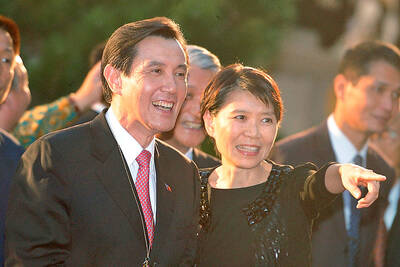
Former president Ma Ying-jeou (馬英九) yesterday expressed “shock and regret” over a statement issued by his wife without his consent, and rejected her assertion that his eldest sister, Ma Yi-nan (馬以南), would manage his medical care or act as his spokesperson amid an ongoing embezzlement probe into his foundation. Ma Ying-jeou in a statement said he was shocked by a statement by his wife, Chou Mei-ching (周美青), regarding his affairs. Ma Yi-nan “must not” be in charge of his healthcare and other personal affairs, nor can she be allowed to represent the Ma family, the former president said. He said he was also


 RSS
RSS