


Inbound travelers who need to change locations for the four-day self-disease prevention period following their three-day quarantine must apply with their local government, the Central Epidemic Command Center (CECC) said yesterday.
The “one person per household” principle would remain in place under the new “3+4” quarantine policy, which was implemented yesterday, the center said.
More than 4,500 incoming travelers were expected yesterday, including more than 980 people who entered Taiwan in the early morning, said Centers for Disease Control Deputy Director-General Philip Lo (羅一鈞), the CECC’s acting spokesman and medical response division deputy head.
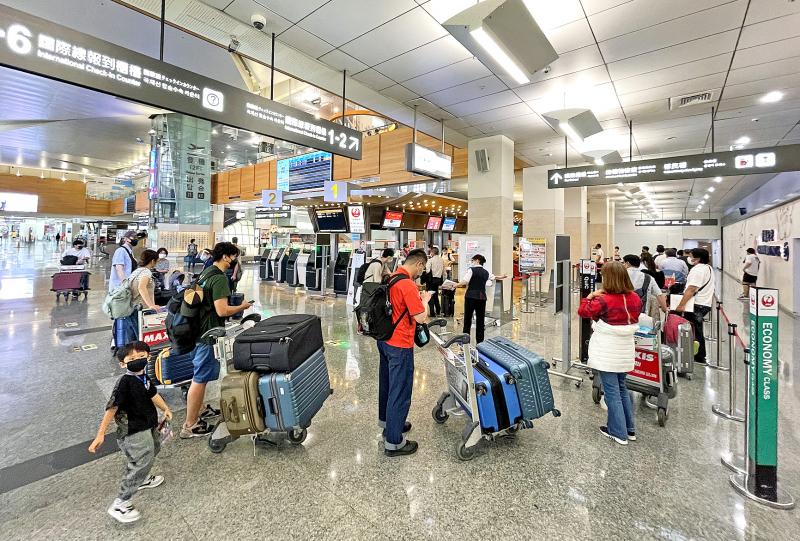
Photo: CNA
Lo said many people had asked the CECC whether family members can return to the quarantine location to live with the traveler during their four-day self-disease prevention period.
That would not be allowed, Lo said, adding that new variants of SARS-CoV-2 pose too great of a risk to local communities.
Infected travelers might still be in the incubation period during the self-disease prevention period, so those quarantining at home are required to conform to the “one person per household” rule, he said.
Another newly implemented rule is that travelers can be picked up by friends or family members at the airport and take a private vehicle to their quarantine location, he said.
Those travelers should tick the “pick up by family’s or friends’ or facilities’ vehicle” box in the Quarantine System for Entry form and take personal protective measures in the private vehicle, Lo said.
Many people have also asked whether travelers can change locations between their quarantine and self-disease prevention periods, he said.
This would be possible as long as they conform to the “one person per household” principle and apply with the local government, he said.
The CECC advises travelers to stay in the same location throughout the seven days, but if they need to change locations, they should apply with the local government at their intended self-disease prevention location, Lo said.
They would have to sign a form and can only change location once, he said.
“Necessary outings” that are allowed during self-disease prevention include going to work, buying daily necessities, making visits, giving lectures and attending meetings based on contractual obligations, Lo said.
People must wear a mask at all times during those outings, practice social distancing, and avoid crowded spaces and direct contact with strangers, he said.
If a traveler who is staying at a quarantine hotel for self-disease prevention does not return during the night or has gone missing, the hotel is required to file a report with the local government the next morning, he said.
Those who breach self-disease prevention rules might face penalties based on the Communicable Disease Control Act (傳染病防治法), he said.

SPACE VETERAN: Kjell N. Lindgren, who helps lead NASA’s human spaceflight missions, has been on two expeditions on the ISS and has spent 311 days in space Taiwan-born US astronaut Kjell N. Lindgren is to visit Taiwan to promote technological partnerships through one of the programs organized by the US for its 250th national anniversary. Lindgren would be in Taiwan from Tuesday to Saturday next week as part of the US Bureau of Educational and Cultural Affairs’ US Speaker Program, organized to celebrate the 250th anniversary of the signing of the Declaration of Independence, the American Institute in Taiwan (AIT) said in a statement yesterday. Lindgren plans to engage with key leaders across the nation “to advance cutting-edge technological partnerships and inspire the next generation of scientists and engineers,”

UNREASONABLE SURVEILLANCE: A camera targeted on an road by a neighbor captured a man’s habitual unsignaled turn into home, netting him dozens of tickets The Taichung High Administrative Court has canceled all 45 tickets given to a man for failing to use a turn signal while driving, as it considered long-term surveillance of his privacy more problematic than the traffic violations. The man, surnamed Tseng (曾), lives in Changhua County and was reported 45 times within a month for failing to signal while driving when he turned into the alley where his residence is. The reports were filed by his neighbor, who set up security cameras that constantly monitored not only the alley but also the door and yard of Tseng’s house. The surveillance occurred from July

A Japan Self-Defense Forces vessel entered the Taiwan Strait yesterday, Japanese media reported. After passing through the Taiwan Strait, the Ikazuchi was to proceed to the South China Sea to take part in a joint military exercise with the US and the Philippines, the reports said. Japan Self-Defense Force vessels were first reported to have passed through the strait in September, 2024, with two further transits taking place in February and June last year, the Asahi Shimbun reported. Yesterday’s transit also marked the first time since Japanese Prime Minister Sanae Takaichi took office that a Japanese warship has been sent through the Taiwan

‘SAME OLD TRICK’: Even if Beijing resumes individual travel to Taiwan, it would only benefit Chinese tourism companies, the Economic Democracy Union convener said China’s 10 new “incentives” are “sugar-coated poison,” an official said yesterday, adding that Taiwanese businesses see them clearly for what they are, but that Beijing would inevitably find some local collaborators to try to drums up support. The official, speaking on condition of anonymity, made the remark ahead of a news conference the General Chamber of Commerce is to hold today. The event, titled “Industry Perspectives on China’s Recent Pro-Taiwan Policies,” is expected to include representatives from industry associations — such as those in travel, hotels, food and agriculture — to request the government cooperate with China’s new measures, people familiar with


 RSS
RSS