


The National Communications Commission (NCC) yesterday approved Mirror Media’s application to establish Mirror News (鏡電視) after reviewing the case for more than two years, provided it strictly follows 26 obligations and conditions set by the commission.
It is the first TV news license that the broadcast media regulator has issued in nearly 10 years.
Mirror Media said in a statement that it welcomed the decision and respects the conditions set by the NCC, as it aims to produce quality and diverse news content as stated in its business plan.

Photo: CNA
NCC Vice Chairman and spokesman Wong Po-tsung (翁柏宗) said that the approval came with 12 attached obligations and 14 conditions under which the commission’s ruling could be invalidated.
In addition, the commission listed 16 other items as “administrative guidance” to be implemented to oversee the operation of Mirror News, he said.
A majority of the obligations and conditions are already stated in Mirror News’ business plan, Department of Broadcasting and Content Affairs Director-General Huang Wen-che (黃文哲) said.
“NCC commissioners added only two other conditions: First, the news channel must not accept direct or indirect instructions, investments or sponsorships from any foreign influence against Taiwan, as stipulated in the Anti-Infiltration Act (反滲透法). Second, any interactions that the news channel would have with the Chinese government and its people should be within boundaries set by the Act Governing Relations Between the People of the Taiwan Area and the Mainland Area (台灣地區與大陸地區人民關係條例),” Huang said.
According to the commission’s ruling, the news channel pledged to maintain a clear separation between the ownership and management, and follow journalism guidelines in producing quality and diverse news quality.
It also pledged to increase the number of staff in the news department to at least 450 within three months after the channel starts broadcasting on cable. It further promised not to share the use of personnel with other media outlets in the Mirror Media group.
Mirror TV is also committed to airing daily one hour of art and entertainment news and two hours of Taiwanese-language news. It is to broadcast two to four hours of news concerning children and teenagers per week.
In addition, the news channel plans to budget at least NT$50 million (US$1.8 million) per year in the production and broadcast of international news, and to have foreign correspondents stationed in Europe and the US, the NCC said.
International news is to account for 15 percent of the channel’s daily news content, the commission said, adding that the channel is to air a one-hour program per day on international news features.
Half of the channel’s board members must be non-shareholders, it said, adding that personnel representing Mirror Media must neither serve on the channel’s board nor be part of its management.
Each shareholder must limit their stake in the channel to not more than 15 percent, it said.
The channel must also increase its registered capital from about NT$1.35 billion to NT$2 billion within three months after receiving its license. The license is valid for six years, and the channel is to start broadcasting on cable three to six months after obtaining its license.
The ruling was not unanimously supported by all seven commissioners, with two of them preparing to write a letter of dissent, a source told the Taipei Times.
The two commissioners said the channel offers content that is no different from that of other cable news channels and questioned whether it has sustainable funding to produce quality news as it promised, the source said.
“Although Taiwan has many news channels, the fierce competition has brought nothing but similar content and low-quality products. News channels fail to generate sufficient profits to sustain themselves and rely largely on income from doing government-funded projects. In the long run, this would compromise the independence of journalism and affect society and democracy in Taiwan,” they said.

The military has spotted two Chinese warships operating in waters near Penghu County in the Taiwan Strait and sent its own naval and air forces to monitor the vessels, the Ministry of National Defense (MND) said. Beijing sends warships and warplanes into the waters and skies around Taiwan on an almost daily basis, drawing condemnation from Taipei. While the ministry offers daily updates on the locations of Chinese military aircraft, it only rarely gives details of where Chinese warships are operating, generally only when it detects aircraft carriers, as happened last week. A Chinese destroyer and a frigate entered waters to the southwest
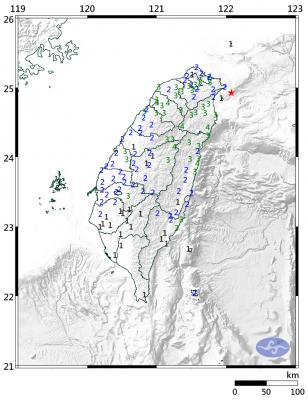
A magnitude 6.1 earthquake struck off the coast of Yilan County at 8:39pm tonight, the Central Weather Administration (CWA) said, with no immediate reports of damage or injuries. The epicenter was 38.7km east-northeast of Yilan County Hall at a focal depth of 98.3km, the CWA’s Seismological Center said. The quake’s maximum intensity, which gauges the actual physical effect of a seismic event, was a level 4 on Taiwan’s 7-tier intensity scale, the center said. That intensity level was recorded in Yilan County’s Nanao Township (南澳), Hsinchu County’s Guansi Township (關西), Nantou County’s Hehuanshan (合歡山) and Hualien County’s Yanliao (鹽寮). An intensity of 3 was

Japanese Prime Minister Sanae Takaichi’s comment last year on Tokyo’s potential reaction to a Taiwan-China conflict has forced Beijing to rewrite its invasion plans, a retired Japanese general said. Takaichi told the Diet on Nov. 7 last year that a Chinese naval blockade or military attack on Taiwan could constitute a “survival-threatening situation” for Japan, potentially allowing Tokyo to exercise its right to collective self-defense. Former Japan Ground Self-Defense Force general Kiyofumi Ogawa said in a recent speech that the remark has been interpreted as meaning Japan could intervene in the early stages of a Taiwan Strait conflict, undermining China’s previous assumptions
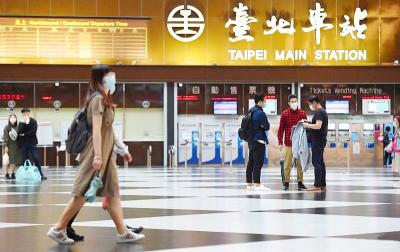
Taiwan Railways Corp (TRC) today announced that Shin Kong Mitsukoshi has been selected as the preferred bidder to operate the Taipei Railway Station shopping mall, replacing the current operator, Breeze Development Co Ltd. Among eight qualified firms that delivered presentations and were evaluated by a review committee, Shin Kong Mitsukoshi was ranked first, while Breeze was named the runner-up, the rail company said in a statement. Contract negotiations are to proceed in accordance with regulations, it said, adding that if negotiations with the top bidder fail, it could invite the second-ranked applicant to enter talks. Breeze in a statement today expressed doubts over


 RSS
RSS