


Two Taiwanese space technology products developed by National Cheng Kung University (NCKU) and start-up Tensor Tech Co were yesterday launched by a SpaceX Falcon 9 rocket from Florida in a joint mission.
The Transporter-3 mission launched at 10:25am on Thursday at Cape Canaveral Space Force Station in Florida. The program put 105 small satellites into a sun-synchronous orbit at an altitude of 525km, NASASpaceflight.com says.
Among them was a cubesat — a small research satellite — named Iris-A, developed by NCKU electrical engineering professor Juang Jyh-ching (莊智清).
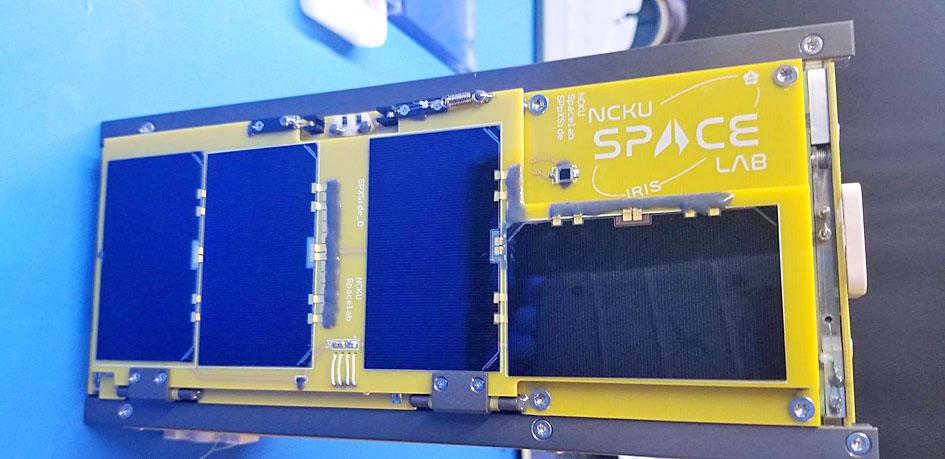
Photo courtesy of NCKU professor Juang Jyh-ching
Juang said that his team has received data transmitted by the cubesat via a ground station at the university’s campus in Tainan’s Gueiren District (歸仁).
The cubesat consists of a camera developed by Liscotech System Co, a long-range receiver by Letscom International Ltd, a GPS receiver by the National Space Organization (NSPO) and a reference clock by NCKU, according to Juang’s Space Lab Web site.
The GPS receiver in the cubesat is a miniaturized test model of what is to be used in NSPO Triton and Formosat-8 satellites to be launched at later dates, Juang said.
The cubesat is tasked with demonstrating Internet of Things (IoT) technology, including communication experiments using long-range delay tolerant network and Doppler compensation experiments, as well as testing the camera’s imaging capability, he said.
Iris-A is the first of a cubesat series, with Iris-B and Iris-C set to be launched at the end of this year or later, Juang said.
The launch mission also involves a novel attitude determination and control system (ADCS) developed by Tensor Tech, installed on Polish firm SatRevolution’s cubesat named Stork-1.
“This ADCS is actuated using a spherical motor with a rotor that can spin on multiple axes,” Tensor Tech said in a statement.
Conventional ADCS systems use three motors on three axes to rotate a satellite to a desired position, while Tensor Tech refined the functioning to one spherical motor to minimize the satellite’s weight, volume and power consumption, it said.
Stork-1 was designed to last three years, although its lifespan would be affected by a number of factors, said Tensor Tech cofounder and CEO Thomas Yen (顏伯勳).
The company is seeking clients in the US, Europe, Japan and India, and has discussed possible cooperation opportunities with local universities, Yen said.
Most Taiwanese businesses in the space-tech supply chain serve as OEM suppliers or satellite component producers, while the company aims to develop satellite subsystems or services to expand its market scope, he said.
The company could face challenges if it attempts to install the system on larger satellites, industry experts have said.
While the logic for controlling different satellites is the same, Tensor Tech will have to redesign the ADCS for larger satellites, which is one of the company’s goals, Yen said.
Founded in 2019, Tensor Tech branched from the laboratory of NCKU electrical engineering professor Hsieh Min-fu (謝旻甫), Yen said, adding that local electronics firms are its main investors.
The company has six full-time employees and two part-time workers, said 21-year-old Yen, who suspended his studies during his first year at National Taiwan University.

UPGRADE: The Kang Ding-class frigate is replacing its Chaparall missiles with Tien Chien II and Hua Yang VLS, which would provide it with long-range, 360° air defense Taiwan plans to produce 1,200 to 1,376 Hai Chien II missiles (海劍二, Sea Sword II) — also known as TC-2N — to serve as the standard air defense system of the navy’s surface combatant fleet, a source said yesterday. Last week, the Hai Chien II, the naval version of the Tien Kung II missile (天劍二, Sky Sword II), completed a live-fire test in waters off the National Chungshan Institute of Science and Technology’s Jiupeng facility (九鵬) in Pingtung County’s Manjhou Township (滿州). The MIM72 Chaparral and other dated air defense missiles that currently arm Taiwanese ships have inadequate range to combat Chinese

REASONS FOR TRAVEL: An assistant professor said that proposed amendments to penalize drivers if they used drugs overseas would not deter people from traveling People who operate a motor vehicle under the influence of marijuana would have their driver’s license revoked, even if they used the substance while overseas, the Ministry of Transportation and Communications said yesterday, citing proposed amendments to the Road Traffic Management and Penalty Act (道路交通管理處罰條例). The amendments would also authorize the government to revoke the licenses of people determined to have used Category 1 or Category 2 narcotics, even if they were not operating a vehicle while under the influence of drugs, as well as ban them from taking the license test for three years, the ministry said. People aged 18 or

HEAVY WEATHER: Typhoon Jangmi is due to crash straight into the Ryukyus as airlines look to shift flights to larger aircraft or cancel flights to Okinawa entirely Taiwan’s international air carriers announced flight adjustments over the weekend as Typhoon Jangmi is forecast to hit the Ryukyu Islands today and tomorrow. The Central Weather Administration (CWA) upgraded Jangmi from a tropical storm to a typhoon at 8am yesterday, with the eye located 580km south of Naha city. It was moving north at 19kph. Today, China Airlines’ CI-120, CI-121, CI-122 and CI-123 flights between Taoyuan and Naha, Okinawa, have been canceled as well as CI-132 and CI-133 between Kaohsiung and Naha. EVA Air’s BR-112, BR-113, BR-186 and BR-185 flights between Taoyuan and Naha are also canceled. Low-cost carrier Tigerair Taiwan canceled IT-230,

Johanne Liou (劉喬安), a Taiwanese woman who shot to unwanted fame during the Sunflower movement protests in 2014, returned to Taiwan last night after being deported from the US. She is to stand trial in Taiwan for charges involving embezzlement, fraud and drug crimes. The Criminal Investigation Bureau (CIB) said it took her into custody at Taiwan Taoyuan International Airport and would first question her before transferring her to the New Taipei District Prosecutors’ Office. She was arrested upon disembarking a flight from San Francisco that landed shortly before 7pm. Liou absconded to the US in 2019 after jumping bail


 RSS
RSS