


Taiwan’s coffee industry has grown by leaps and bounds over the past two decades, and annual average coffee consumption in Taiwan last year reached 1.8kg per person, exceeding the 1.4kg average per person for tea.
It is possible that this could be an indication that coffee could soon replace tea as Taiwan’s go-to drink.
From the 4.73 hectares of coffee planted in 2001 to the 1,153.21 hectares planted last year, it is apparent that a large number of people are investing in the coffee industry, Taiwan Coffee Laboratory researcher Lin Jen-an (林仁安) said on Tuesday last week, citing statistics provided by the Council of Agriculture.
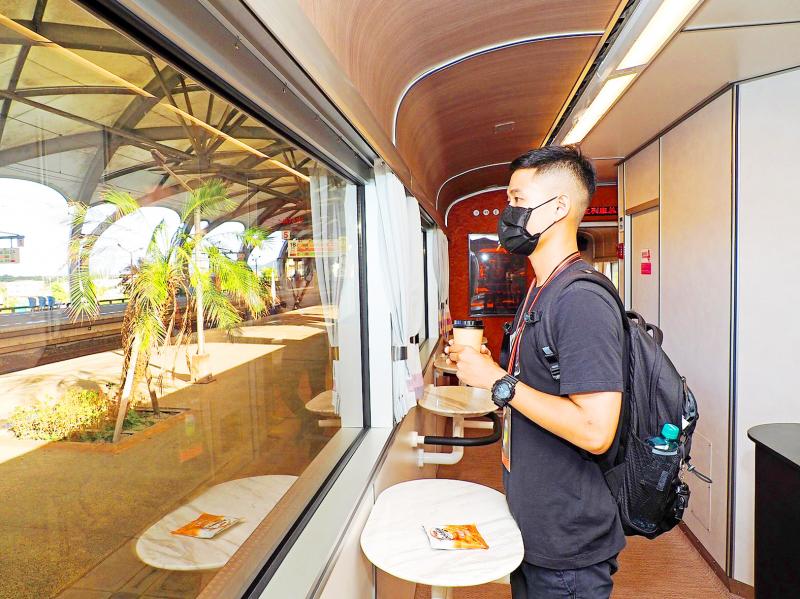
Photo courtesy of Lion Travel
Most coffee farms that have earned themselves a good reputation are located on mountains 700m above sea level, and many have been repurposed from tea farms, he said.
The frequent interaction between coffee farmers, baristas and roasters gives Taiwan’s coffee industry its competitive edge, as it aims to attract more attention at the Private Collection Auction today.
Lin said that Taiwan is the only place in the world, with the exception of Hawaii, in which there is nearly no distance between production and consumption.
Like the Hawaiian Kona beans, Taiwan’s beans cost more but have excellent taste, which would give Taiwan an edge in making a name for itself in the international gourmet coffee market, he added.
Comparing the quality of Taiwan’s coffee to the Geisha bean produced in Panama’s Hacienda La Esmeralda region, which sells for US$156 per kilogram, Lin said that Taiwan is looking to obtain a good price on its first appearance on the international coffee bidding scene.
At the event, a panel of 26 judges from five countries are scheduled to select nine of the best brews out of 19 entries of Taiwan-grown coffee beans for auctioning, the Alliance of Coffee Excellence said.
The beans selected are then to be auctioned online, with buyers from Taiwan, Japan, South Korea, the US, New Zealand, Australia and Saudi Arabia doing the bidding, the alliance said.
Taiwan Agricultural Research Institute director Fang Yi-chou (方怡舟) said that the institute has obtained a patent for the first locally cultivated type of coffee, which can be planted in plains and can yeild 1.2 times more beans than current coffee plants.
Fang said that the institute hopes to promote the new bean among local growers soon.
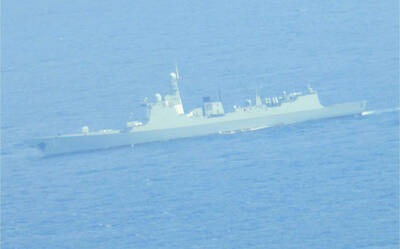
The military has spotted two Chinese warships operating in waters near Penghu County in the Taiwan Strait and sent its own naval and air forces to monitor the vessels, the Ministry of National Defense (MND) said. Beijing sends warships and warplanes into the waters and skies around Taiwan on an almost daily basis, drawing condemnation from Taipei. While the ministry offers daily updates on the locations of Chinese military aircraft, it only rarely gives details of where Chinese warships are operating, generally only when it detects aircraft carriers, as happened last week. A Chinese destroyer and a frigate entered waters to the southwest
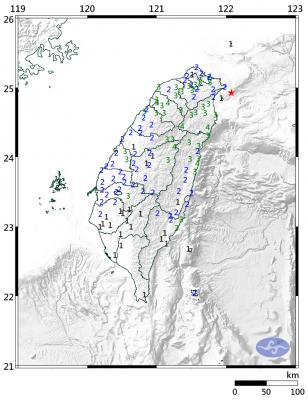
A magnitude 6.1 earthquake struck off the coast of Yilan County at 8:39pm tonight, the Central Weather Administration (CWA) said, with no immediate reports of damage or injuries. The epicenter was 38.7km east-northeast of Yilan County Hall at a focal depth of 98.3km, the CWA’s Seismological Center said. The quake’s maximum intensity, which gauges the actual physical effect of a seismic event, was a level 4 on Taiwan’s 7-tier intensity scale, the center said. That intensity level was recorded in Yilan County’s Nanao Township (南澳), Hsinchu County’s Guansi Township (關西), Nantou County’s Hehuanshan (合歡山) and Hualien County’s Yanliao (鹽寮). An intensity of 3 was
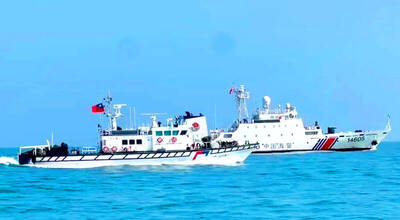
Instead of focusing solely on the threat of a full-scale military invasion, the US and its allies must prepare for a potential Chinese “quarantine” of Taiwan enforced through customs inspections, Stanford University Hoover fellow Eyck Freymann said in a Foreign Affairs article published on Wednesday. China could use various “gray zone” tactics in “reconfiguring the regional and ultimately the global economic order without a war,” said Freymann, who is also a nonresident research fellow at the US Naval War College. China might seize control of Taiwan’s links to the outside world by requiring all flights and ships entering or leaving Taiwan
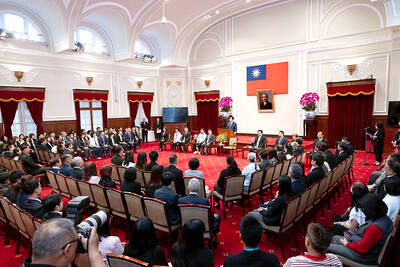
The next minimum wage hike is expected to exceed NT$30,000, President William Lai (賴清德) said yesterday during an award ceremony honoring “model workers,” including migrant workers, at the Presidential Office ahead of Workers’ Day today. Lai said he wished to thank the awardees on behalf of the nation and extend his most sincere respect for their hard work, on which Taiwan’s prosperity has been built. Lai specifically thanked 10 migrant workers selected for the award, saying that although they left their home countries to further their own goals, their efforts have benefited Taiwan as well. The nation’s industrial sector and small businesses lay


 RSS
RSS