


It is impossible to compare Taiwan with Afghanistan, academics said yesterday in response to claims that the US’ withdrawal proves that Taiwan cannot rely on US military assistance.
Nearly two decades after the US took control of Kabul, the Taliban on Sunday swiftly retook control of the Afghan capital, prompting the nation’s president to flee.
Critics have been quick to compare the situation to the fall of Saigon after the withdrawal of US troops during the Vietnam War, with some suggesting that the US’ track record bodes poorly for Taiwan’s chances in the event of an invasion by China.
“Taiwan is not Afghanistan,” former National Defense University distinguished lecturer Holmes Liao (廖宏祥) said.
The Afghan government is extremely corrupt, while Taiwan enjoys a stable democracy, he said.
Additionally, Taiwan’s defense strategy is based on a standard island military defense, as opposed to the domestic strife and guerrilla warfare that typify the conflicts in Afghanistan and previously Vietnam, he said, calling the two “entirely different.”
The hidden problems facing Taiwan are the belief in a “great Chinese nation,” defeatism and unprofessionalism within all ranks of the military leadership, Liao said.
The US, Japan, South Korea, the EU and G7 nations all support maintaining stability in the Taiwan Strait in recognition of the nation’s strategic placement within the Indo-Pacific region, Taiwan East Turkestan Association president Ho Chao-tung (何朝棟) said.
Considering China’s considerable global influence, using Afghanistan to claim that Taipei cannot rely on the US is an erroneous comparison, he added.
Meanwhile, Democratic Progressive Party Legislator Cheng Yun-peng (鄭運鵬) yesterday condemned some Chinese Nationalist Party (KMT) politicians for using the Afghanistan example to warn Taiwan about the dangers of relying on the US.
“Some are saying it should serve as a warning to Taiwan not to get too close to the US, and even use it as a taunt about China mounting a military invasion of Taiwan,” Chen wrote on Facebook. “Has the KMT not learned its lesson after being deceived by the Chinese Communist Party so many times? Or maybe it is a case of KMT politicians manifesting their suffering as ‘Stockholm syndrome’ victims?”
The parallel comparison does not work; US troops are not stationed in Taiwan, so there is no US military to withdraw, Cheng said.
“Taiwan has our own military for national defense, while we collaborate with other militaries and procure arms from the US and other allied countries,” he said.
In response to media queries for comment, Kaohsiung Mayor Chen Chi-mai (陳其邁) said: “The events in Afghanistan are connected to the geopolitics of the Middle East.”
“In a geopolitical context, Taiwan is situated at the forefront of an alliance of democratic countries, with peace and stability in the Taiwan Strait also being in the best interest of countries in the region, which Taiwan can contribute to,” he said.
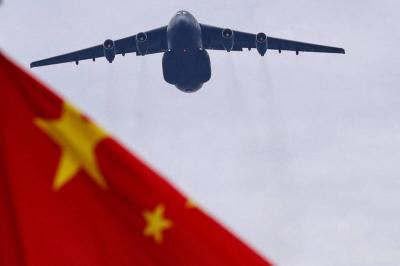
Beijing could eventually see a full amphibious invasion of Taiwan as the only "prudent" way to bring about unification, the US Department of Defense said in a newly released annual report to Congress. The Pentagon's "Annual Report to Congress: Military and Security Developments Involving the People's Republic of China 2025," was in many ways similar to last year’s report but reorganized the analysis of the options China has to take over Taiwan. Generally, according to the report, Chinese leaders view the People's Liberation Army's (PLA) capabilities for a Taiwan campaign as improving, but they remain uncertain about its readiness to successfully seize

Taiwan is getting a day off on Christmas for the first time in 25 years. The change comes after opposition parties passed a law earlier this year to add or restore five public holidays, including Constitution Day, which falls on today, Dec. 25. The day marks the 1947 adoption of the constitution of the Republic of China, as the government in Taipei is formally known. Back then the Chinese Nationalist Party (KMT) governed China from Nanjing. When the KMT, now an opposition party in Taiwan, passed the legislation on holidays, it said that they would help “commemorate the history of national development.” That

Taiwan has overtaken South Korea this year in per capita income for the first time in 23 years, IMF data showed. Per capita income is a nation’s GDP divided by the total population, used to compare average wealth levels across countries. Taiwan also beat Japan this year on per capita income, after surpassing it for the first time last year, US magazine Newsweek reported yesterday. Across Asia, Taiwan ranked fourth for per capita income at US$37,827 this year due to sustained economic growth, the report said. In the top three spots were Singapore, Macau and Hong Kong, it said. South
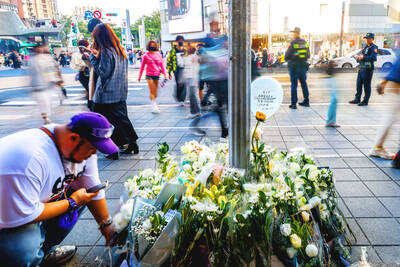
HORROR STORIES: One victim recounted not realizing they had been stabbed and seeing people bleeding, while another recalled breaking down in tears after fleeing A man on Friday died after he tried to fight the knife-wielding suspect who went on a stabbing spree near two of Taipei’s busiest metro stations, Taipei Mayor Chiang Wan-an (蔣萬安) said. The 57-year-old man, identified by his family name, Yu (余), encountered the suspect at Exit M7 of Taipei Main Station and immediately tried to stop him, but was fatally wounded and later died, Chiang said, calling the incident “heartbreaking.” Yu’s family would receive at least NT$5 million (US$158,584) in compensation through the Taipei Rapid Transit Corp’s (TRTC) insurance coverage, he said after convening an emergency security response meeting yesterday morning. National


 RSS
RSS