


Taiwan has completed a three-day Disaster Management Workshop in Koror, Palau, in partnership with the US, the Ministry of Science and Technology said on Thursday.
As part of the US-hosted Pacific Partnership, the event, which ran from Tuesday to Thursday, was conducted to enhance joint capabilities, technology sharing and coordination in humanitarian relief, the ministry said in a news release.
Taiwan was invited for being an innovator of technologies utilized in disaster response and for the ministry-affiliated National Science and Technology Center for Disaster Reduction (NCDR), it said.

Photo AFP
Palau’s telecommunications, power and water systems were damaged by Typhoon Surigae in April, which highlighted the need to improve disaster management, Palauan President Surangel Whipps Jr said at the workshop on Tuesday.
Palau must gain knowledge and experience in preventing and mitigating natural disasters to meet the challenges of climate change and extreme weather, he said.
Palauan Vice President J. Uduch Sengebau Sr said natural disaster resiliency and sustainablility are universal issues that Palau would continue to discuss with Taiwan.
Deputy Minister of Science and Technology Lin Minn-tsong (林敏聰), who attended the event by teleconference, said Taiwan would share early warning systems and analytics for earthquakes, droughts and typhoons.
The ministry’s disaster management program is to continue its focus on innovative technologies and sustainable development, in line with the New Southbound Policy as it pertains to smart technology, he said.
Taiwan is to share expertise for applying big data analysis in disaster management, knowledge that it acquired after creating and operating 400 governmental databases, NCDR Director Hongey Chen (陳宏宇) told the event.
An international version of the platform is being created by the center in collaboration with the Philippines, Bhutan and Nepal as part of a smart disaster prevention program launched by the ministry in 2018, Chen said.
Taiwanese officials are to discuss the creation of Palau’s information network for receiving and distributing intelligence about natural disasters, as well as the utilization of redundant systems for alerting the public, he said.

Fast food chain McDonald's is to raise prices by up to NT$5 on some products at its restaurants across Taiwan, starting on Wednesday next week, the company announced today. The prices of all extra value meals and sharing boxes are to increase by NT$5, while breakfast combos and creamy corn soup would go up by NT$3, the company said in a statement. The price of the main items of those meals, if ordered individually, would remain the same. Meanwhile, the price of a medium-sized lemon iced tea and hot cappuccino would rise by NT$3, extra dipping sauces for chicken nuggets would go up
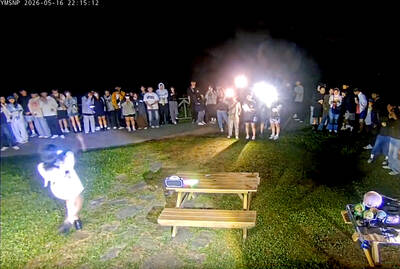
Yangmingshan National Park’s Qingtiangang (擎天崗) nature area has gone viral after a park livestream camera observed a couple in the throes of intimate congress, which was broadcast live on YouTube, drawing large late-night crowds and sparking a backlash over noise, bright lights and disruption to wildlife habitat. The area’s livestream footage appeared to show a couple engaging in sexual activity on a picnic table in the park on Friday last week, with the uncensored footage streamed publicly online. The footage quickly spread across social media, prompting a tide of visitors to travel to the site to “check in” and recreate the

Minister of Digital Affairs Lin Yi-ching (林宜敬) yesterday cited regulatory issues and national security concerns as an expert said that Taiwan is among the few Asian regions without Starlink. Lin made the remarks on Facebook after funP Innovation Group chief executive officer Nathan Chiu (邱繼弘) on Friday said Taiwan and four other countries in Asia — China, North Korea, Afghanistan and Syria — have no access to Starlink. Starlink has become available in 166 countries worldwide, including Ukraine, Malaysia, the Philippines and Vietnam, in the six years since it became commercial, he said. While China and North Korea block Starlink, Syria is not
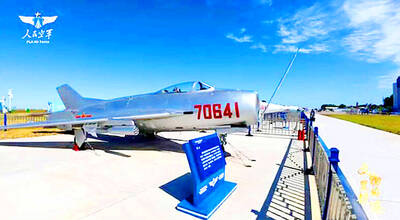
GROUNDED: A KMT lawmaker proposed eliminating drone development programs and freezing funding for counterdrone systems, despite China’s adoption of the technology China has deployed attack drones at air bases near the Taiwan Strait in a strategy aimed at overwhelming Taiwan’s air defense systems through saturation attacks, the Mainland Affairs Council (MAC) said. The council’s latest quarterly report on China said that satellite imagery and open-source intelligence indicate that the Chinese People’s Liberation Army (PLA) had converted retired J-6 fighter jets into J-6W drones, which the PLA has stationed at six air bases near Taiwan, five in China’s Fujian Province and one in Guangdong Province. The report cited J. Michael Dahm, a senior fellow at the US-based Mitchell Institute, as saying that China has


 RSS
RSS