


Former New Taipei City mayor Eric Chu (朱立倫) yesterday announced his bid for Chinese Nationalist Party (KMT) chairperson, a position he held from 2015 to 2016.
Chu made the announcement via a post on Facebook under the title “Change brings hope, regaining leadership brings about change.”
“Given the plight facing the KMT, as a member of the party, I feel duty-bound [to help] and officially announce that I will join the race for KMT chairperson,” he wrote.
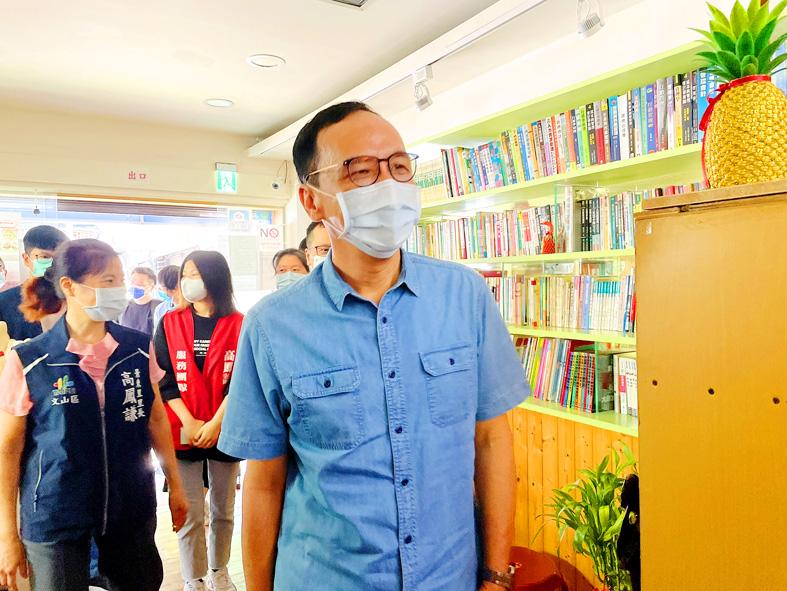
Photo: Cheng Ming-hsiang, Taipei Times
If elected, Chu promised to form a work panel to prepare for next year’s local elections and to select the strongest candidate to represent the party in the 2024 presidential race to help the KMT return to power.
“In face of the Democratic Progressive Party’s chaotic governance,” he said he would integrate and present the achievements of the 14 local governments ruled by the KMT to demonstrate the party’s governing capacity.
Chu is expected to pose the greatest challenge to KMT Chairman Johnny Chiang’s (江啟臣) re-election bid.
The KMT chairperson election was originally scheduled for July 24, but was postponed to Sept. 25 due to a local COVID-19 outbreak. Aside from Chiang and Chu, three other KMT members have expressed their intention to join the race — Chang Ya-chung (張亞中), president of the non-governmental organization the Sun Yat-sen School; Wei Po-tao (韋伯韜), former head of the Directorate-General of Budget, Accounting and Statistics; and former Changhua County commissioner Cho Po-yuan (卓伯源).
Local media reports said former Kaohsiung mayor Han Kuo-yu (韓國瑜) and Sean Lien (連勝文), son of former vice president Lien Chan (連戰), are also interested in running for KMT chairperson.

The military has spotted two Chinese warships operating in waters near Penghu County in the Taiwan Strait and sent its own naval and air forces to monitor the vessels, the Ministry of National Defense (MND) said. Beijing sends warships and warplanes into the waters and skies around Taiwan on an almost daily basis, drawing condemnation from Taipei. While the ministry offers daily updates on the locations of Chinese military aircraft, it only rarely gives details of where Chinese warships are operating, generally only when it detects aircraft carriers, as happened last week. A Chinese destroyer and a frigate entered waters to the southwest

A magnitude 6.1 earthquake struck off the coast of Yilan County at 8:39pm tonight, the Central Weather Administration (CWA) said, with no immediate reports of damage or injuries. The epicenter was 38.7km east-northeast of Yilan County Hall at a focal depth of 98.3km, the CWA’s Seismological Center said. The quake’s maximum intensity, which gauges the actual physical effect of a seismic event, was a level 4 on Taiwan’s 7-tier intensity scale, the center said. That intensity level was recorded in Yilan County’s Nanao Township (南澳), Hsinchu County’s Guansi Township (關西), Nantou County’s Hehuanshan (合歡山) and Hualien County’s Yanliao (鹽寮). An intensity of 3 was
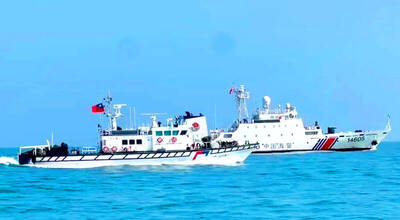
Instead of focusing solely on the threat of a full-scale military invasion, the US and its allies must prepare for a potential Chinese “quarantine” of Taiwan enforced through customs inspections, Stanford University Hoover fellow Eyck Freymann said in a Foreign Affairs article published on Wednesday. China could use various “gray zone” tactics in “reconfiguring the regional and ultimately the global economic order without a war,” said Freymann, who is also a nonresident research fellow at the US Naval War College. China might seize control of Taiwan’s links to the outside world by requiring all flights and ships entering or leaving Taiwan
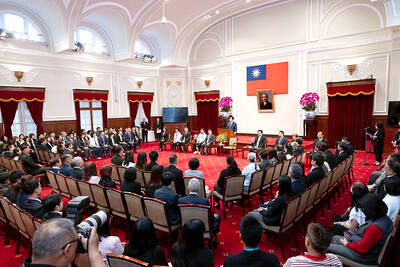
The next minimum wage hike is expected to exceed NT$30,000, President William Lai (賴清德) said yesterday during an award ceremony honoring “model workers,” including migrant workers, at the Presidential Office ahead of Workers’ Day today. Lai said he wished to thank the awardees on behalf of the nation and extend his most sincere respect for their hard work, on which Taiwan’s prosperity has been built. Lai specifically thanked 10 migrant workers selected for the award, saying that although they left their home countries to further their own goals, their efforts have benefited Taiwan as well. The nation’s industrial sector and small businesses lay


 RSS
RSS