


Democratic Progressive Party (DPP) lawmakers yesterday called for more proactive action against climate change to keep pace with other nations, starting with amending a climate-related law to help industries reduce carbon emissions.
The legislators’ appeal comes a week after the EU unveiled a broad climate plan that includes a “carbon border adjustment mechanism,” which, if approved, would impose a border tax on imports from countries with less-stringent climate policies from 2026.
Japan has also indicated interest in creating a similar mechanism, while US Democrats on Monday introduced legislation that would impose a tariff on certain carbon-intensive imports.
This indicates that a new stage in the battle over global supply chains has begun, DPP Legislator Hung Sun-han (洪申翰) told a virtual news conference, adding that as a major exporter, Taiwan must be proactive in response.
“Many friends in industry are well aware that this is a hurdle to their survival,” so they are greatly concerned about the progress of government policy, he said.
“They hope the government can back their move toward a low-carbon economy,” he added.
A crucial milestone in this transition would be a complete overhaul of the Greenhouse Gas Reduction and Management Act (溫室氣體減量及管理法), he said.
In December last year, a bipartisan group of 20 legislators introduced a bill to replace the act, which Hung at the time said had proven incapable of curbing greenhouse gas emissions.
The bill includes a carbon levy — a key component to meeting the proposed EU regulation, Hung said.
No one is a bystander in the fight against climate change, Deputy Legislative Speaker Tsai Chi-chang (蔡其昌) said, adding that the government must take on the greatest responsibility.
Seven amendments to the act have been proposed by the legislature, Tsai said, calling on the Executive Yuan to propose its own version as soon as possible, so the matter could be deliberated during this legislative session.
The Environmental Protection Administration (EPA) earlier this year announced a NT$100 tax per tonne of carbon emissions, but it is unclear whether the minimal sum would have the desired effect of curbing emissions to meet international standards, DPP Legislator Su Chiao-hui (蘇巧慧) said.
However, a report published in July last year by a British think tank commissioned by the EPA and British Office Taipei suggested starting from a base tax of NT$300 per tonne of carbon emitted, to be adjusted upward over time, Su added.
Not only must the act be amended, but the EPA, the Ministry of Economic Affairs and other agencies must take part in making and enforcing rules on carbon pricing, and drawing up a roadmap for carbon reduction, she said.
The EU would only become tougher on the issue, “so if you have to pay a carbon tariff, why not pay your own people first?” DPP Legislator Michelle Lin (林楚茵) said.
The government should take a gradual approach, first adopting a carbon fee to get industries used to the cost and using public funds to reduce emissions, before eventually falling in line with EU standards, she said.
Businesses should publish corporate social responsibility documents that clearly show annual emissions, and set near, middle and long-term carbon reduction goals, she added.
At the same time, regulatory mechanisms should be set up to track progress and set a unified definition of “carbon neutrality,” Lin said.
Lastly, environmental, social and governance (ESG) criteria should be used to encourage banks to give preferential loans to companies with good ESG ratings, she added.
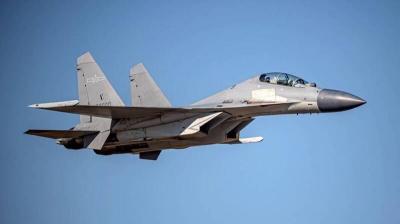
Eight Chinese naval vessels and 24 military aircraft were detected crossing the median line of the Taiwan Strait between 6am yesterday and 6am today, the Ministry of National Defense said this morning. The aircraft entered Taiwan’s northern, central, southwestern and eastern air defense identification zones, the ministry said. The armed forces responded with mission aircraft, naval vessels and shore-based missile systems to closely monitor the situation, it added. Eight naval vessels, one official ship and 36 aircraft sorties were spotted in total, the ministry said.

INCREASED CAPACITY: The flights on Mondays, Wednesdays, Fridays and Sundays would leave Singapore in the morning and Taipei in the afternoon Singapore Airlines is adding four supplementary flights to Taipei per week until May to meet increased tourist and business travel demand, the carrier said on Friday. The addition would raise the number of weekly flights it operates to Taipei to 18, Singapore Airlines Taiwan general manager Timothy Ouyang (歐陽漢源) said. The airline has recorded a steady rise in tourist and business travel to and from Taipei, and aims to provide more flexible travel arrangements for passengers, said Ouyang, who assumed the post in July last year. From now until Saturday next week, four additional flights would depart from Singapore on Monday, Wednesday, Friday
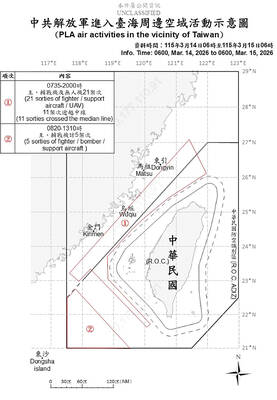
The Ministry of National Defense yesterday reported the return of large-scale Chinese air force activities after their unexplained absence for more than two weeks, which had prompted speculation regarding Beijing’s motives. China usually sends fighter jets, drones and other military aircraft around the nation on a daily basis. Interruptions to such routine are generally caused by bad weather. The Ministry of National Defense said it had detected 26 Chinese military aircraft in the Taiwan Strait over the previous 24 hours. It last reported that many aircraft on Feb. 25, when it spotted 30 aircraft, saying Beijing was carrying out another “joint combat
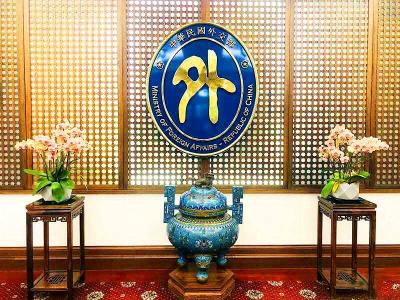
The Ministry of Foreign Affairs (MOFA) today said that if South Korea does not reply appropriately to its request to correct Taiwan’s name on its e-Arrival card system before March 31, it would take corresponding measures to alter how South Korea is labeled on the online Taiwan Arrival Card system. South Korea’s e-Arrival card system lists Taiwan as “China (Taiwan)” in the “point of departure” and “next destination” fields. The ministry said that it changed the nationality for South Koreans on Taiwan’s Alien Resident Certificates from “Korea” to “South Korea” on March 1, in a gesture of goodwill and based on the


 RSS
RSS