


Feeding wild animals in Taipei’s parks would be prohibited from June 1, with offenders to face fines of NT$1,200 to NT$6,000, the Taipei City Government said.
The frequent feeding of squirrels and pigeons has disrupted the ecological balance and food chain in the city’s parks, but many people continue to feed them even after being asked to stop, the Taipei Parks and Street Lights Office said.
The firefly restoration ecological pond in Taipei’s Daan Forest Park is being invaded by an exotic species, the many-rayed sailfin sucker catfish, while Neihu District’s (內湖) Bihu Park is being invaded by the invasive marbled crayfish, causing ecological balance issues, the office said.
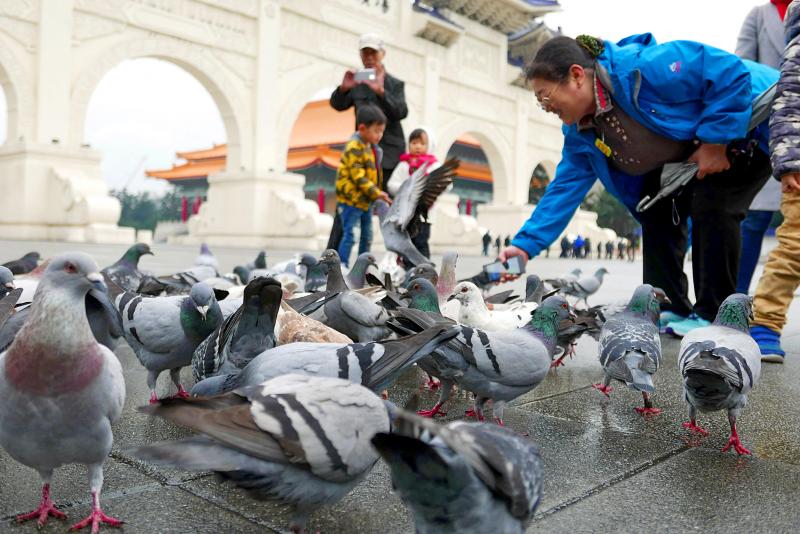
Photo: CNA
Taipei Youth Park Management Office Director Wang Shu-ya (王淑雅) said that people often feed squirrels in Daan Forest Park, and the squirrels have become accustomed to eating human food, which can affect their digestive systems.
The squirrels also become less willing to find their own food, leading some to strip the bark from trees to eat, which can cause fungal infections in the tree, she said.
Sometimes, park security guards are scolded by people they tell to stop feeding squirrels, she added.
Another problem is photographers putting food out to lure wild birds into the open to get a shot of them, the Parks and Street Lights Office said.
Although feeding wild animals was not prohibited, park security usually try to persuade people to stop when they see it occur, it said.
However, the office is to start making announcements and giving out flyers urging people to stop feeding wild animals in parks, it said, adding that borough offices and related agencies would be informed of the policy.
Starting from June 1, people who feed wild animals in the city’s parks and refuse to stop after being asked to by park security will face fines from NT$1,200 to NT$6,000, the office said.
If an offender refuses to provide identifying information, park security can contact local police to issue a ticket, it said.
People can also record the behavior as evidence and report it to the office or park security, so that they can handle the issue, but no cash reward would be given for reporting feeding incidents, Wang said.
According to the Wildlife Protection Act (野生動物保育法), wild animals are any animals living in a natural habitat, including mammals, birds, reptiles, amphibians, fish, insects and others, so they cannot be fed in the parks, she said.
However, feeding stray dogs and cats would not be considered feeding wild animals, so people who feed them would be fined, she added.

FUKUOKA SITUATION: Japanese media reported that the pathogen is expected to be identified by the summer, while the CDC downplayed the idea that it was hMPV A “mysterious cold-like illness” reported in Japan’s Fukuoka Prefecture does not seem to be a new disease, but Japanese authorities have been asked about the situation, the Centers for Disease Control (CDC) said yesterday. The Fukuoka Prefectural Medical Association on Wednesday told a news conference that a “mystery cold” that has become a hot topic on social media is “highly likely to be caused by some kind of viral infection,” Japan’s KBC News reported. “Many people are experiencing symptoms starting with a sore throat, followed by a runny nose, phlegm and a severe cough,” KBC News reported, citing association officials. Health authorities are

Nvidia Corp CEO Jensen Huang (黃仁勳) arrived in Taiwan yesterday ahead of upcoming AI and technology events, saying he plans to meet with clients and Taiwan Semiconductor Manufacturing Co Chairman C.C. Wei (魏哲家) during his visit. After landing at Taipei Songshan Airport, Huang posed for photos with fans and handed out Yakult drinks to reporters and supporters waiting at the scene, saying he has “a lot to do” during the trip. Asked about reports that Nvidia’s planned headquarters site in Taipei’s Beitou Shilin Technology Park could break ground on May 27, Huang said that if the company holds an event, he would

The Ministry of Finance this afternoon announced the winning numbers for the March-April uniform invoice lottery. The winning number for the NT$10 million (US$318,060) special prize is 19531471, and the winning number for the NT$2 million grand prize is 85941329. Three numbers were drawn for the NT$200,000 first prize: 07225810, 20231230 and 83518781. Those with receipts matching the last seven digits of any of the first-prize numbers will win the NT$40,000 second prize, while those matching the last six digits will win the NT$10,000 third prize. Those whose receipts match the last five digits of the first-prize numbers can claim the NT$4,000 fourth prize,

SIX SUBSIDIES: The monthly allowance for older farmers is to increase to NT$10,000, and NT$5,000 is to be given to homemakers under the national pension system, Lai said The government is to implement major welfare policies for disadvantaged groups, including raising the monthly allowance for older farmers to NT$10,000 and providing homemakers with NT$5,000 per month, President William Lai (賴清德) said yesterday. Lai made the remarks during a visit to Wangling Temple in Chiayi County, saying that the planned increases were being introduced amid economic growth and an increase in tax revenue. Touting a policy, in which the government plans to provide a monthly allowance of NT$5,000 for every child under the age of 18 in a bid to address Taiwan’s low birthrate, Lai said that if received for the


 RSS
RSS