


The Chinese Nationalist Party (KMT) caucus yesterday accused the government of conducting “surveillance of the opposition” after the installation of CCTV cameras in front of its office in the Legislative Yuan in Taipei.
KMT Legislator Alex Fai (費鴻泰) told a conference outside the legislative chamber that the cameras — which have facial recognition and sound recording capabilities — were installed without the caucus’ assent.
The lack of such devices outside the Democratic Progressive Party (DPP) caucus office just down the corridor suggests the decision was politically motivated, Fai said, asking: “When did Taiwan become a police state?”
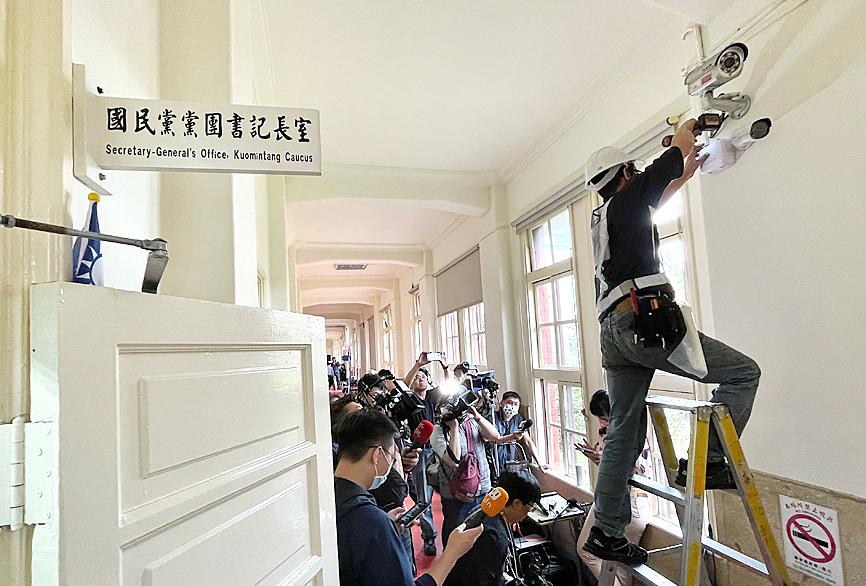
Photo: Liu Hsin-de, Taipei Times
KMT caucus secretary-general Cheng Li-wen (鄭麗文) said that the cameras that were installed in 2014 were not so out-of-date that replacement was necessary.
Legislative Speaker You Si-kun (游錫堃) should explain the matter, she said.
KMT lawmakers also lodged a protest on the legislative floor.
You asked Legislative Yuan Secretary-General Lin Jih-jia (林志嘉) to halt installations until the matter is looked into and a report is delivered within 10 days.
Cameras were installed in 2012 following a request by the KMT caucus, which at the time was concerned about possible break-ins at office, Lin said.
As with the originals, the replacement cameras can only record video, and have no sound recording or facial recognition capabilities, he said.
The KMT caucus is free to sign a statement that it does not wish the installation to continue, he said.
Taiwan People’s Party Legislator Ann Kao (高虹安) said that no one would oppose the installations if they were for security purposes, but there should be more communication between the two sides prior to any such work.
There should also be strict regulations on how footage from the cameras is allowed to be used, Kao said.
Meanwhile, the DPP on Facebook yesterday said that the KMT caucus’ actions were out of line with the Occupational Hazard Insurance and Protection Act (勞工職業災害保險及保護法) and that its accusations about being surveilled were nonsense.
The KMT caucus said that the DPP, as the ruling party and having a legislative majority, should not shy from answering legitimate questions on possible abuse of surveillance footage.
It can do better than smearing the opposition and shifting the focus, the caucus said.
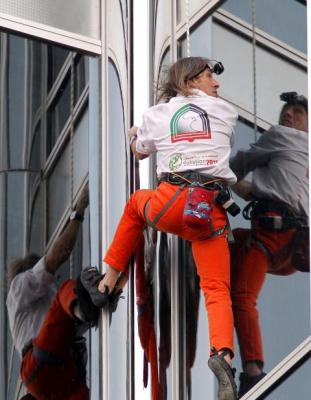
Alain Robert, known as the "French Spider-Man," praised Alex Honnold as exceptionally well-prepared after the US climber completed a free solo ascent of Taipei 101 yesterday. Robert said Honnold's ascent of the 508m-tall skyscraper in just more than one-and-a-half hours without using safety ropes or equipment was a remarkable achievement. "This is my life," he said in an interview conducted in French, adding that he liked the feeling of being "on the edge of danger." The 63-year-old Frenchman climbed Taipei 101 using ropes in December 2004, taking about four hours to reach the top. On a one-to-10 scale of difficulty, Robert said Taipei 101

Nipah virus infection is to be officially listed as a category 5 notifiable infectious disease in Taiwan in March, while clinical treatment guidelines are being formulated, the Centers for Disease Control (CDC) said yesterday. With Nipah infections being reported in other countries and considering its relatively high fatality rate, the centers on Jan. 16 announced that it would be listed as a notifiable infectious disease to bolster the nation’s systematic early warning system and increase public awareness, the CDC said. Bangladesh reported four fatal cases last year in separate districts, with three linked to raw date palm sap consumption, CDC Epidemic Intelligence
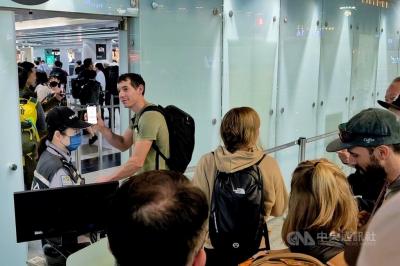
US climber Alex Honnold left Taiwan this morning a day after completing a free-solo ascent of Taipei 101, a feat that drew cheers from onlookers and gained widespread international attention. Honnold yesterday scaled the 101-story skyscraper without a rope or safety harness. The climb — the highest urban free-solo ascent ever attempted — took just more than 90 minutes and was streamed live on Netflix. It was covered by major international news outlets including CNN, the New York Times, the Guardian and the Wall Street Journal. As Honnold prepared to leave Taiwan today, he attracted a crowd when he and his wife, Sanni,

Taiwanese and US defense groups are collaborating to introduce deployable, semi-autonomous manufacturing systems for drones and components in a boost to the nation’s supply chain resilience. Taiwan’s G-Tech Optroelectronics Corp subsidiary GTOC and the US’ Aerkomm Inc on Friday announced an agreement with fellow US-based Firestorm Lab to adopt the latter’s xCell, a technology featuring 3D printers fitted in 6.1m container units. The systems enable aerial platforms and parts to be produced in high volumes from dispersed nodes capable of rapid redeployment, to minimize the risk of enemy strikes and to meet field requirements, they said. Firestorm chief technology officer Ian Muceus said


 RSS
RSS