


Former president Ma Ying-jeou (馬英九), Chinese Nationalist Party (KMT) Chairman Johnny Chiang (江啟臣) and Broadcasting Corp of China chairman Jaw Shaw-kong (趙少康) yesterday visited the Xianse Temple (先嗇宮) in New Taipei City’s Sanchong District (三重), vowing to unify the party and return it to power in 2024.
Ma worshiped and gave red envelopes to temple visitors at the invitation of KMT Secretary-General Lee Chien-lung (李乾龍), who is also the temple’s chairman.
Jiang and Jaw joined Ma at the temple, and their interactions were closely watched by the news media, as Jaw last week announced his bid to enter the KMT’s presidential primary, about a week after he announced his return to the party after leaving it in 1993.
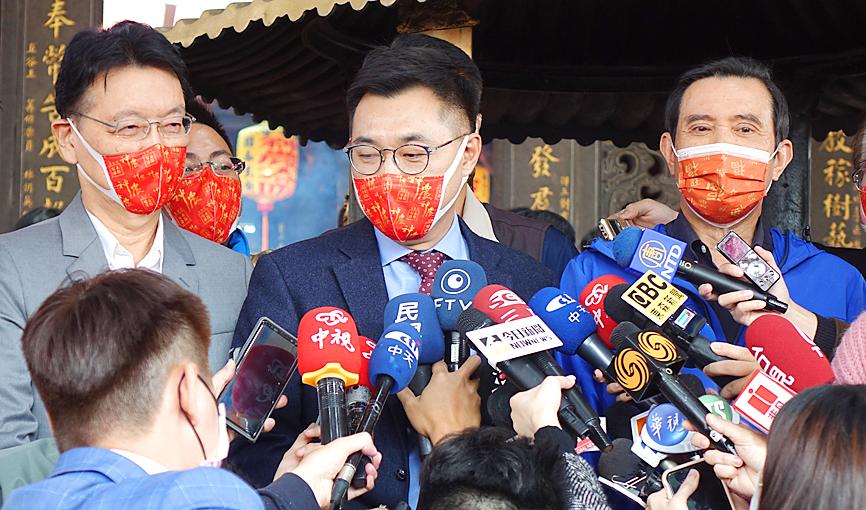
Photo: Wang Yi-sung, Taipei Times
“I hope Jaw’s return will encourage other members who have lost contact with the party to return to the fold as well. [KMT Legislator] Chiang Wan-an (蔣萬安) also expressed his willingness to shoulder his responsibility. Both are positive developments for the party,” Ma said, referring to remarks by Chiang Wan-an in a political talk show on Friday that he would not shun his responsibility when asked if he would run in the Taipei mayoral election next year.
Asked if he would encourage Jaw and Johnny Chiang to pair and contend in the 2024 presidential election, Ma said the party has an established mechanism to elect presidential candidates, whom the party would support.
Johnny Chiang said whoever is chosen to represent the party in 2024 should be supported by all party members.
Jaw said he joined Ma in his visit to the temple for the sake of party unity.
“The KMT lost the presidential election in 2020 because of its failure to unite party members. The party has to be united for the 2024 presidential election. Those interested in participating in the 2024 presidential election should fairly compete with one another for the spot,” he said.
Ma and Jaw said that President Tsai Iing-wen’s (蔡英文) administration should not immediately dismiss the possibility of using Chinese-made COVID-19 vaccines.
“We do not know how the pandemic situation will change. We should not give up on any potential source of vaccines, which could add one more layer of protection for the public,” Ma said.
Jaw said Taiwan should show a goodwill gesture after Tsai said Taiwan and China should forge a dialogue.
He also urged the Tsai administration to stop calling COVID-19 the “Wuhan pneumonia,” saying such a discriminatory and derogatory term would not help improve cross-strait relations.
Minister of Health and Welfare Chen Shih-chung (陳時中) later yesterday said there is insufficient information, such as studies published in scientific journals, about Chinese vaccines to consider them candidates.

FUKUOKA SITUATION: Japanese media reported that the pathogen is expected to be identified by the summer, while the CDC downplayed the idea that it was hMPV A “mysterious cold-like illness” reported in Japan’s Fukuoka Prefecture does not seem to be a new disease, but Japanese authorities have been asked about the situation, the Centers for Disease Control (CDC) said yesterday. The Fukuoka Prefectural Medical Association on Wednesday told a news conference that a “mystery cold” that has become a hot topic on social media is “highly likely to be caused by some kind of viral infection,” Japan’s KBC News reported. “Many people are experiencing symptoms starting with a sore throat, followed by a runny nose, phlegm and a severe cough,” KBC News reported, citing association officials. Health authorities are

Nvidia Corp CEO Jensen Huang (黃仁勳) arrived in Taiwan yesterday ahead of upcoming AI and technology events, saying he plans to meet with clients and Taiwan Semiconductor Manufacturing Co Chairman C.C. Wei (魏哲家) during his visit. After landing at Taipei Songshan Airport, Huang posed for photos with fans and handed out Yakult drinks to reporters and supporters waiting at the scene, saying he has “a lot to do” during the trip. Asked about reports that Nvidia’s planned headquarters site in Taipei’s Beitou Shilin Technology Park could break ground on May 27, Huang said that if the company holds an event, he would

Carrefour Taiwan is to begin using a new name from the start of July, but it cannot divulge the name until then, the chairman of the supermarket chain's parent company said today. President Chain Store Co chairman Lo Chih-hsien (羅智先) was asked by reporters after a shareholders' meeting to confirm whether the company has settled on a new name for the supermarket brand. In March, the government-registered name of two Carrefour Taiwan branches was quietly changed to "Le Chia Kang" (樂家康) in Chinese, raising speculation that has been selected as the name. Lo said that because of local regulations and contractual obligations, the
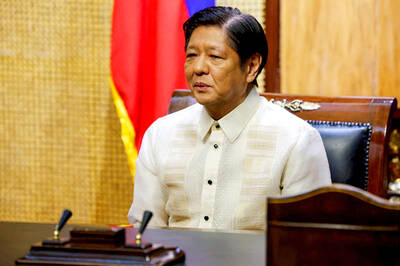
The Philippines would likely be involved in any conflict over Taiwan due to its proximity to the democracy claimed by China, President Ferdinand Marcos Jr said, reiterating a stance that risks angering Beijing. “In the Philippines, we do not have a choice because Taiwan is so close to the Philippines and we have almost 200,000 Filipino nationals living and working in Taiwan,” Marcos said in an interview with Japanese media in Manila on Monday. The Philippine leader’s comments come ahead of a state visit to Japan next week, where he is to meet with Japanese Prime Minister Sanae Takaichi to discuss security


 RSS
RSS