


Former president Chen Shui-bian (陳水扁) yesterday started a radio show on Smile Taiwan with Smile founder Shih Chuan (石川) as his first guest.
Speaking to reporters before the program began, Chen said it was his first time hosting a show, and although he was unfamiliar with radio, he was not embarrassed to learn something new.
The program would not focus on politics, but rather life and inspiring stories, he said.
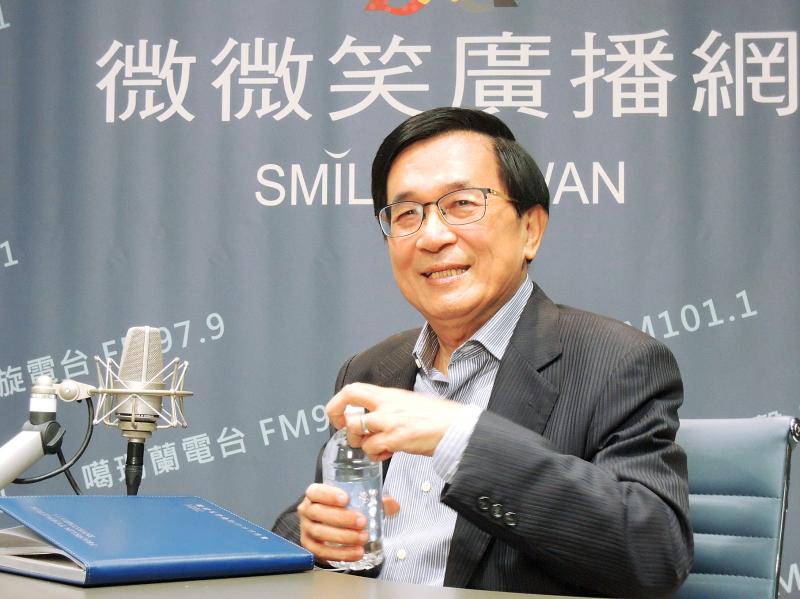
Photo: Wang Jung-hsiang, Taipei Times
His guests would be people from various professions with inspiring stories, he said, adding that among those he planned to interview was the composer of Mother’s Tears (阿母的目屎), the lyrics to which Chen wrote while in prison.
Chen was sentenced to 20 years in prison for money laundering and bribery, but was released on medical parole on Jan. 6, 2015, due to his deteriorating health.
As part of his parole, he may not appear on stage, give speeches or interviews, or discuss politics, and must abide by medical parole regulations, the prison said.
Taichung Prison deputy warden Wu Chao-ming (吳照明) has said it would collect data as part of an evaluation of Chen’s program.
Responding to reports that the prison did not approve of his radio show, Chen said that prison authorities had visited him on Wednesday, and that they had communicated about it in advance.
The show is scheduled to air every Sunday from 10am to 11am on the Kaohsiung-based station.
During yesterday’s show, Chen and Shih discussed growing up in poor families and their personal journeys.
Chen said he is grateful that his parents helped him pursue an education even if that meant borrowing money for tuition, and they respected his choice of the path he wanted to take, including changing his course of study from business to law.
He said that young people should work hard, adding that hard work can make up for a person’s shortcomings.

AGING: While Japan has 22 submarines, Taiwan only operates four, two of which were commissioned by the US in 1945 and 1946, and transferred to Taiwan in 1973 Taiwan would need at least 12 submarines to reach modern fleet capabilities, CSBC Corp, Taiwan chairman Chen Cheng-hung (陳政宏) said in an interview broadcast on Friday, citing a US assessment. CSBC is testing the nation’s first indigenous defense submarine, the Hai Kun (海鯤, Narwhal), which is scheduled to be delivered to the navy next month or in July. The Hai Kun has completed torpedo-firing tests and is scheduled to undergo overnight sea trials, Chen said on an SET TV military affairs program. Taiwan would require at least 12 submarines to establish a modern submarine force after assessing the nation’s operational environment and defense

A white king snake that frightened passengers and caused a stir on a Taipei MRT train on Friday evening has been claimed by its owner, who would be fined, Taipei Rapid Transit Corp (TRTC) said yesterday. A person on Threads posted that he thought he was lucky to find an empty row of seats on Friday after boarding a train on the Bannan (Blue) Line, only to spot a white snake with black stripes after sitting down. Startled, he jumped up, he wrote, describing the encounter as “terrifying.” “Taipei’s rat control plan: Release snakes on the metro,” one person wrote in reply, referring
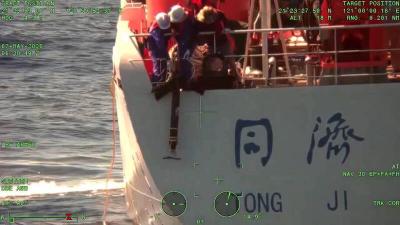
The coast guard today said that it had disrupted "illegal" operations by a Chinese research ship in waters close to the nation and driven it away, part of what Taipei sees a provocative pattern of China's stepped up maritime activities. The coast guard said that it on Thursday last week detected the Chinese ship Tongji (同濟號), which was commissioned only last year, 29 nautical miles (54km) southeast of the southern tip of Taiwan, although just outside restricted waters. The ship was observed lowering ropes into the water, suspected to be the deployment of scientific instruments for "illegal" survey operations, and the coast
Yangmingshan National Park authorities yesterday urged visitors to respect public spaces and obey the law after a couple was caught on a camera livestream having sex at the park’s Qingtiangang (擎天崗) earlier in the day. The Shilin Police Precinct in Taipei said it has identified a suspect and his vehicle registration number, and would summon him for questioning. The case would be handled in accordance with public indecency charges, it added. The couple entered the park at about 11pm on Thursday and began fooling around by 1am yesterday, the police said, adding that the two were unaware of the park’s all-day live


 RSS
RSS