


The government should create a public database to house academic theses and dissertations, lawmakers and academics said on Wednesday, after private database host Airiti was last month accused of changing papers to conform to Chinese censorship rules.
“Taiwan is already 20 years late; we cannot delay any longer,” Democratic Progressive Party (DPP) Legislator Fan Yun (范雲) told a news conference at the Legislative Yuan in Taipei.
Nearly all of the nation’s academic achievements are only possible through public funding distributed by the Ministry of Education and the Ministry of Science and Technology, Fan said.
Producers of knowledge have gradually realized that sharing their findings not only benefits everyone involved, but also leads to more breakthroughs, she said.
However, only the National Central Library is tasked with indexing theses, dissertations, journals and citations, and most articles cannot be accessed online, she said, adding that to quickly read an article online, Airiti is the only option.
Knowledge should be public property, she said, citing international practice.
For more than two decades, the “open access” movement has been countering the corporatization of academia by encouraging the free distribution of research results online, she said.
The Airiti incident has given the nation an opportunity to make its academic achievements available to all, Fan said, calling on the ministries to follow the international trend and improve copyright protections by creating an open access database.
“No science should be locked behind paywalls,” DPP Legislator Chuang Ching-cheng (莊競程) said.
Knowledge formation and dissemination is no longer top-down, he said, adding that allowing everyone to access information could improve the review process and advance science.
Opening access would improve Taiwan’s international standing by showing its academic achievements to the world, he added.
The education ministry on Thursday last week found that Airiti had contravened copyright and cross-strait relations law by altering “sensitive” terms in papers available on its Chinese Web site, such as changing all instances of “my country” to “Taiwan,” and asked the company to provide an explanation.
Airiti in a news release on Wednesday denied having a monopoly, saying that most Taiwanese periodicals use non-exclusive licensing and allow free downloads from their Web sites.
The open access movement emerged to combat the monopoly held by periodicals, not by databases, which have no way of monopolizing the industry, it added.
Many top journals require submitting authors to transfer the copyright to them, but this does not happen in the local publishing industry, the firm said.
Airiti also said that it is not the nation’s only database, as there are at least two other companies that provide the same service.
Once a journal licensed by Airiti decides to provide open access, the articles can be read for free on the firm’s international site, it said, adding that 12 percent of the journals on Airiti are open access.
As for the education ministry’s request, Airiti assistant general manager Yang Chang-chun (楊長春) said that the firm would issue a response after it receives a formal notice from the ministry.

EXCUSES: Beijing is using government and research vessels as a pretext to harass the nation and enter its EEZ, and engage in ‘hegemonic expansion,’ the coast guard said The Coast Guard Administration yesterday said it drove away Chinese oceanographic research vessel Xiang Yang Hong 22 (向陽紅33) from restricted waters after warning it that it was in Taiwan’s exclusive economic zone (EEZ). The Chinese vessel entered restricted waters off the coast of Yilan County’s Suao (蘇澳) at 11:35pm on Thursday, the coast guard said, adding that it dispatched the Lanyu patrol vessel and the boat PP-10077 to shadow the Chinese ship and issue radio warnings ordering it to leave. China has no sovereignty over waters off Taiwan’s east coast, Lanyu’s crew told Xiang Yang Hong 22 over the radio, and demanded

BAIT AND SWITCH: Allowing KMT-run counties to sell to China while the threat of abrupt cancelations hangs overhead is another form of coercion, officials said Beijing is using agricultural purchase offers announced during the Straits Forum to deepen Taiwan’s dependence on the Chinese market, a Taiwanese official said yesterday as they criticized the Taitung County commissioner’s participation in the initiative. During the Straits Forum held in Xiamen on Saturday, Chinese officials announced a sales and purchase agreement for agricultural products from some counties led by the Chinese Nationalist Party (KMT). Taitung County Commissioner Yao Ching-ling (饒慶鈴), who was barred from attending the event in person by the Mainland Affairs Council, participated via video. Under the agreement, China would purchase atemoyas, pomeloes, tea and grouper harvested in Taitung,
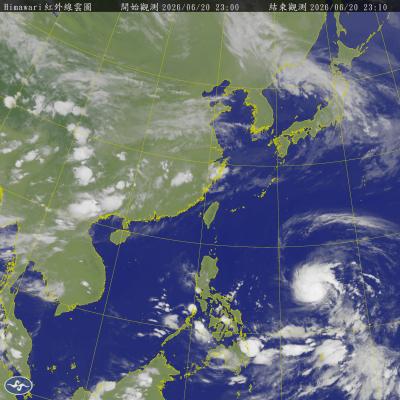
Tropical Storm Mekkhala is forecast to strengthen into a typhoon tomorrow and could come close enough to Taiwan later in the week to prompt a sea warning, the Central Weather Administration (CWA) said yesterday. As of 2 pm, the storm was located 1,870 kilometers southeast of Taiwan's southern tip and moving west- northwest at 23 km per hour. CWA forecaster Cheng Chieh-jen (鄭傑仁) said Mekkhala is expected to continue moving west-northwest through Tuesday under the influence of the Pacific high- pressure system before gradually turning north toward waters east of Taiwan or south of the Ryukyu Islands. The timing and angle of the

Four Taiwanese universities have been ranked among the world's top 200 institutions in the Quacquarelli Symonds (QS) World University Rankings for next year, the highest Taiwan has ever placed in the category, with National Taiwan University (NTU) achieving its best performance at 54th globally and 17th in Asia. The four Taiwanese institutions in the global top 200 are NTU (54th), National Tsing Hua University (142nd), National Yang Ming Chiao Tung University (177th) and National Cheng Kung University (191st), the rankings showed. All four universities achieved their highest-ever global rankings this year, QS data showed. National Cheng Kung University entered the top 200 for


 RSS
RSS