


Malnutrition is likely to blame for a recent spate of water buffalo deaths on Yangmingshan (陽明山), the Taipei Animal Protection Office said on Monday.
Twenty-five water buffaloes have been reported dead from the 94 recorded as living on the mountain as of September, Yangmingshan National Park Service statistics showed.
Seventeen were found dead in Qingtiangang (擎天崗), six in Shitiling (石梯嶺) and two on Huangzuishan (磺嘴山), data showed.
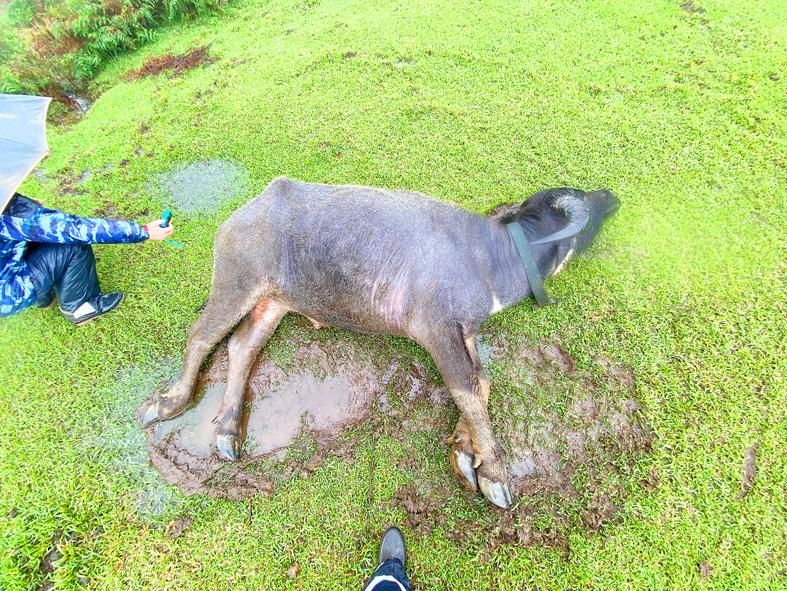
Photo courtesy of Keng Wei’s office via CNA
The animals developed nutritional deficiencies after eating low-quality food over a long period, the office said.
It advised the park to provide emergency nutritional supplements for the buffaloes in Qingtiangang and Shitiling.
The supplements should include protein and mineral-rich salt licks, and fodder, the office said, adding that park officials should step up patrols and communication with the public.
Officials should also take samples from the buffaloes to conduct health checks, and carry out a long-term assessment of their habitat, it said.
The park said it had instructed rangers to prepare nutrient-rich fodder and licks, which would be placed for the buffaloes within two or three days.
A relatively large number of water buffaloes this year, compounded by constant rain, has affected the nutritional content of the grass, it said.
Park spokesman Chang Shun-fa (張順發) called on the public to refrain from feeding the animals.
Aside from the risk associated with coming in contact with wild animals, feeding them could make them unwilling to graze naturally, Chang said.
He advised adhering to the “three noes” principle: Do not touch, do not bother and do not feed.
Chinese Nationalist Party (KMT) Taipei City Councilor Keng Wei (耿葳) said that park officials have since last year been erecting fences to restrict the buffaloes’ grazing area, yet are blaming the mass die-off on the weather.
Keng accused the park of deliberately hiding the fact that its misguided policy has starved the animals.
Park officials should bear full responsibility and the office should handle the matter according to the law, she said.
Additional reporting by CNA

Considering that most countries issue more than five denominations of banknotes, the central bank has decided to redesign all five denominations, the bank said as it prepares for the first major overhaul of the banknotes in more than 24 years. Central bank Governor Yang Chin-lung (楊金龍) is expected to report to the Legislative Yuan today on the bank’s operations and the redesign’s progress. The bank in a report sent to the legislature ahead of today’s meeting said it had commissioned a survey on the public’s preferences. Survey results showed that NT$100 and NT$1,000 banknotes are the most commonly used, while NT$200 and NT$2,000

The Centers for Disease Control (CDC) yesterday reported the first case of a new COVID-19 subvariant — BA.3.2 — in a 10-year-old Singaporean girl who had a fever upon arrival in Taiwan and tested positive for the disease. The girl left Taiwan on March 20 and the case did not have a direct impact on the local community, it said. The WHO added the BA.3.2 strain to its list of Variants Under Monitoring in December last year, but this was the first imported case of the COVID-19 variant in Taiwan, CDC Deputy Director-General Lin Ming-cheng (林明誠) said. The girl arrived in Taiwan on

ANNUAL EVENT: Two massive Pokemon balloons are to be set up in Daan Park, with an event zone operating from 10am to 6pm This year’s Taipei Floral Picnic is to be held at Daan Park today and tomorrow, featuring an exclusive Pokemon Go event, a themed food market, a coffee rave picnic area and stage performances, the Taipei Department of Information and Tourism said yesterday. Two massive Pokemon balloons are to be set up in the park as attractions, with an exclusive event zone operating from 10am to 6pm, it said. Participants who complete designated tasks on-site would have a chance to receive limited-edition souvenirs, it added. People could also try the newly launched game Pokemon Pokopia in the trial area, the department said. Three PokeStops are

South Korea is planning to revise its controversial electronic arrival card, a step Taiwanese officials said prompted them to hold off on planned retaliatory measures, a South Korean media report said yesterday. A Yonhap News Agency report said that the South Korean Ministry of Foreign Affairs is planning to remove the “previous departure place” and “next destination” fields from its e-arrival card system. The plan, reached after interagency consultations, is under review and aims to simplify entry procedures and align the electronic form with the paper version, a South Korean ministry official said. The fields — which appeared only on the electronic form


 RSS
RSS