


Foreign media and the international community should be concerned about the possibility of press freedom and freedom of speech being oppressed in Taiwan, the Chinese Nationalist Party (KMT) said yesterday.
The KMT made the call at an international news conference in Taipei ahead of the CTi News channel going off the air at 12am today.
The National Communications Commission (NCC) on Nov. 18 said that it would not renew CTi News’ broadcast license, citing “repeated violations of regulations and the failure of its internal discipline and control mechanisms.”
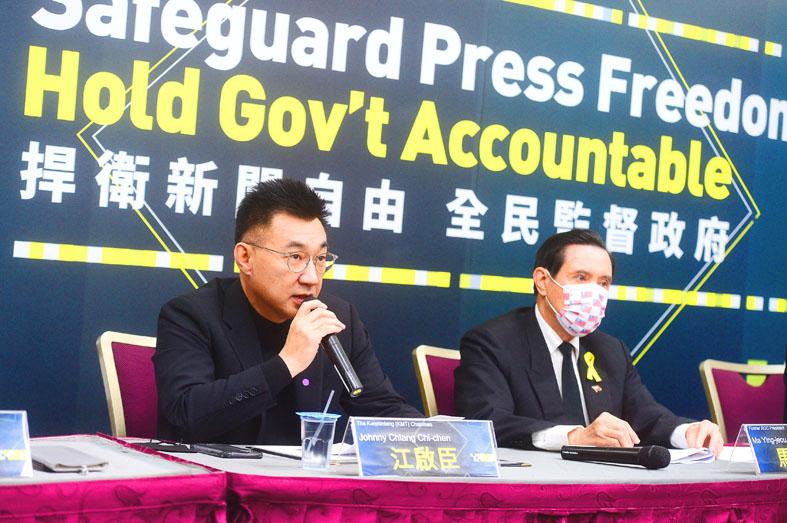
Photo: Wang Yi-sung, Taipei Times
CTi TV has said that the NCC’s decision was politically motivated, as CTi News is known for being critical of the Democratic Progressive Party (DPP) administration and friendly toward China.
The Taipei High Administrative Court on Monday rejected a request by CTi TV for an injunction to prevent the shutdown of its CTi News channel, meaning that CTi News is to cease broadcasting on local TV networks from today.
The DPP government cannot dismiss a news channel because it disagrees with government positions on matters, as it is the media’s role to oversee the government, not become its mouthpiece, KMT Chairman Johnny Chiang (江啟臣) told the news conference.
Freedom of the press is a basic human right and President Tsai Ing-wen’s (蔡英文) administration denying it greatly harms Taiwan’s international image of having freedom of speech, he said.
“One wonders whether Taiwan is still a democracy, or under an authoritarian government, as the government weeds out opinions and voices contrary to its own,” he said.
The NCC’s refusal to extend CTi News’ license undercuts claims that the commission is independent, Chiang said, adding that the suspicion is that it has infringed on democratic freedoms guaranteed by the Constitution.
The KMT cited files, allegedly leaked from the Presidential Office in May, as evidence that the NCC’s refusal to extend the license was a predetermined decision, not based on CTi having “failed to self-regulate.”
On May 15, an e-mail account named “ser lo” sent to members of the media on the Presidential Office’s contact list two e-mails containing several files, purportedly documents prepared by aides for two meetings between Tsai and Premier Su Tseng-chang (蘇貞昌) regarding the selection of members of Tsai’s second-term Cabinet.
One of the documents reportedly said that of the three newly appointed NCC commissioners, two were pan-green in ideology and could “assist with handling CTi News.”
Meanwhile, former president Ma Ying-jeou (馬英九) told the news conference that a statement issued on Nov. 18 by Reporters Without Borders “does not resemble commentary from professional media personnel.”
The statement said that the decision not to renew CTi News’ license was “regrettable, but does not go against press freedom.”
Press freedom does not mean “without regulations” and the review of the license was a legitimate action, the statement said.
It is interesting that the organization’s reaction differed from the past, Chiang said, adding that the ratio of media in Taiwan that oversee the government to that which critique the opposition is heavily skewed in the government’s favor.
CTi News provided information for the public to form their own opinions and its removal was, essentially, divesting the public of differing opinions and commentary, Ma said, adding that unless one lives in an autocratic nation, shutting down a TV station harms press freedom.
Additional reporting by CNA

FUKUOKA SITUATION: Japanese media reported that the pathogen is expected to be identified by the summer, while the CDC downplayed the idea that it was hMPV A “mysterious cold-like illness” reported in Japan’s Fukuoka Prefecture does not seem to be a new disease, but Japanese authorities have been asked about the situation, the Centers for Disease Control (CDC) said yesterday. The Fukuoka Prefectural Medical Association on Wednesday told a news conference that a “mystery cold” that has become a hot topic on social media is “highly likely to be caused by some kind of viral infection,” Japan’s KBC News reported. “Many people are experiencing symptoms starting with a sore throat, followed by a runny nose, phlegm and a severe cough,” KBC News reported, citing association officials. Health authorities are

Nvidia Corp CEO Jensen Huang (黃仁勳) arrived in Taiwan yesterday ahead of upcoming AI and technology events, saying he plans to meet with clients and Taiwan Semiconductor Manufacturing Co Chairman C.C. Wei (魏哲家) during his visit. After landing at Taipei Songshan Airport, Huang posed for photos with fans and handed out Yakult drinks to reporters and supporters waiting at the scene, saying he has “a lot to do” during the trip. Asked about reports that Nvidia’s planned headquarters site in Taipei’s Beitou Shilin Technology Park could break ground on May 27, Huang said that if the company holds an event, he would

The Ministry of Finance this afternoon announced the winning numbers for the March-April uniform invoice lottery. The winning number for the NT$10 million (US$318,060) special prize is 19531471, and the winning number for the NT$2 million grand prize is 85941329. Three numbers were drawn for the NT$200,000 first prize: 07225810, 20231230 and 83518781. Those with receipts matching the last seven digits of any of the first-prize numbers will win the NT$40,000 second prize, while those matching the last six digits will win the NT$10,000 third prize. Those whose receipts match the last five digits of the first-prize numbers can claim the NT$4,000 fourth prize,

Taiwan Travelogue (臺灣漫遊錄), which earlier this week became the first Taiwanese novel to win the International Booker Prize, is to be adapted into a television series through a Taiwan-Japan coproduction, producer Chang Chen-yu (張辰漁) said yesterday. Chang, a producer at World Softest Production Film Co, wrote on Facebook that the company had been searching for projects with international appeal that retain a strong Taiwanese identity after colleagues and Japanese partners strongly recommended the novel. After reading the book, Chang said he immediately decided to pursue the screen rights. “A great story has the power to transcend time and borders, and connect countless people,”


 RSS
RSS