


The Taipei High Administrative Court yesterday denied CTi TV’s request for an injunction over the rejection of its application to renew CTi News’ operating license.
The network filed for an injunction after the seven members of the National Communications Commission (NCC) on Nov. 18 unanimously denied the news channel’s license renewal application.
CTi TV asked the court to give it a temporary license so that it could continue operating after its license expires on Friday, and prevent the NCC from allowing other news channels to use its coveted Channel 52 slot until after the dispute has been settled.
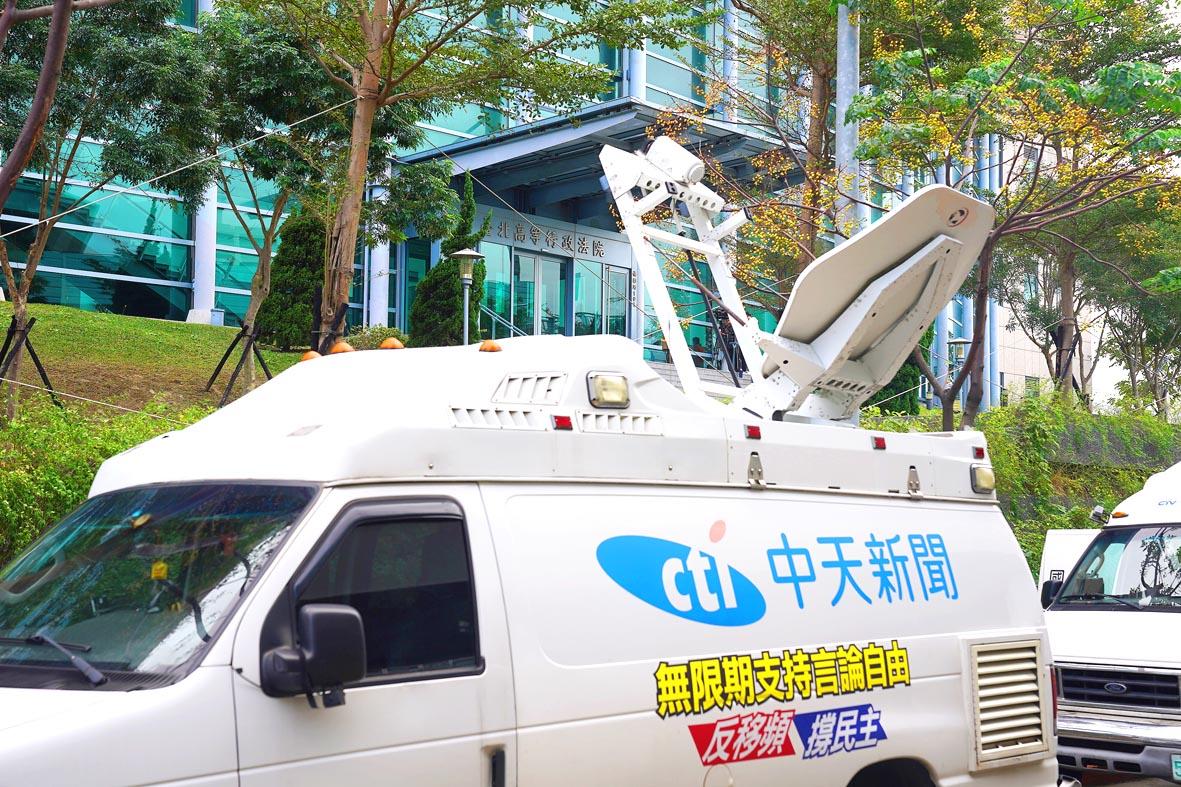
Photo: CNA
However, the court denied the network’s petition, saying that it failed to convince the court that it has a high probability of winning subsequent lawsuits, adding that the NCC’s ruling did not cause CTi TV major damage or place it in immediate danger.
“From the explanations we have heard so far from CTi TV and the NCC, we cannot determine in definite terms the legality of NCC’s ruling to reject the license renewal,” the court said.
The network questioned the NCC’s fines and penalties against CTi News, but the court said that those issues would have to be settled through subsequent litigation.
Broadcasting licenses are valid for six years under the Satellite Broadcasting Act (衛星廣播電視法), and CTi TV understood that it might not secure a license renewal and should have prepared accordingly, the court said, adding that any financial losses it sustained as a result of the application’s rejection should not be considered “unusual damages.”
CTi TV can continue using the personnel and facilities at the news channel to produce programs, which can be aired through other platforms, the court said.
As the network can continue to generate revenue by operating its other channels, any financial losses and damage to its reputation sustained as a result of the news channel losing its license are not irreparable, the court said.
News media are public services, and the use and development of them should be overseen by the commission based on media regulations, the court said.
“If the court grants CTi TV an injunction over the NCC’s ruling, it would allow the network to circumvent oversight by the agency, which would nullify the effects of the license renewal mechanism stated in Satellite Broadcasting Act and affect the authority of the NCC to maintain the order of broadcast media,” it said.
As to preventing NCC from reassigning Channel 52 to another news network, the court said that the channel lineups are determined through negotiations between cable system operators and networks or agents representing channels, which means they are private disputes.
As the NCC has no way of intervening in those matters, the network cannot ask for an injunction on this issue either, the court said.
CTi News said it would appeal to the Supreme Administrative Court.
“We are angry and disappointed that the court said nothing about the freedom of the press, which faces significant and immediate danger,” the channel said in a statement. “It also disregarded that the NCC’s ruling has a weak legal basis, and the commission’s administrative hearing over our license renewal application had major flaws. Nor did it question the political interference that might have occurred in this case.”
“This is the heaviest day for the 475 employees at CTi News. We will continue to stand up and defend the freedom of the press and hope that the judicial system will do us justice,” it said.
The Chinese Nationalist Party (KMT) said in a statement yesterday that it regrets the court’s decision.
The closure of a television news station in Taiwan one day after Human Rights Day, which is on Thursday, would damage the nation’s international image, the KMT said, urging people to “remember this day,” and to defend freedom of the press and free speech.
Additional reporting by Sherry Hsiao

LOUD AND PROUD Taiwan might have taken a drubbing against Australia and Japan, but you might not know it from the enthusiasm and numbers of the fans Taiwan might not be expected to win the World Baseball Classic (WBC) but their fans are making their presence felt in Tokyo, with tens of thousands decked out in the team’s blue, blowing horns and singing songs. Taiwanese fans have packed out the Tokyo Dome for all three of their games so far and even threatened to drown out home team supporters when their team played Japan on Friday. They blew trumpets, chanted for their favorite players and had their own cheerleading squad who dance on a stage during the game. The team struggled to match that exuberance on the field, with
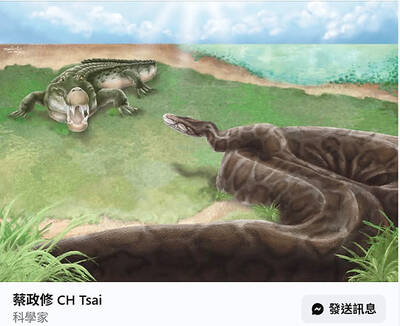
Taiwanese paleontologists have discovered fossil evidence that pythons up to 4m long inhabited Taiwan during the Pleistocene epoch, reporting their findings in the international scientific journal Historical Biology. National Taiwan University (NTU) Institute of Ecology and Evolutionary Biology associate professor Tsai Cheng-hsiu (蔡政修) led the team that discovered the largest snake fossil ever found in Taiwan. The single trunk vertebra was discovered in Tainan at the Chiting Formation, dated to between 400,000 and 800,000 years ago in the Middle Pleistocene, the paper said. The area also produced Taiwan’s first avian fossil, as well as crocodile, mammoth, saber-toothed cat and rhinoceros fossils, it said. Discoveries

Taiwanese paleontologists have discovered fossil evidence that pythons up to 4m long inhabited Taiwan during the Pleistocene epoch, reporting their findings in the international scientific journal Historical Biology. National Taiwan University (NTU) Institute of Ecology and Evolutionary Biology associate professor Tsai Cheng-hsiu (蔡政修) led the team that discovered the largest snake fossil ever found in Taiwan. A single trunk vertebra was discovered in Tainan at the Chiting Formation, dated to between 800,000 to 400,000 years ago in the Middle Pleistocene, the paper said. The area also produced Taiwan’s first avian fossil, as well as crocodile, mammoth, sabre-toothed cat and rhinoceros fossils, it said. Discoveries

Whether Japan would help defend Taiwan in case of a cross-strait conflict would depend on the US and the extent to which Japan would be allowed to act under the US-Japan Security Treaty, former Japanese minister of defense Satoshi Morimoto said. As China has not given up on the idea of invading Taiwan by force, to what extent Japan could support US military action would hinge on Washington’s intention and its negotiation with Tokyo, Morimoto said in an interview with the Liberty Times (sister paper of the Taipei Times) yesterday. There has to be sufficient mutual recognition of how Japan could provide


 RSS
RSS