


Verbal feuding continued at the Legislative Yuan yesterday, as lawmakers discussed who would pay for the damage after Chinese Nationalist Party (KMT) lawmakers threw pig skin and entrails around in the legislature on Friday.
Opposition lawmakers have been demanding an apology from the Democratic Progressive Party (DPP) government for its plan to lift an import ban on US pork containing ractopamine.
During the administration of former president Ma Ying-jeou (馬英九), the DPP, then in opposition, opposed imports of US pork containing the leanness-enhancing additive.

Photo: Liu Hsin-de, Taipei Times
It would cost more than NT$1 million (US$34,693) to replace the carpet inside the chamber, Legislative Yuan Secretary-General Lin Jih-jia (林志嘉) said yesterday, adding that microphones and the audio system were also damaged during Friday’s scuffle.
The cleanup is being handled by a contracted cleaning company, including washing and disinfecting, and would cost about NT$50,000 to NT$60,000, Lin told a meeting of the legislature’s Judiciary and Organic Laws and Statutes Committee.
“The company also used special products to eliminate odor. If the floor is clean and no foul smell is left, then we need not change the carpet. But if not, and the carpet needs replacing, then the cost would be more than NT$1 million,” Lin said. “Whoever caused the damage will have to pay. So the bill will be sent to the KMT.”
Lin said that the KMT was billed NT$415,000 for damage to legislature property after party members in July brawled with other lawmakers and police in an attempt to stop the confirmation of Chen Chu (陳菊) as Control Yuan president.
“KMT officials had promised to pay that bill, but have not yet done so. We still believe the KMT will keep its word and eventually pay the amount,” Lin said.
Asked by lawmakers about payment for other incidents, Lin said that all other political parties had paid their bills for damage, except the KMT.
Lin listed earlier incidents, including New Power Party members in January 2018 damaging the legislature’s entrance doors when protesting amendments to the Labor Standards Act (勞動基準法). They paid the NT$120,000 bill.
Organizers of the 2014 Sunflower movement paid NT$2.63 million for destroying property while inside the legislature, Lin said, adding that the DPP paid more than NT$20,000 for occupying the legislature for five days in June 2012 over the importation of US meat products.
Asked for comment, KMT caucus whip Lin Wei-chou (林為洲) said: “Our party is willing to pay any price to stop imports of ractopamine-tainted pork, including having to pay for damage to the legislative chamber floor.”
“The DPP should present its past payments, listing how much was paid and when it was paid. If the DPP does that, then we will pay, as we are not afraid to pay any costs as long as we can block the pork imports,” he said.

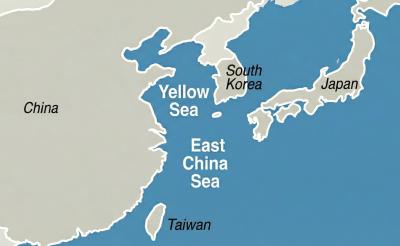
China has reserved offshore airspace in the Yellow Sea and East China Sea from March 27 to May 6, issuing alerts usually used to warn of military exercises, although no such exercises have been announced, the Wall Street Journal (WSJ) reported yesterday. Reserving such a large area for 40 days without explanation is an “unusual step,” as military exercises normally only last a few days, the paper said. These alerts, known as Notice to Air Missions (Notams), “are intended to inform pilots and aviation authorities of temporary airspace hazards or restrictions,” the article said. The airspace reserved in the alert is
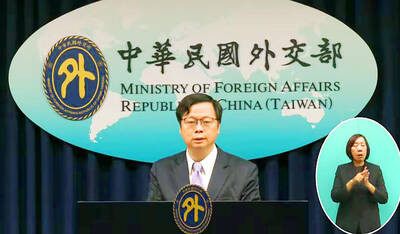
NAMING SPAT: The foreign ministry called on Denmark to propose an acceptable solution to the erroneous nationality used for Taiwanese on residence permits Taiwan has revoked some privileges for Danish diplomatic staff over a Danish permit that lists “Taiwan” as “China,” Eric Huang (黃鈞耀), head of the Ministry of Foreign Affairs’ Department of European Affairs, told a news conference in Taipei yesterday. Reporters asked Huang whether the Danish government had responded to the ministry’s request that it correct the nationality on Danish residence permits of Taiwanese, which has been listed as “China” since 2024. Taiwan’s representative office in Denmark continues to communicate with the Danish government, and the ministry has revoked some privileges previously granted to Danish representatives in Taiwan and would continue to review

More than 6,000 Taiwanese students have participated in exchange programs in China over the past two years, despite the Mainland Affairs Council’s (MAC) “orange light” travel advisory, government records showed. The MAC’s publicly available registry showed that Taiwanese college and university students who went on exchange programs across the Strait numbered 3,592 and 2,966 people respectively. The National Immigration Agency data revealed that 2,296 and 2,551 Chinese students visited Taiwan for study in the same two years. A review of the Web sites of publicly-run universities and colleges showed that Taiwanese higher education institutions continued to recruit students for Chinese educational programs without

A bipartisan group of US senators has introduced a bill to enhance cooperation with Taiwan on drone development and to reduce reliance on supply chains linked to China. The proposed Blue Skies for Taiwan Act of 2026 was introduced by Republican US senators Ted Cruz and John Curtis, and Democratic US senators Jeff Merkley and Andy Kim. The legislation seeks to ease constraints on Taiwan-US cooperation in uncrewed aerial systems (UAS), including dependence on China-sourced components, limited access to capital and regulatory barriers under US export controls, a news release issued by Cruz on Wednesday said. The bill would establish a "Blue UAS


 RSS
RSS