

President Tsai Ing-wen (蔡英文), as the Democratic Progressive Party (DPP) chairperson, should let party legislators vote as they wish on the issue of importing pork containing ractopamine, the Civil Alliance Against Poisoned Pork said yesterday.
Ever since Tsai on Aug. 28 promised to ease restrictions on imports of US cattle more than 30 months old and US pork containing the leanness-enhancing additive, Council of Agriculture Minister Chen Chi-chung (陳吉仲) has become a spokesman for ractopamine-fed pork, former Taipei Veterans General Hospital physician Su Wei-shuo (蘇偉碩) told a news conference at the Legislative Yuan in Taipei.
However, from a scientific as well as democratic standpoint, the approval process constitutes dereliction of duty, Su said, calling on the government to let go of its political machinations, and return to governing based on the law and the defense of the people’s right to health.
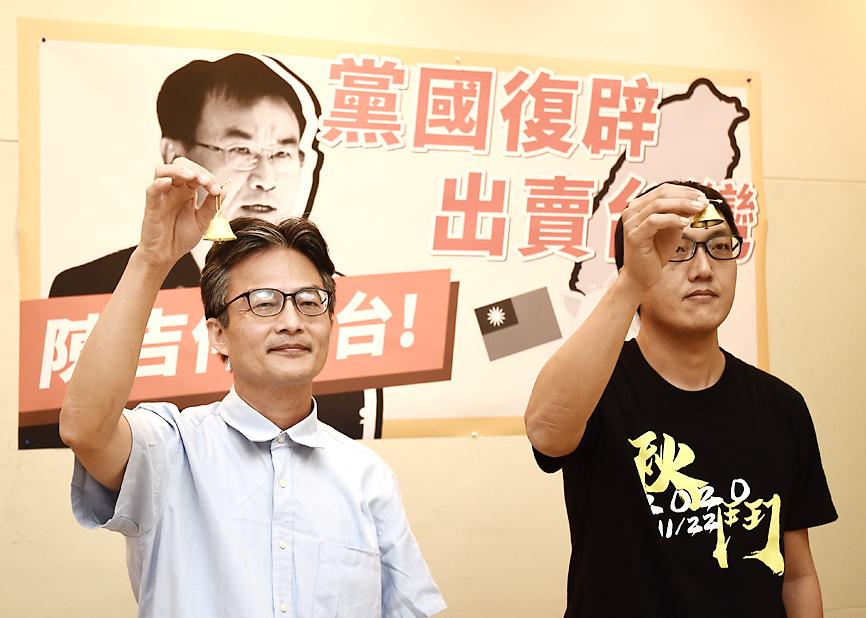
Photo: Chien Jung-fong, Taipei Times
Chen might not actually support the policy, in which case he should urge the Tsai administration to clean up its own mess, Su added.
As public opinion is in favor of banning ractopamine-fed meat, Tsai should release her grip on the DPP and allow legislators to reflect the public’s will by telling party caucus whip Ker Chien-ming (柯建銘) to stop pressuring DPP lawmakers into supporting the policy, Su said.
If this happens, the executive order might even be abolished, allowing the matter to proceed in a democratic and scientific fashion, and a risk assessment to proceed in accordance with the law, he said, adding that this would be the best Christmas present for the nation.
Chen is bringing ractopamine-laced pork into the nation without considering its effect on domestic pork prices, while insisting that it would not be competitive in the market, alliance spokesman Lee Chien-cheng (李建誠) said.
Chen is not differentiating between the party and the state, or between right and wrong, only seeking to protect the party’s will at the expense of the nation’s livestock industry, Lee said, urging the minister to step down over the ill-advised policy.
After white-meat chicken was opened for import, its share of the market increased from 10 percent to 60 percent, Lee said, asking how Chen could guarantee that US pork would never grow to more than a 1 percent share of the market.
The Tsai administration has changed its position on imports of pork and beef containing ractopamine, now saying it would not have any effect, he said, adding that it might even allow ractopamine to be used domestically.
Small and medium-sized swine farms are being forced out of the market, selling pork nearly at cost, yet Chen still only cares about beef noodle soup and steak vendors, Lee added.
During the annual Autumn Struggle (秋鬥) labor protest march on Sunday, the alliance said it would hang bells on the trees in front of the Presidential Office Building in Taipei as a message to the administration.
The protest is a reference to the adage “Whoever tied the bell [to the tiger] should take it off” (解鈴還需繫鈴人), meaning that whoever made the mess should clean it up.

The donation of offshore patrol vessel Kinmen to the Philippines includes provisions that protect Taiwanese fishers and facilitate security cooperation across the First Island Chain, officials said yesterday. The comment was made during the Cabinet’s comprehensive administrative report at the legislature after Chinese Nationalist Party (KMT) Legislator Hsu Yu-chen (許宇甄) expressed concerns about the decision to give a ship to a country whose coast guard had in 2013 fired on a Taiwanese trawler and killed its captain without provocation. The Cabinet should lay out the safeguards that have been established to prevent the Philippine government from using the Kinmen to harass, expel
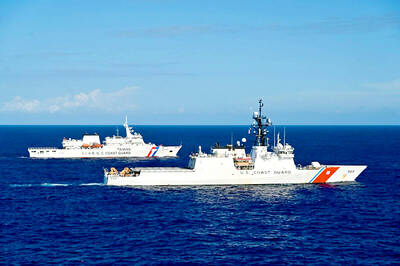
GROWING TIES: The CGA is planning a goodwill mission to the Philippines, in what would be the first time since 1975 a Taiwanese paramilitary vessel has visited the country The Coast Guard Administration (CGA) plans to significantly expand its participation in international security cooperative frameworks and its operational capabilities, a budget proposal for next year showed. The budget indicates a transformation of the CGA from a maritime law enforcement arm into a national defense and intelligence gathering entity capable of tackling larger regional security matters. The proposal showed that personnel from the coast guard’s Intelligence Division and Special Action Support Center are to participate in high-level national security talks with the US. As the CGA has dealt with China’s rising “gray zone” threats around Taiwan, it has become a valuable asset to
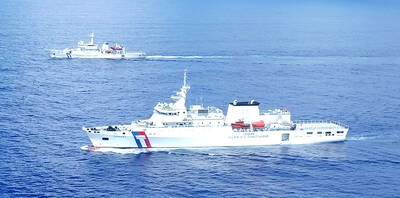
‘FRIENDSHIP FLEET’: A CGA official is scheduled to meet with the president of the Pacific nation, while one of the ships is to host a banquet and National Day event Two Coast Guard Administration (CGA) patrol vessels have docked at Malakal Harbor in Palau as part of an expedition exercise and diplomatic visit, during which a senior official is expected to meet with Palauan President Surangel Whipps Jr, the agency said yesterday. The two vessels, the 4,000-tonne-class Chiayi and the 1,000-tonne-class Penghu, set sail for Palau from Taiwan last week and arrived on Tuesday at Malakal Harbor, the CGA’s Fleet Branch said in a statement. The journey marks the second time the CGA has dispatched a “friendship fleet” to another country, after it sent its first-ever goodwill fleet, comprising the Hualien and
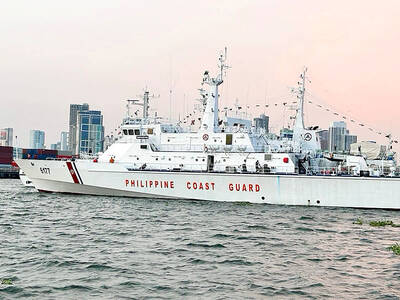
A patrol vessel donated by the Coast Guard Administration (CGA) to the Philippines was commissioned into the Philippine Coast Guard (PCG) on Friday, a Philippine non-governmental organization said. The CGA on Sept. 16 confirmed media reports that Taiwan had donated a retired 500-tonne patrol vessel to the Philippines. The Manila-based We Protect Our Seas (WPS) foundation, which served as an intermediary in the transfer, said that the vessel was formerly the CGA’s 500-tonne petrol vessel Kinmen (CG123). The WPS, in a statement issued on Friday, said the vessel, renamed as the BRP Sarangani, had been commissioned into the PCG the


 RSS
RSS