


Nitrous oxide, commonly known as laughing gas, has been listed in Taiwan as a controlled substance, meaning the regulations governing its production, importation, sale, use and storage have been tightened, the Environmental Protection Administration (EPA) said yesterday.
The EPA yesterday listed laughing gas as the first non-toxic chemical regulated under the Toxic Chemical Substances Control Act (毒性化學物質管理法), Toxic and Chemical Substances Bureau Director-General Hsieh Yein-rui (謝燕儒) said.
While nitrous oxide is used in several industries, including the semiconductor manufacturing and food sectors, its unregulated use for recreational purposes has increased in the past few months, the EPA told a news conference in Taipei.
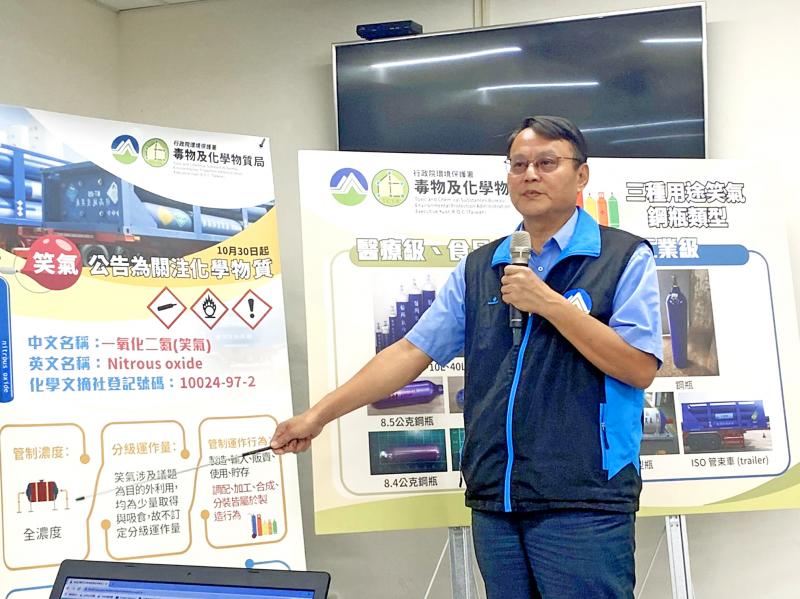
Photo: CNA
For example, the number of cases in which laughing gas was abused for recreational purposes in Taoyuan jumped from 134 last year to 455 in the first seven months of this year, police data showed.
Unlicensed operators involved in the supply and use of controlled chemicals are subject to a fine of NT$30,000 to NT$300,000 (US$1,037 to US$10,372), while in cases where unlicensed use of the chemical results in death, the penalty is seven years to life in prison and a fine of up to NT$10 million, Hsieh said, citing the act.
If it is determined that illegal use of the chemical resulted in harm to other people’s health, a person found to have contravened the act faces a prison sentence of six months to 10 years, and a fine of NT$1 million to NT$5 million, he said.
Laughing gas was previously covered under the Pharmaceutical Affairs Act (藥事法).
Manufacturers of the chemical are now required to record each transaction online and submit a monthly report to the government on those transactions, while unlicensed producers, sellers, importers and users have until May 1 next year to obtain permits, Hsieh said.
The EPA, the Ministry of Health and Welfare and the police next month are to launch an effort to tackle the growing misuse of the chemical, he said.
The effort would focus on stopping illegal online sales of laughing gas and ensuring that it is properly labeled when sold legally, Hsieh said.
As of Wednesday last week, the EPA had carried out inspections of six laughing gas producers and more than 150 companies had submitted transaction records, he said.
As part of the efforts to deter recreational use of laughing gas, the government would require producers to add sulfur dioxide, which has a pungent odor, to orders for some customers, depending on proposed use, the EPA said.
Recreational use of laughing gas produces a feeling of euphoria, the EPA said.
Side effects include nausea and vomiting, as well as vitamin B-12 deficiency with long-term use, which could lead to nerve damage, it said.

Taiwan has received more than US$70 million in royalties as of the end of last year from developing the F-16V jet as countries worldwide purchase or upgrade to this popular model, government and military officials said on Saturday. Taiwan funded the development of the F-16V jet and ended up the sole investor as other countries withdrew from the program. Now the F-16V is increasingly popular and countries must pay Taiwan a percentage in royalties when they purchase new F-16V aircraft or upgrade older F-16 models. The next five years are expected to be the peak for these royalties, with Taiwan potentially earning
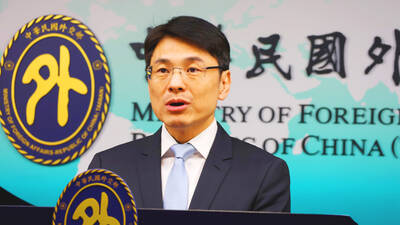
STAY IN YOUR LANE: As the US and Israel attack Iran, the ministry has warned China not to overstep by including Taiwanese citizens in its evacuation orders The Ministry of Foreign Affairs (MOFA) yesterday rebuked a statement by China’s embassy in Israel that it would evacuate Taiwanese holders of Chinese travel documents from Israel amid the latter’s escalating conflict with Iran. Tensions have risen across the Middle East in the wake of US and Israeli airstrikes on Iran beginning Saturday. China subsequently issued an evacuation notice for its citizens. In a news release, the Chinese embassy in Israel said holders of “Taiwan compatriot permits (台胞證)” issued to Taiwanese nationals by Chinese authorities for travel to China — could register for evacuation to Egypt. In Taipei, the ministry yesterday said Taiwan
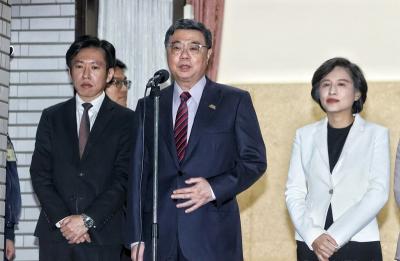
Taiwan is awaiting official notification from the US regarding the status of the Agreement on Reciprocal Trade (ART) after the US Supreme Court ruled US President Donald Trump's global tariffs unconstitutional. Speaking to reporters before a legislative hearing today, Premier Cho Jung-tai (卓榮泰) said that Taiwan's negotiation team remains focused on ensuring that the bilateral trade deal remains intact despite the legal challenge to Trump's tariff policy. "The US has pledged to notify its trade partners once the subsequent administrative and legal processes are finalized, and that certainly includes Taiwan," Cho said when asked about opposition parties’ doubts that the ART was
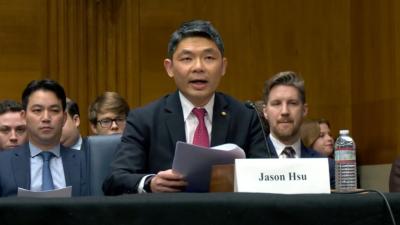
If China chose to invade Taiwan tomorrow, it would only have to sever three undersea fiber-optic cable clusters to cause a data blackout, Jason Hsu (許毓仁), a senior fellow at the Hudson Institute and former Chinese Nationalist Party (KMT) legislator, told a US security panel yesterday. In a Taiwan contingency, cable disruption would be one of the earliest preinvasion actions and the signal that escalation had begun, he said, adding that Taiwan’s current cable repair capabilities are insufficient. The US-China Economic and Security Review Commission (USCC) yesterday held a hearing on US-China Competition Under the Sea, with Hsu speaking on


 RSS
RSS