


Legislation introduced on Thursday in the US urged Washington to re-establish formal diplomatic relations with Taiwan, and to end its “outdated and counterproductive one China policy.”
US Representative Tom Tiffany said in a press release that the non-binding bill calls on the US administration to support Taiwan’s membership in international organizations and to begin negotiations toward a bilateral trade agreement.
Tiffany said that Taiwan and the US maintained friendly diplomatic relations until then-US president Jimmy Carter cut ties in 1979 and recognized Beijing.
Shortly after that, the US Congress approved the Taiwan Relations Act, which authorized defensive arms sales to Taiwan, Tiffany said.
The relationship was further “upgraded” with the “six assurances” to Taiwan during the administration of former US president Ronald Reagan, Tiffany said.
Tiffany praised the “bold steps” of US President Donald Trump to initiate closer ties with Taiwan, such as approving arms sales and sending Cabinet-level officials to visit.
However, more concrete actions are needed, he said.
“Now is the time for America to stop parroting Beijing’s one China fantasy, and for US policy to reflect the reality that Taiwan is a free, democratic and independent country,” he said.
Premier Su Tseng-chang (蘇貞昌) yesterday said that Taiwan can contribute more if it is given international space.
Taiwan has been an exemplary member of the “free world” and has always been willing to shoulder responsibility when called upon, Su said, adding that the nation has more to contribute to the world if the international community remains unmoved by Chinese political intervention.
Additional reporting by Peng Wan-hsin

LOUD AND PROUD Taiwan might have taken a drubbing against Australia and Japan, but you might not know it from the enthusiasm and numbers of the fans Taiwan might not be expected to win the World Baseball Classic (WBC) but their fans are making their presence felt in Tokyo, with tens of thousands decked out in the team’s blue, blowing horns and singing songs. Taiwanese fans have packed out the Tokyo Dome for all three of their games so far and even threatened to drown out home team supporters when their team played Japan on Friday. They blew trumpets, chanted for their favorite players and had their own cheerleading squad who dance on a stage during the game. The team struggled to match that exuberance on the field, with
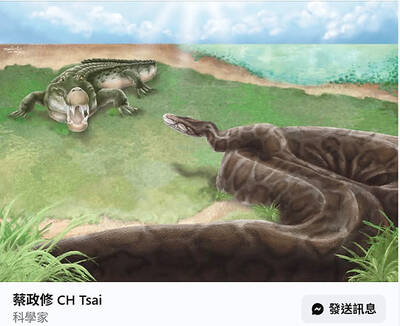
Taiwanese paleontologists have discovered fossil evidence that pythons up to 4m long inhabited Taiwan during the Pleistocene epoch, reporting their findings in the international scientific journal Historical Biology. National Taiwan University (NTU) Institute of Ecology and Evolutionary Biology associate professor Tsai Cheng-hsiu (蔡政修) led the team that discovered the largest snake fossil ever found in Taiwan. The single trunk vertebra was discovered in Tainan at the Chiting Formation, dated to between 400,000 and 800,000 years ago in the Middle Pleistocene, the paper said. The area also produced Taiwan’s first avian fossil, as well as crocodile, mammoth, saber-toothed cat and rhinoceros fossils, it said. Discoveries

Taiwanese paleontologists have discovered fossil evidence that pythons up to 4m long inhabited Taiwan during the Pleistocene epoch, reporting their findings in the international scientific journal Historical Biology. National Taiwan University (NTU) Institute of Ecology and Evolutionary Biology associate professor Tsai Cheng-hsiu (蔡政修) led the team that discovered the largest snake fossil ever found in Taiwan. A single trunk vertebra was discovered in Tainan at the Chiting Formation, dated to between 800,000 to 400,000 years ago in the Middle Pleistocene, the paper said. The area also produced Taiwan’s first avian fossil, as well as crocodile, mammoth, sabre-toothed cat and rhinoceros fossils, it said. Discoveries
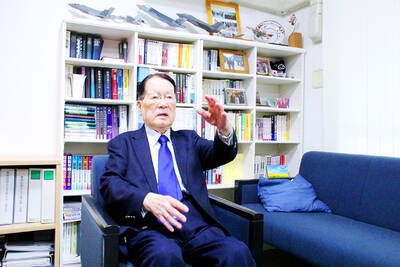
Whether Japan would help defend Taiwan in case of a cross-strait conflict would depend on the US and the extent to which Japan would be allowed to act under the US-Japan Security Treaty, former Japanese minister of defense Satoshi Morimoto said. As China has not given up on the idea of invading Taiwan by force, to what extent Japan could support US military action would hinge on Washington’s intention and its negotiation with Tokyo, Morimoto said in an interview with the Liberty Times (sister paper of the Taipei Times) yesterday. There has to be sufficient mutual recognition of how Japan could provide


 RSS
RSS