


More than 200 Chinese Nationalist Party (KMT) supporters yesterday protested outside the office of Taoyuan City Councilor Wang Hao-yu (王浩宇), a Democratic Progressive Party (DPP) member, angered by his Facebook post about the late Kaohsiung City Council speaker Hsu Kun-yuan (許崑源).
Protesters outside Wang’s office in Jhongli District (中壢) said the post made light of Hsu’s death on Saturday night, hours after the recall election of Kaohsiung mayor Han Kuo-yu (韓國瑜).
“Staunchly support Han Kuo-yu! Kaohsiung City Council Speaker Hsu Kun-yuan has died after falling from a building,” Wang wrote.
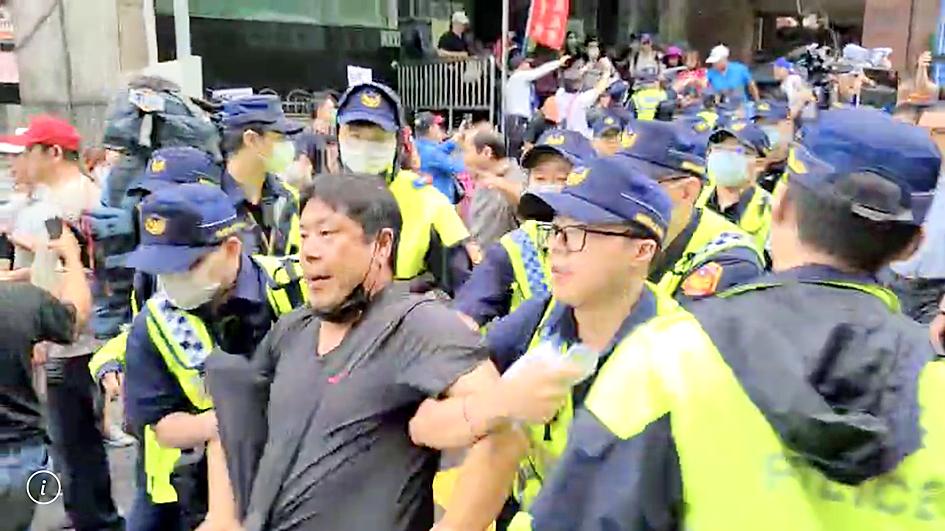
Photo: Lee Jung-ping, Taipei Times
DPP Taipei City Councilor Liang Wen-chieh (梁文傑) has also come under fire for a Facebook post on Saturday asking if Hsu’s death was linked to gambling debts. Liang deleted the post and issued an apology later that night.
KMT Taoyuan City Councilor Chan Chiang-tsun (詹江村) and former KMT legislator Wu Yu-jen (吳育仁) yesterday called on supporters to protest in front of Wang’s office.
Wang had made similar remarks in the past, which showed he was unfit to hold office, Chan said, citing a post about a protester against pension reforms who fell from a building and died in 2018, and a post after former premier Hau Pei-tsun (郝柏村) died in March.
Wang’s office closed for the day, and at about noon the Jhongli Police Precinct erected barricades in front of the office, restricted traffic on the road in front of it to one direction and deployed a large number of officers at the site as a precautionary measure.
More than 200 people showed up to protest. After reading condolences for Hsu, some of them began yelling insults at Wang’s office, calling for his recall and throwing eggs at the building.
The crowd became agitated after Wu and two others were taken away by police for contravening the Social Order Maintenance Act (社會秩序維護法).
Separately, about 50 members of the Blue Sky Action Alliance, the pro-unification Concentric Patriotism Association and other groups protested outside Liang’s office in Taipei’s Datong District (大同), calling for his recall.
Liang’s office, which was closed, issued a statement saying Liang respected the protesters’ views and asked for them to remain calm.
In other developments, Han led Kaohsiung City Government officials in paying respects to Hsu at a funeral hall in the city, where he recited chants from Buddhism’s Heart Sutra (心經) for an hour.
New Power Party Kaohsiung City Councilor Huang Jie (黃捷) also visited the funeral home to pay respects to Hsu, but was criticized by Wu Chiu-li (吳秋麗), an official in Kaohsiung’s Legal Affairs Department, for wearing red lipstick to the wake and not wearing a mask while inside.
Additional reporting by Chen Wen-chan and Kuo An-chia

The military has spotted two Chinese warships operating in waters near Penghu County in the Taiwan Strait and sent its own naval and air forces to monitor the vessels, the Ministry of National Defense (MND) said. Beijing sends warships and warplanes into the waters and skies around Taiwan on an almost daily basis, drawing condemnation from Taipei. While the ministry offers daily updates on the locations of Chinese military aircraft, it only rarely gives details of where Chinese warships are operating, generally only when it detects aircraft carriers, as happened last week. A Chinese destroyer and a frigate entered waters to the southwest
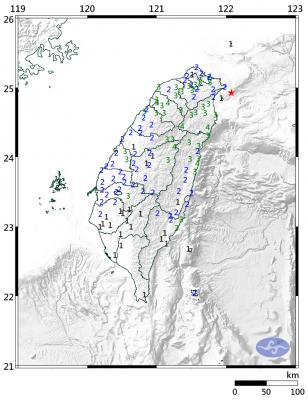
A magnitude 6.1 earthquake struck off the coast of Yilan County at 8:39pm tonight, the Central Weather Administration (CWA) said, with no immediate reports of damage or injuries. The epicenter was 38.7km east-northeast of Yilan County Hall at a focal depth of 98.3km, the CWA’s Seismological Center said. The quake’s maximum intensity, which gauges the actual physical effect of a seismic event, was a level 4 on Taiwan’s 7-tier intensity scale, the center said. That intensity level was recorded in Yilan County’s Nanao Township (南澳), Hsinchu County’s Guansi Township (關西), Nantou County’s Hehuanshan (合歡山) and Hualien County’s Yanliao (鹽寮). An intensity of 3 was

Japanese Prime Minister Sanae Takaichi’s comment last year on Tokyo’s potential reaction to a Taiwan-China conflict has forced Beijing to rewrite its invasion plans, a retired Japanese general said. Takaichi told the Diet on Nov. 7 last year that a Chinese naval blockade or military attack on Taiwan could constitute a “survival-threatening situation” for Japan, potentially allowing Tokyo to exercise its right to collective self-defense. Former Japan Ground Self-Defense Force general Kiyofumi Ogawa said in a recent speech that the remark has been interpreted as meaning Japan could intervene in the early stages of a Taiwan Strait conflict, undermining China’s previous assumptions
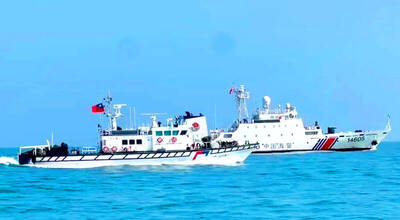
Instead of focusing solely on the threat of a full-scale military invasion, the US and its allies must prepare for a potential Chinese “quarantine” of Taiwan enforced through customs inspections, Stanford University Hoover fellow Eyck Freymann said in a Foreign Affairs article published on Wednesday. China could use various “gray zone” tactics in “reconfiguring the regional and ultimately the global economic order without a war,” said Freymann, who is also a nonresident research fellow at the US Naval War College. China might seize control of Taiwan’s links to the outside world by requiring all flights and ships entering or leaving Taiwan


 RSS
RSS