


A civic group consisting of Hong Kongers in Taiwan yesterday issued a statement urging the government to provide more concrete support for Hong Kong in the face of Beijing’s imposition of a national security legislation, while urging the government to terminate preferential treatment for Hong Kong-based organizations controlled by China.
China’s National People’s Congress yesterday passed national security legislation for Hong Kong.
Earlier, Hong Kong Outlanders issued a “press statement on Pompeo’s report on Hong Kong national security legislation,” referring to a report that US Secretary of State Mike Pompeo on Wednesday submitted to the US Congress to confirm that Hong Kong is no longer a territory with a high degree of autonomy, and that the US would withdraw the territory’s preferential trade and financial status.
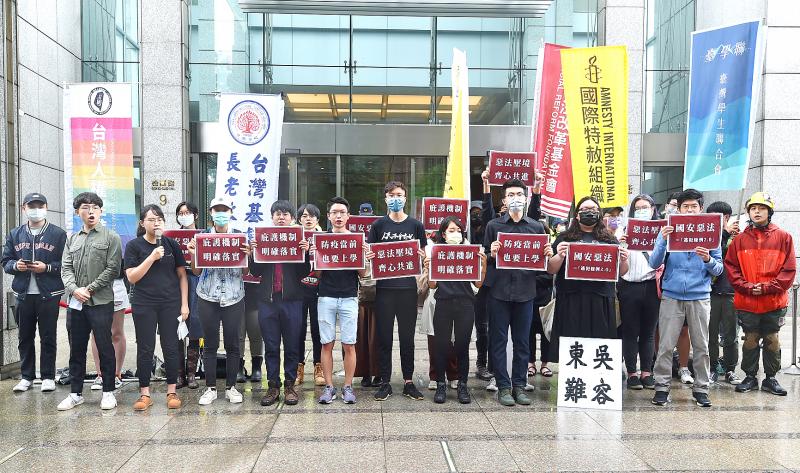
Photo: Liao Chen-huei, Taipei Times
The statement said that Taiwan should not invoke Article 60 of the Act Governing Relations with Hong Kong and Macau (香港澳門關係條例), under which Taiwan has established long-term relationship with the territory.
Article 60 states that if any change occurs in Hong Kong or Macau that endangers the security of Taiwan, the Cabinet could ask President Tsai Ing-wen (蔡英文) to order a suspension of the application of “all or part of the provisions of the act.”
Taiwan offers preferential treatment to Hong Kong and Macau in terms of trade, travel and cultural relations.
“The puppeted Hong Kong government, which is run by the Chinese Communist Party [CCP] government under the table, should be the rightful target of such international sanctions instead of resilient and brave Hong Kong,” it said.
Taiwan should also expand the scope of services it would provide in a Humanitarian Assistance Action Plan for Hong Kong, considering the “extreme consequences” that the legislation would create for the territory, it said.
The plan is to be devised by the Executive Yuan as part of the nation’s efforts to safeguard the democratic values upheld by Hong Kong.
Taiwan should “increase the numbers of beneficiaries of the Humanitarian Assistance Action Plan, especially to include protesters who used extreme measures against communist Hong Kong Police and officials,” the statement said.
Taiwan should also withdraw the preferential status it gives to Hong Kong-based organizations controlled by China, as well as deny entry to Taiwan by violators of human rights, it said.
Chinese funding could infiltrate the local market in the form of Hong Kong investments, so the government should cancel the special status of Hong Kong-based institutes and organizations that China controls, it added.
Groups and organizations that fail to prove that “Chinese funds do not have a major influence over them” should be disqualified from the preferential treatment provided for entities based in Hong Kong and Macau, the statement said.
“Hong Kong and Taiwan are on the front line of the global alliance in resisting the communist Chinese invasion,” it added.

Yangmingshan National Park authorities yesterday urged visitors to respect public spaces and obey the law after a couple was caught on a camera livestream having sex at the park’s Qingtiangang (擎天崗) earlier in the day. The Shilin Police Precinct in Taipei said it has identified a suspect and his vehicle registration number, and would summon him for questioning. The case would be handled in accordance with public indecency charges, it added. The couple entered the park at about 11pm on Thursday and began fooling around by 1am yesterday, the police said, adding that the two were unaware of the park’s all-day live
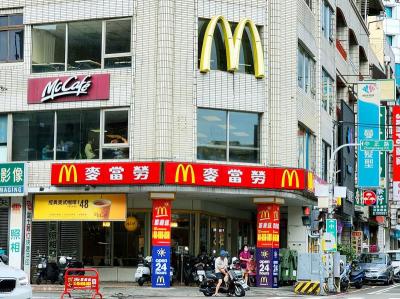
Fast food chain McDonald's is to raise prices by up to NT$5 on some products at its restaurants across Taiwan, starting on Wednesday next week, the company announced today. The prices of all extra value meals and sharing boxes are to increase by NT$5, while breakfast combos and creamy corn soup would go up by NT$3, the company said in a statement. The price of the main items of those meals, if ordered individually, would remain the same. Meanwhile, the price of a medium-sized lemon iced tea and hot cappuccino would rise by NT$3, extra dipping sauces for chicken nuggets would go up

Yangmingshan National Park’s Qingtiangang (擎天崗) nature area has gone viral after a park livestream camera observed a couple in the throes of intimate congress, which was broadcast live on YouTube, drawing large late-night crowds and sparking a backlash over noise, bright lights and disruption to wildlife habitat. The area’s livestream footage appeared to show a couple engaging in sexual activity on a picnic table in the park on Friday last week, with the uncensored footage streamed publicly online. The footage quickly spread across social media, prompting a tide of visitors to travel to the site to “check in” and recreate the

Minister of Digital Affairs Lin Yi-ching (林宜敬) yesterday cited regulatory issues and national security concerns as an expert said that Taiwan is among the few Asian regions without Starlink. Lin made the remarks on Facebook after funP Innovation Group chief executive officer Nathan Chiu (邱繼弘) on Friday said Taiwan and four other countries in Asia — China, North Korea, Afghanistan and Syria — have no access to Starlink. Starlink has become available in 166 countries worldwide, including Ukraine, Malaysia, the Philippines and Vietnam, in the six years since it became commercial, he said. While China and North Korea block Starlink, Syria is not


 RSS
RSS