


The legislative caucuses of three parties yesterday reiterated calls to amend a law governing relations with Hong Kong to elucidate steps the government could take to help protesters there.
The Taiwan People’s Party (TPP), the Chinese Nationalist Party (KMT) and the New Power Party (NPP) said that they have separately created draft amendments to Article 18 of the Act Governing Relations with Hong Kong and Macau (香港澳門關係條例).
The article requires the government to aid Hong Kongers who face political persecution, but does not specify a specific course of action.
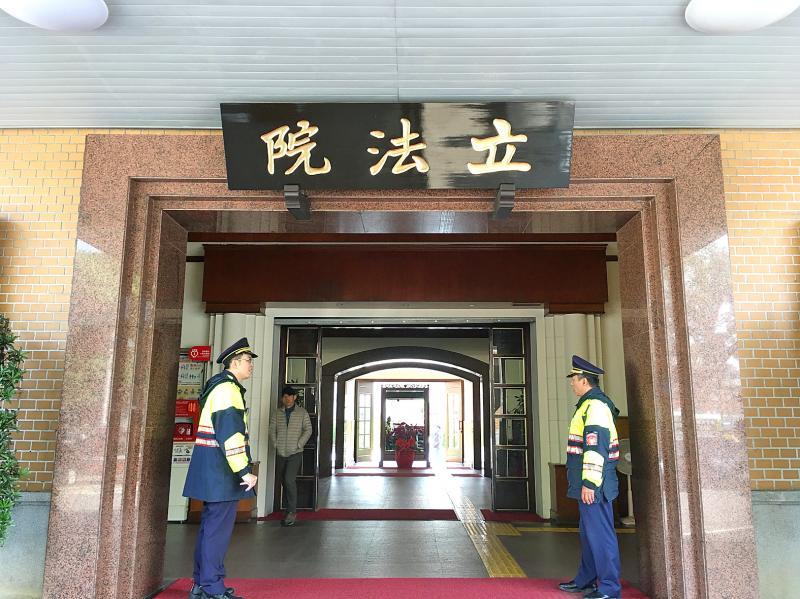
Photo: Lin Liang-sheng, Taipei Times
The KMT’s proposal, which would create a way for Hong Kongers with criminal records who are believed to be victims of political persecution to be allowed to enter Taiwan, was submitted by KMT Legislator Charles Chen (陳以信).
Individuals with criminal records would normally be required to apply for special permission to enter Taiwan, and entry without permission is punishable by up to three years in prison and a fine of up to NT$90,000, according to Article 74 of the Immigration Act (入出國及移民法).
The KMT’s amendment would exclude Hong Kongers from Article 74.
It was necessary for the amendment to address entry into Taiwan, as this is not covered by the laws governing Hong Kong, Chen said, adding that the change must be stipulated so that Taiwan can effectively provide emergency help to Hong Kongers.
The proposal would be ready for review by Friday at the earliest, he said.
Chen said he still hopes that full democracy would be implemented in Hong Kong.
Separately, NPP caucus whip Chiu Hsien-chih (邱顯智) said that his party finished its proposed amendment at the end of last month and was waiting for the draft to be reviewed.
An amendment is crucial, as the situation in Hong Kong is becoming “increasingly dangerous,” and there will likely be a spike in the number of people seeking help from Taiwan, Chiu said.
Hong Kongers and people from Macau who, because of their political views, expressions or the community they belong to, come under threat in the territories should be offered political protection, he said, adding that the NPP draft says that they would be eligible to apply for protection through rules governing political asylum seekers.
Chiu called on Legislative Speaker You Si-kun (游錫堃) to convene a cross-party caucus meeting as soon as possible to discuss the NPP proposal and to issue a joint statement denouncing the Chinese Communist Party’s planned implementation of a national security law in Hong Kong.
Meanwhile, TPP caucus whip Lai Hsiang-ling (賴香伶) said that the TPP completed a proposal on May 15 and that it had already passed one reading.
The TPP supports the democracy movement in Hong Kong, Lai said.
Echoing statements from the other parties, she said an amendment was urgently needed to bolster the government’s efforts to help protesters in Hong Kong.
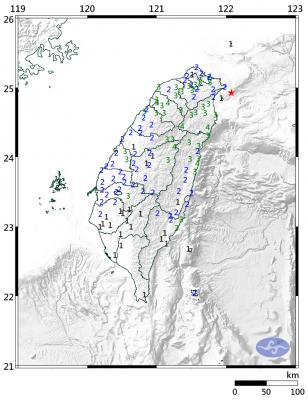
A magnitude 6.1 earthquake struck off the coast of Yilan County at 8:39pm tonight, the Central Weather Administration (CWA) said, with no immediate reports of damage or injuries. The epicenter was 38.7km east-northeast of Yilan County Hall at a focal depth of 98.3km, the CWA’s Seismological Center said. The quake’s maximum intensity, which gauges the actual physical effect of a seismic event, was a level 4 on Taiwan’s 7-tier intensity scale, the center said. That intensity level was recorded in Yilan County’s Nanao Township (南澳), Hsinchu County’s Guansi Township (關西), Nantou County’s Hehuanshan (合歡山) and Hualien County’s Yanliao (鹽寮). An intensity of 3 was
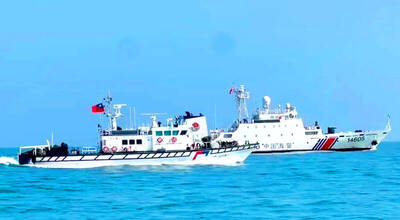
Instead of focusing solely on the threat of a full-scale military invasion, the US and its allies must prepare for a potential Chinese “quarantine” of Taiwan enforced through customs inspections, Stanford University Hoover fellow Eyck Freymann said in a Foreign Affairs article published on Wednesday. China could use various “gray zone” tactics in “reconfiguring the regional and ultimately the global economic order without a war,” said Freymann, who is also a nonresident research fellow at the US Naval War College. China might seize control of Taiwan’s links to the outside world by requiring all flights and ships entering or leaving Taiwan
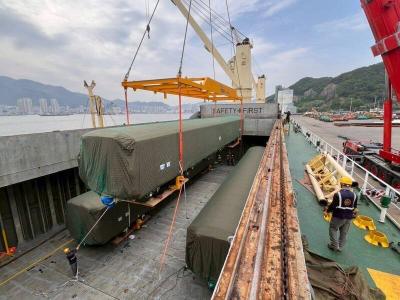
The first of 10 new high-capacity trains purchased from South Korea’s Hyundai Rotem arrived at the Port of Taipei yesterday to meet the demands of an expanding metro network, Taipei Rapid Transit Corp (TRTC) said yesterday. The train completed a three-day, 1,200km voyage from the Port of Masan in South Korea, the company said. Costing NT$590 million (US$18.79 million) each, the new six-carriage trains feature a redesigned interior based on "human-centric" transportation concepts, TRTC said. The design utilizes continuous longitudinal seating to widen the aisles and optimize passenger flow, while also upgrading passenger information displays and driving control systems for a more comfortable
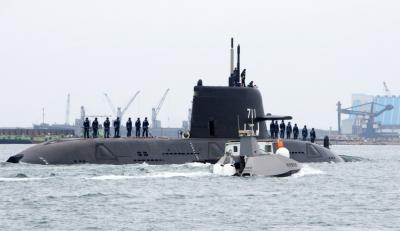
Taiwan's first indigenous defense submarine, the SS-711 Hai Kun (海鯤, or Narwhal), departed for its 13th sea trial at 7am today, marking its seventh submerged test, with delivery to the navy scheduled for July. The outing also marked its first sea deployment since President William Lai (賴清德) boarded the submarine for an inspection on March 19, drawing a crowd of military enthusiasts who gathered to show support. The submarine this morning departed port accompanied by CSBC Corp’s Endeavor Manta (奮進魔鬼魚號) uncrewed surface vessel and a navy M109 assault boat. Amid public interest in key milestones such as torpedo-launching operations and overnight submerged trials,


 RSS
RSS