


Taiwan is manufacturing certified and high-quality products to help combat the COVID-19 pandemic worldwide, the Ministry of Economic Affairs said yesterday, adding that many of the products have also secured certification in other countries.
“The nation provides certified and effective disease-prevention products to the world. People can be reassured that products with Taiwan Excellence Awards certification are safe, reliable and high-quality,” said Chen Chern-chyi (陳正祺), director-general of the ministry’s Bureau of Foreign Trade.
The bureau announced the launch of a virtual healthcare pavilion on the Taiwan External Trade Development Council’s (TAITRA) Web site (http://anti-epidemic.taiwantrade.com). It features 42 disease-prevention products made by 33 domestic companies recognized with Taiwan Excellence Awards, ranging from masks, protective clothing and test kits to respiratory devices and disinfection robots, the bureau said.
Through the online pavilion, interested buyers and journalists from more than 280 countries can watch Taiwanese manufacturers’ presentations, it said.
The pavilion’s launch came after some countries, including Spain, Turkey and the Netherlands, reportedly rejected Chinese-made equipment designed to combat the coronavirus outbreak.
Testing kits and masks made in China were below standards or defective, officials from those countries said.
Taiwan can export disease-prevention products, because the products and the facilities they are manufactured in meet health certification standards at home and in destination countries, Chen said.
“As the world combats the spread of COVID-19, we want to contribute to the world by engaging in free trade. Taiwan would not forget to help others, even though it regulates the export of certain products to protect its people,” he said.
The nation has the capacity to produce ventilators used in intensive care units, but it needs to work with overseas partners, Chen said, adding that some key international companies have expressed an interest in working with Taiwanese manufacturers.
Demand for Taiwanese-made disease-prevention products surged after the nation earned worldwide renown for successfully containing the COVID-19 outbreak and attracted international media coverage, Chen said, adding that local manufacturers have also earned the trust of their foreign counterparts due to their honesty.
TAITRA president Walter Yeh (葉明水) said that the products featured in the virtual pavilion are badly needed in countries hit hardest by the pandemic, adding that the council has included 130 domestic manufacturers of disease-prevention products in its ecosystem and has recommended them to overseas buyers.
The council has also facilitated exchanges between doctors from National Cheng Kung University Hospital and 14,000 medical personnel from India via an online conference, Yeh said, adding that a similar exchange also took place between doctors from Changhua Christian Hospital and those from Myanmar.
The council hopes to conduct similar exchanges with medical personnel from Bangladesh, Indonesia and other countries covered by the government’s New Southbound Policy, he said.

NATIONAL SECURITY: Authorities are working to confirm the identities of the military personnel involved and investigating possible illegal conduct and regulatory violations Authorities are probing possible national security implications after Kinmen police and immigration officers on Sunday found a Chinese woman allegedly posing as a tourist while engaging in prostitution involving more than 10 military personnel. The woman, surnamed Chen (陳), has since been deported, authorities said, adding that investigators are still working to confirm the identities of those implicated, as the records only listed code names and aliases. The case stemmed from a report received by the Kinmen District Prosecutors’ Office on Friday last week from the Jinhu Precinct of the Kinmen County Police Bureau. On Sunday, police, along with the National Immigration

GLOBALGIVING: ‘ Caving to external pressure is not acceptable for an organization that has cultivated justice reform and human rights for 30 years,’ one NGO said A slew of non-government organizations (NGOs) have withdrawn from the GlobalGiving fundraising platform after it announced it would use “Chinese Taipei” instead of “Taiwan” from next month. The Taiwan Good Rice Association wrote on Facebook on Friday that it was informed on April 28 via a teleconference call of the change, which was made because the platform wanted to operate in China. Taiwan Good Rice is to terminate all cooperative relationships with GlobalGiving in response to the platform’s “unilateral and non-negotiable” decision to remove references to Taiwan, the NGO said. “Taiwan is in the official name of Taiwan Good Rice Association and the

HEAVY WEATHER: Typhoon Jangmi is due to crash straight into the Ryukyus as airlines look to shift flights to larger aircraft or cancel flights to Okinawa entirely Taiwan’s international air carriers announced flight adjustments over the weekend as Typhoon Jangmi is forecast to hit the Ryukyu Islands today and tomorrow. The Central Weather Administration (CWA) upgraded Jangmi from a tropical storm to a typhoon at 8am yesterday, with the eye located 580km south of Naha city. It was moving north at 19kph. Today, China Airlines’ CI-120, CI-121, CI-122 and CI-123 flights between Taoyuan and Naha, Okinawa, have been canceled as well as CI-132 and CI-133 between Kaohsiung and Naha. EVA Air’s BR-112, BR-113, BR-186 and BR-185 flights between Taoyuan and Naha are also canceled. Low-cost carrier Tigerair Taiwan canceled IT-230,
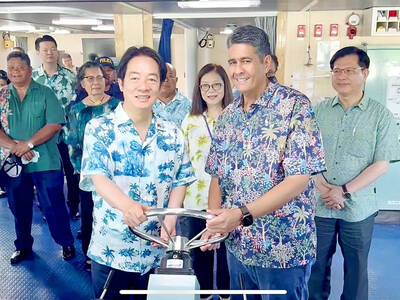
MULTIPRONGED APPROACH: China has sought to pressure Palau across a number of fronts, but the island nation has staunchly resisted overtures to ditch Taiwan Palau has been firm in backing Taiwan despite Chinese pressure that uses tourism economics, cyberattacks and criminal infiltration as tools to threaten the Pacific ally into renouncing its recognition of Taiwan as a sovereign state. The Presidential Office yesterday announced that Vice President Hsiao Bi-khim (蕭美琴) would visit Palau from Saturday to Wednesday next week at the invitation of Palauan President Surangel Whipps Jr. Whipps in April said in an interview that China had outspokenly asked Palau to “denounce Taiwan.” “And we have said: ‘We have no enemies, but nobody tells us who our friends are,’” he said. Whipps has told reporters multiple times


 RSS
RSS