


Taiwan Statebuilding Party Legislator Chen Po-wei (陳柏惟) yesterday asked Premier Su Tseng-chang (蘇貞昌) to offer monetary compensation to medical personnel who have to forgo overseas travel due to a travel ban amid a COVID-19 outbreak.
There has been an increase in the workload of medical personnel since the novel coronavirus reached Taiwan, and they have been asked not to travel to countries and regions affected by the virus, Chen said at a question-and-answer session at the Legislative Yuan.
Medical personnel live in fear of contracting the virus and have come under immense pressure from some members of the public, he said, adding that some couriers refuse to deliver food to hospitals.
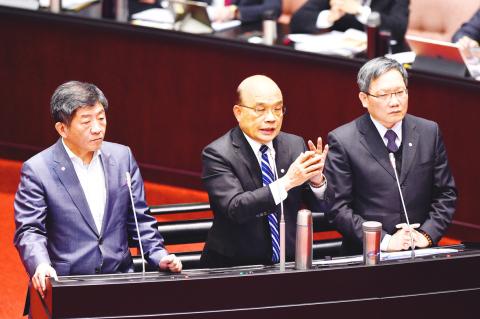
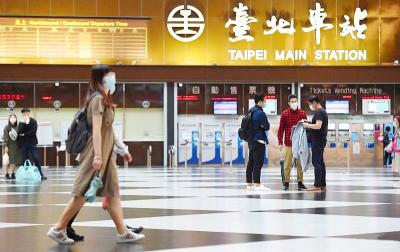
Photo: George Tsorng, Taipei Times
Chen asked Minister of Health and Welfare Chen Shih-chung (陳時中) how many medical personnel have been placed under travel restrictions, how much the government plans to compensate them daily and how the Ministry of Health and Welfare intends to spend its proposed NT$16.9 billion (US$561.7 million) slice of a NT$60 billion special budget for containing the epidemic and bailing out affected sectors.
About 320,000 medical personnel, including physicians, nurses and pharmacists, have been asked not to travel to countries and regions affected by the coronavirus, Chen Shih-chung said, adding that all of them would be compensated.
The ministry has set aside NT$1.8 billion for the research and development of drugs to treat COVID-19, NT$2 billion for compensating medical personnel and NT$4 billion to make up for possible shortfalls in these expenses, he added.
Directorate-General of Budget, Accounting and Statistics Minister Chu Tzer-ming (朱澤民) said that of the personnel treating COVID-19 patients, physicians would receive a daily subsidy of NT$10,000, nurses NT$5,000 per day and administrative workers NT$1,500.
Chen Po-wei said that the outbreak has reaffirmed the nation’s sovereignty, as some Taiwanese entertainers who had been Chinese “lapdogs” have suddenly become “proud Taiwanese,” adding that people who view this as a positive development should thank medical personnel combating the epidemic.
Su said that the government imposed the travel restrictions not because it wants medical personnel to work longer, but because 67 nations have been affected by the coronavirus.
The government would reimburse medical personnel for any losses they incur as a result of the travel restrictions, including any fees that have to be forfeited, he said.
International observers had predicted that Taiwan would be the second-most affected nation from COVID-19 after China, but the epidemic has been brought under control domestically, Su said, thanking all medical personnel who have dedicated themselves to containing the virus.
The Ministry of Health and Welfare, the Ministry of Finance and other concerned agencies would fine tune subsidy and compensation rules in the interests of medical personnel, he said.
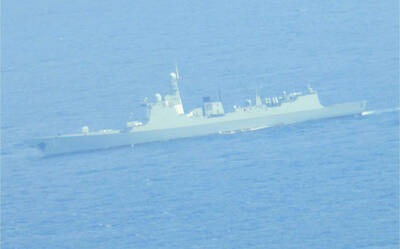
The military has spotted two Chinese warships operating in waters near Penghu County in the Taiwan Strait and sent its own naval and air forces to monitor the vessels, the Ministry of National Defense (MND) said. Beijing sends warships and warplanes into the waters and skies around Taiwan on an almost daily basis, drawing condemnation from Taipei. While the ministry offers daily updates on the locations of Chinese military aircraft, it only rarely gives details of where Chinese warships are operating, generally only when it detects aircraft carriers, as happened last week. A Chinese destroyer and a frigate entered waters to the southwest
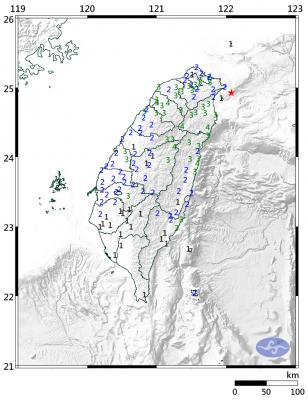
A magnitude 6.1 earthquake struck off the coast of Yilan County at 8:39pm tonight, the Central Weather Administration (CWA) said, with no immediate reports of damage or injuries. The epicenter was 38.7km east-northeast of Yilan County Hall at a focal depth of 98.3km, the CWA’s Seismological Center said. The quake’s maximum intensity, which gauges the actual physical effect of a seismic event, was a level 4 on Taiwan’s 7-tier intensity scale, the center said. That intensity level was recorded in Yilan County’s Nanao Township (南澳), Hsinchu County’s Guansi Township (關西), Nantou County’s Hehuanshan (合歡山) and Hualien County’s Yanliao (鹽寮). An intensity of 3 was
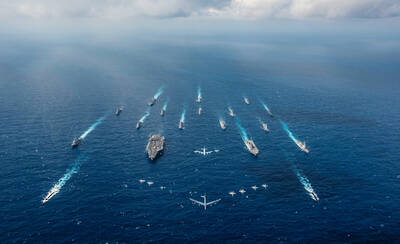
Japanese Prime Minister Sanae Takaichi’s comment last year on Tokyo’s potential reaction to a Taiwan-China conflict has forced Beijing to rewrite its invasion plans, a retired Japanese general said. Takaichi told the Diet on Nov. 7 last year that a Chinese naval blockade or military attack on Taiwan could constitute a “survival-threatening situation” for Japan, potentially allowing Tokyo to exercise its right to collective self-defense. Former Japan Ground Self-Defense Force general Kiyofumi Ogawa said in a recent speech that the remark has been interpreted as meaning Japan could intervene in the early stages of a Taiwan Strait conflict, undermining China’s previous assumptions
Taiwan Railways Corp (TRC) today announced that Shin Kong Mitsukoshi has been selected as the preferred bidder to operate the Taipei Railway Station shopping mall, replacing the current operator, Breeze Development Co Ltd. Among eight qualified firms that delivered presentations and were evaluated by a review committee, Shin Kong Mitsukoshi was ranked first, while Breeze was named the runner-up, the rail company said in a statement. Contract negotiations are to proceed in accordance with regulations, it said, adding that if negotiations with the top bidder fail, it could invite the second-ranked applicant to enter talks. Breeze in a statement today expressed doubts over


 RSS
RSS